Kingdom
Pseudomonadati
Phylum
Pseudomonadota
Class
Gammaproteobacteria
Order
Enterobacterales
Family
Enterobacteriaceae
Genus
Escherichia
Description
Taxonomy
| Kingdom | Pseudomonadati |
|---|---|
| Phylum | Pseudomonadota |
| Class | Gammaproteobacteria |
| Order | Enterobacterales |
| Family | Enterobacteriaceae |
| Genus | Escherichia |
| Species | Escherichia coli |
| Strain | 11128 |
Profile
| Physiology | |
|---|---|
| Gram staining properties | Negative |
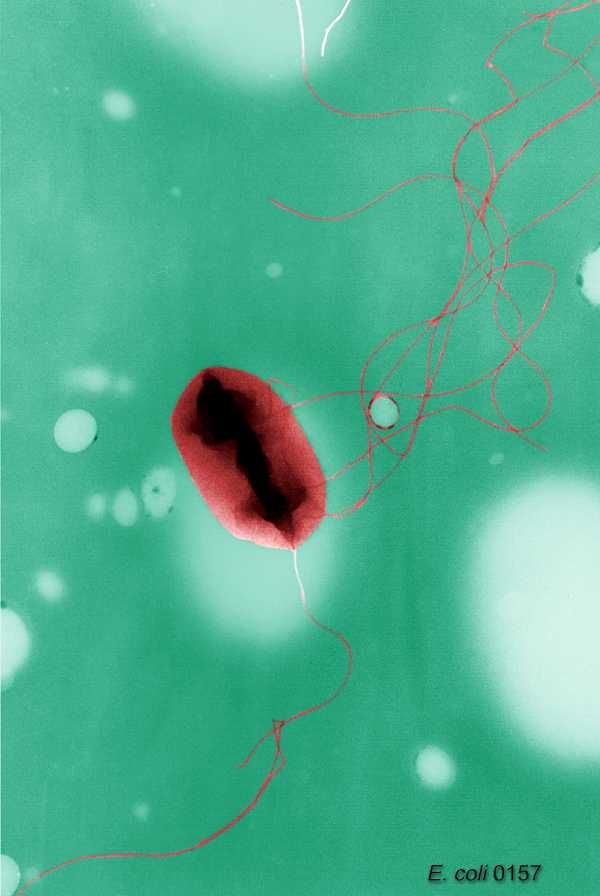
| Shape | Rod |
| Mobility | Yes |
| Flagellar presence | Yes |
| Number of membranes | 2 |

Image source: Wikipedia/Wikimedia
| Ecology, Host, and Life Cycle | |
|---|---|
| Oxygen requirements | Facultative anaerobe |
| Optimal temperature | 37 |
| Temperature range | Mesophilic |
| Habitat | HostAssociated |
| Biotic relationship | Free living |
| Host(s) | Not Available |
| Cell arrangement | Pairs - Singles |
| Sporulation | Nonsporulating |
| Energy source | Not Available |
| Pathogenicity | Not Available |
Genome Summary
Escherichia coli O111:H- str. 11128 plasmid pO111_5, complete
Gene Summary
Adenine Count
1665 bp
Thymine Count
1658 bp
Guanine Count
1934 bp
Cytosine Count
1416 bp
Genome Length
6673 bp
Protein-coding Genes
9 genes
Non-Coding Genes
0 genes
# of Chromosomes/Plasmids
6
Genes
| Name | Locus Tag | UniProt ID | Strand Orientation | Gene Start/End | Protein Molecular Weight |
|---|---|---|---|---|---|
| duf1889 family protein | ECO111_RS12120 | Not Available | Positive | 2316640 - 2316939 | 10836.0 |
| yoah family protein | ECO111_RS12125 | Not Available | Negative | 2317059 - 2317238 | 6554.7 |
| aminodeoxychorismate synthase component 1 | ECO111_RS12130 | Not Available | Positive | 2317312 - 2318673 | 51016.3 |
| coa pyrophosphatase | ECO111_RS12135 | Not Available | Positive | 2318677 - 2319255 | 21464.9 |
| l-serine ammonia-lyase | ECO111_RS12140 | Not Available | Positive | 2319439 - 2320803 | 48909.5 |
| eal domain-containing protein | ECO111_RS12145 | Not Available | Positive | 2320934 - 2322532 | 59715.0 |
| cnnm family cation transport protein yoae | ECO111_RS12150 | Not Available | Negative | 2322536 - 2324092 | 56531.5 |
| protein yoal | ECO111_RS35090 | Not Available | Negative | 2324080 - 2324238 | 6104.3 |
| pts mannose transporter subunit iiab | ECO111_RS12160 | Not Available | Positive | 2324555 - 2325526 | 35080.6 |
| pts mannose transporter subunit iic | ECO111_RS12165 | Not Available | Positive | 2325589 - 2326389 | 27637.6 |
Pathways
12514 pathways
Health Effects
No health effects information available for this bacterium.