Kingdom
Pseudomonadati
Phylum
Pseudomonadota
Class
Gammaproteobacteria
Order
Enterobacterales
Family
Enterobacteriaceae
Genus
Escherichia
Description
Taxonomy
| Kingdom | Pseudomonadati |
|---|---|
| Phylum | Pseudomonadota |
| Class | Gammaproteobacteria |
| Order | Enterobacterales |
| Family | Enterobacteriaceae |
| Genus | Escherichia |
| Species | Escherichia coli |
| Strain | 11128 |
Profile
| Physiology | |
|---|---|
| Gram staining properties | Negative |
| Shape | Rod |
| Mobility | Yes |
| Flagellar presence | Yes |
| Number of membranes | 2 |

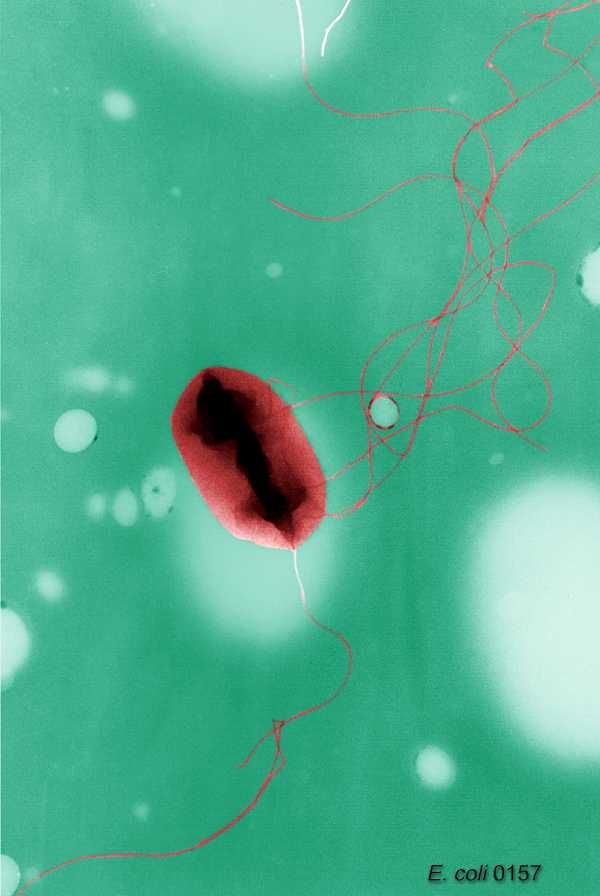
Image source: Wikipedia/Wikimedia
| Ecology, Host, and Life Cycle | |
|---|---|
| Oxygen requirements | Facultative anaerobe |
| Optimal temperature | 37 |
| Temperature range | Mesophilic |
| Habitat | HostAssociated |
| Biotic relationship | Free living |
| Host(s) | Not Available |
| Cell arrangement | Pairs - Singles |
| Sporulation | Nonsporulating |
| Energy source | Not Available |
| Pathogenicity | Not Available |
Genome Summary
Escherichia coli O111:H- str. 11128 plasmid pO111_5, complete
Gene Summary
Adenine Count
1665 bp
Thymine Count
1658 bp
Guanine Count
1934 bp
Cytosine Count
1416 bp
Genome Length
6673 bp
Protein-coding Genes
9 genes
Non-Coding Genes
0 genes
# of Chromosomes/Plasmids
6
Genes
| Name | Locus Tag | UniProt ID | Strand Orientation | Gene Start/End | Protein Molecular Weight |
|---|---|---|---|---|---|
| lon protease family protein | ECO111_RS05370 | Not Available | Negative | 1105696 - 1107456 | 65823.4 |
| macrodomain ter protein matp | ECO111_RS05375 | Not Available | Positive | 1107642 - 1108094 | 17694.4 |
| porin ompa | ECO111_RS05380 | Not Available | Negative | 1108170 - 1109210 | 37202.8 |
| sos-induced cell division inhibitor sula | ECO111_RS05390 | Not Available | Negative | 1109567 - 1110076 | 18802.5 |
| crp-s regulon transcriptional coactivator sxy | ECO111_RS05395 | Not Available | Positive | 1110340 - 1110924 | 22260.1 |
| yccs family putative transporter | ECO111_RS05400 | Not Available | Negative | 1110887 - 1113049 | 82022.8 |
| yccf domain-containing protein | ECO111_RS05405 | Not Available | Negative | 1113059 - 1113505 | 16276.3 |
| dna helicase iv | ECO111_RS05410 | Not Available | Positive | 1113628 - 1115682 | 77967.4 |
| methylglyoxal synthase | ECO111_RS05415 | Not Available | Negative | 1115714 - 1116172 | 16919.6 |
| duf2057 family protein | ECO111_RS05420 | Not Available | Negative | 1116268 - 1116930 | 24595.5 |
Pathways
12514 pathways
Health Effects
No health effects information available for this bacterium.