Kingdom
Pseudomonadati
Phylum
Pseudomonadota
Class
Gammaproteobacteria
Order
Enterobacterales
Family
Enterobacteriaceae
Genus
Escherichia
Description
Taxonomy
| Kingdom | Pseudomonadati |
|---|---|
| Phylum | Pseudomonadota |
| Class | Gammaproteobacteria |
| Order | Enterobacterales |
| Family | Enterobacteriaceae |
| Genus | Escherichia |
| Species | Escherichia coli |
| Strain | 11128 |
Profile
| Physiology | |
|---|---|
| Gram staining properties | Negative |
| Shape | Rod |
| Mobility | Yes |
| Flagellar presence | Yes |
| Number of membranes | 2 |

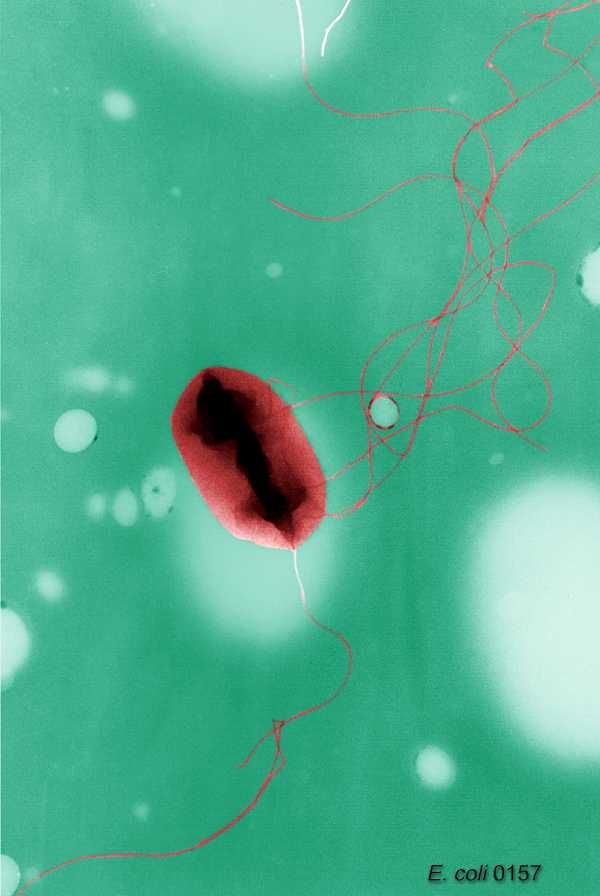
Image source: Wikipedia/Wikimedia
| Ecology, Host, and Life Cycle | |
|---|---|
| Oxygen requirements | Facultative anaerobe |
| Optimal temperature | 37 |
| Temperature range | Mesophilic |
| Habitat | HostAssociated |
| Biotic relationship | Free living |
| Host(s) | Not Available |
| Cell arrangement | Pairs - Singles |
| Sporulation | Nonsporulating |
| Energy source | Not Available |
| Pathogenicity | Not Available |
Genome Summary
Escherichia coli O111:H- str. 11128 plasmid pO111_5, complete
Gene Summary
Adenine Count
1665 bp
Thymine Count
1658 bp
Guanine Count
1934 bp
Cytosine Count
1416 bp
Genome Length
6673 bp
Protein-coding Genes
9 genes
Non-Coding Genes
0 genes
# of Chromosomes/Plasmids
6
Genes
| Name | Locus Tag | UniProt ID | Strand Orientation | Gene Start/End | Protein Molecular Weight |
|---|---|---|---|---|---|
| hydratase | ECO111_RS04120 | Not Available | Positive | 846598 - 848859 | 81479.1 |
| putative acyl-coa thioester hydrolase | ECO111_RS04125 | Not Available | Negative | 849093 - 850376 | 46070.7 |
| helix-turn-helix transcriptional regulator | ECO111_RS32890 | Not Available | Positive | 885024 - 885598 | 21348.8 |
| hypothetical protein | ECO111_RS30695 | Not Available | Positive | 885799 - 886179 | 14337.8 |
| hypothetical protein | ECO111_RS04380 | Not Available | Positive | 886263 - 886484 | 8210.77 |
| type iii secretion system effector adp-ribosyltransferase espj | ECO111_RS04385 | Not Available | Negative | 886497 - 887150 | 24584.8 |
| kinase inhibitor | ECO111_RS04390 | Not Available | Negative | 887654 - 888130 | 17086.0 |
| adenosylmethionine--8-amino-7-oxononanoate transaminase | ECO111_RS04395 | Not Available | Negative | 888189 - 889478 | 47284.3 |
| biotin synthase biob | ECO111_RS04400 | Not Available | Positive | 889565 - 890605 | 38650.3 |
| 8-amino-7-oxononanoate synthase | ECO111_RS04405 | Not Available | Positive | 890602 - 891756 | 41701.9 |
Pathways
12514 pathways
Health Effects
No health effects information available for this bacterium.