Kingdom
Pseudomonadati
Phylum
Pseudomonadota
Class
Gammaproteobacteria
Order
Enterobacterales
Family
Enterobacteriaceae
Genus
Escherichia
Description
Taxonomy
| Kingdom | Pseudomonadati |
|---|---|
| Phylum | Pseudomonadota |
| Class | Gammaproteobacteria |
| Order | Enterobacterales |
| Family | Enterobacteriaceae |
| Genus | Escherichia |
| Species | Escherichia coli |
| Strain | 11128 |
Profile
| Physiology | |
|---|---|
| Gram staining properties | Negative |
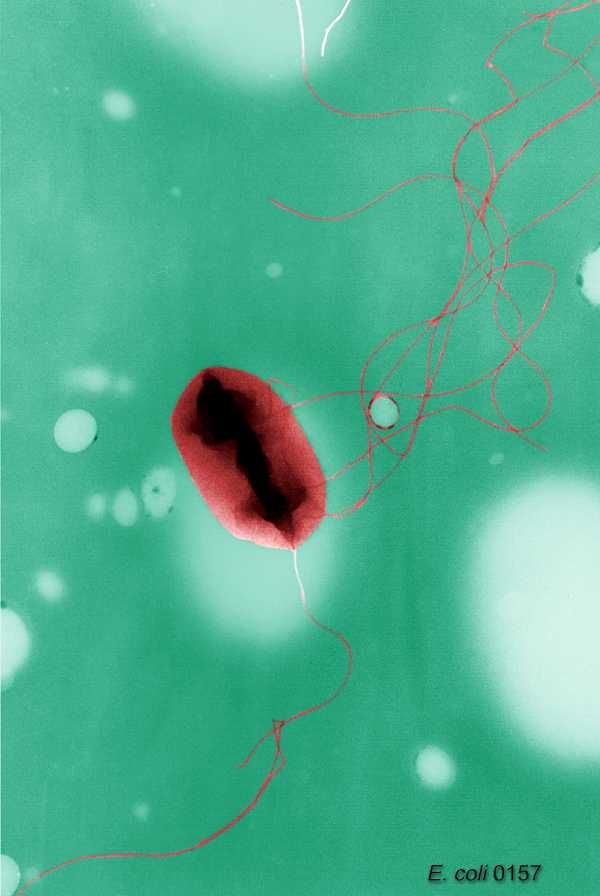
| Shape | Rod |
| Mobility | Yes |
| Flagellar presence | Yes |
| Number of membranes | 2 |

Image source: Wikipedia/Wikimedia
| Ecology, Host, and Life Cycle | |
|---|---|
| Oxygen requirements | Facultative anaerobe |
| Optimal temperature | 37 |
| Temperature range | Mesophilic |
| Habitat | HostAssociated |
| Biotic relationship | Free living |
| Host(s) | Not Available |
| Cell arrangement | Pairs - Singles |
| Sporulation | Nonsporulating |
| Energy source | Not Available |
| Pathogenicity | Not Available |
Genome Summary
Escherichia coli O111:H- str. 11128 plasmid pO111_5, complete
Gene Summary
Adenine Count
1665 bp
Thymine Count
1658 bp
Guanine Count
1934 bp
Cytosine Count
1416 bp
Genome Length
6673 bp
Protein-coding Genes
9 genes
Non-Coding Genes
0 genes
# of Chromosomes/Plasmids
6
Genes
| Name | Locus Tag | UniProt ID | Strand Orientation | Gene Start/End | Protein Molecular Weight |
|---|---|---|---|---|---|
| dna polymerase iii subunit delta | ECO111_RS03470 | Not Available | Negative | 716828 - 717859 | 38718.0 |
| lps assembly lipoprotein lpte | ECO111_RS03475 | Not Available | Negative | 717859 - 718440 | 21356.8 |
| leucine--trna ligase | ECO111_RS03480 | Not Available | Negative | 718455 - 721037 | 97241.0 |
| zinc ribbon-containing protein | ECO111_RS03485 | Not Available | Positive | 721272 - 721754 | 18798.2 |
| sel1 family tpr-like repeat protein ybeq | ECO111_RS03490 | Not Available | Negative | 721824 - 722801 | 37104.8 |
| duf1266 domain-containing protein | ECO111_RS03495 | Not Available | Positive | 722965 - 723672 | 27793.6 |
| j domain-containing protein | ECO111_RS03500 | Not Available | Positive | 723669 - 725096 | 55265.4 |
| tetratricopeptide repeat protein | ECO111_RS03505 | Not Available | Negative | 725106 - 725660 | 20885.9 |
| duf1266 domain-containing protein | ECO111_RS03510 | Not Available | Positive | 725761 - 726468 | 26952.7 |
| co-chaperone djlc | ECO111_RS03515 | Not Available | Positive | 726465 - 727916 | 55686.1 |
Pathways
12514 pathways
Health Effects
No health effects information available for this bacterium.