
Kingdom
Bacillati
Phylum
Bacillota
Class
Bacilli
Order
Caryophanales
Family
Bacillaceae
Genus
Bacillus
Description
Taxonomy
| Kingdom | Bacillati |
|---|---|
| Phylum | Bacillota |
| Class | Bacilli |
| Order | Caryophanales |
| Family | Bacillaceae |
| Genus | Bacillus |
| Species | Bacillus cereus |
| Strain | 03BB102 |
Profile
| Physiology | |
|---|---|
| Gram staining properties | Positive |
| Shape | Rod |
| Mobility | Yes |
| Flagellar presence | Yes |
| Number of membranes | 1 |
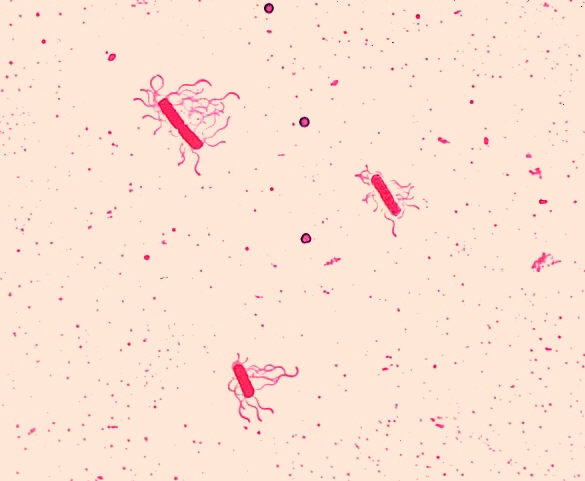
Image source: Wikipedia/Wikimedia
| Ecology, Host, and Life Cycle | |
|---|---|
| Oxygen requirements | Aerobe |
| Optimal temperature | 25 |
| Temperature range | Mesophilic |
| Habitat | Multiple |
| Biotic relationship | Free living |
| Host(s) | Not Available |
| Cell arrangement | Chains |
| Sporulation | Sporulating |
| Energy source | Not Available |
| Pathogenicity | Yes |
Genome Summary
Bacillus cereus 03BB102 plasmid p03BB102_179, complete sequence.
Gene Summary
Adenine Count
62494 bp
Thymine Count
59385 bp
Guanine Count
30497 bp
Cytosine Count
27304 bp
Genome Length
179680 bp
Protein-coding Genes
169 genes
Non-Coding Genes
0 genes
# of Chromosomes/Plasmids
2
Genes
| Name | Locus Tag | UniProt ID | Strand Orientation | Gene Start/End | Protein Molecular Weight |
|---|---|---|---|---|---|
| duf1836 domain-containing protein | BCA_RS15085 | Not Available | Positive | 2710725 - 2711489 | 28652.5 |
| deda family protein | BCA_RS15090 | Not Available | Positive | 2711725 - 2712330 | 22620.2 |
| dinb family protein | BCA_RS15095 | Not Available | Negative | 2712370 - 2712858 | 19248.3 |
| hypothetical protein | BCA_RS15100 | Not Available | Positive | 2713006 - 2713230 | 8699.37 |
| d-alanyl-lipoteichoic acid biosynthesis protein dltd | BCA_RS15105 | Not Available | Negative | 2713270 - 2714451 | 45691.9 |
| gnat family n-acetyltransferase | BCA_RS15110 | Not Available | Negative | 2714751 - 2715245 | 19209.1 |
| peptide abc transporter substrate-binding protein | BCA_RS15115 | Not Available | Negative | 2715363 - 2716985 | 62085.9 |
| c40 family peptidase | BCA_RS15120 | Not Available | Negative | 2717006 - 2718007 | 37116.0 |
| dipeptide epimerase | BCA_RS15125 | Not Available | Negative | 2718047 - 2719099 | 38597.6 |
| duf3870 domain-containing protein | BCA_RS15130 | Not Available | Negative | 2719252 - 2719578 | 12011.5 |
Pathways
0 pathways
No pathways found
No metabolic pathways have been associated with this bacterium yet.






