
Kingdom
Bacillati
Phylum
Bacillota
Class
Bacilli
Order
Caryophanales
Family
Bacillaceae
Genus
Bacillus
Description
Taxonomy
| Kingdom | Bacillati |
|---|---|
| Phylum | Bacillota |
| Class | Bacilli |
| Order | Caryophanales |
| Family | Bacillaceae |
| Genus | Bacillus |
| Species | Bacillus cereus |
| Strain | BDRD-ST196 |
Profile
| Physiology | |
|---|---|
| Gram staining properties | Positive |
| Shape | Rod |
| Mobility | Yes |
| Flagellar presence | Yes |
| Number of membranes | 1 |
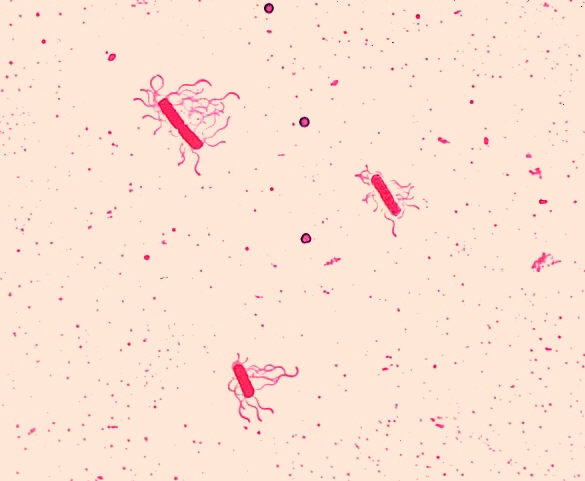
Image source: Wikipedia/Wikimedia
| Ecology, Host, and Life Cycle | |
|---|---|
| Oxygen requirements | Aerobe |
| Optimal temperature | 25 |
| Temperature range | Mesophilic |
| Habitat | Multiple |
| Biotic relationship | Free living |
| Host(s) | Not Available |
| Cell arrangement | Chains |
| Sporulation | Not Available |
| Energy source | Not Available |
| Pathogenicity | Not Available |
Gene Summary
Adenine Count
1795455 bp
Thymine Count
1800555 bp
Guanine Count
970126 bp
Cytosine Count
982015 bp
Genome Length
5548166 bp
Protein-coding Genes
5526 genes
Non-Coding Genes
105 genes
# of Chromosomes/Plasmids
1
Genes
| Name | Locus Tag | UniProt ID | Strand Orientation | Gene Start/End | Protein Molecular Weight |
|---|---|---|---|---|---|
| hypothetical protein | bcere0014_31510 | Not Available | Negative | 3125266 - 3126033 | 29750.4 |
| hypothetical protein | bcere0014_31520 | Not Available | Positive | 3126100 - 3126309 | 7780.08 |
| phenazine biosynthesis protein phzf | bcere0014_31530 | Not Available | Negative | 3126345 - 3127244 | 33270.6 |
| acetyltransferase, gnat | bcere0014_31540 | Not Available | Negative | 3127256 - 3127819 | 22253.5 |
| hypothetical protein | bcere0014_31550 | Not Available | Negative | 3127964 - 3129457 | 56450.1 |
| nadph oxidoreductase | bcere0014_31560 | Not Available | Negative | 3129678 - 3130211 | 20811.7 |
| transcriptional regulator, marr | bcere0014_31570 | Not Available | Positive | 3130336 - 3130659 | 12447.1 |
| transcriptional regulator, arsr | bcere0014_31580 | Not Available | Negative | 3130907 - 3131173 | 9949.49 |
| fmrfamide neuropeptide | bcere0014_31590 | Not Available | Negative | 3131279 - 3131623 | 12590.5 |
| transmembrane anti-sigma factor | bcere0014_31600 | Not Available | Negative | 3131927 - 3132904 | 36736.2 |
Pathways
0 pathways
No pathways found
No metabolic pathways have been associated with this bacterium yet.
Health Effects
No health effects information available for this bacterium.






