
Kingdom
Bacillati
Phylum
Bacillota
Class
Bacilli
Order
Caryophanales
Family
Bacillaceae
Genus
Bacillus
Description
Taxonomy
| Kingdom | Bacillati |
|---|---|
| Phylum | Bacillota |
| Class | Bacilli |
| Order | Caryophanales |
| Family | Bacillaceae |
| Genus | Bacillus |
| Species | Bacillus cereus |
| Strain | BDRD-ST196 |
Profile
| Physiology | |
|---|---|
| Gram staining properties | Positive |
| Shape | Rod |
| Mobility | Yes |
| Flagellar presence | Yes |
| Number of membranes | 1 |
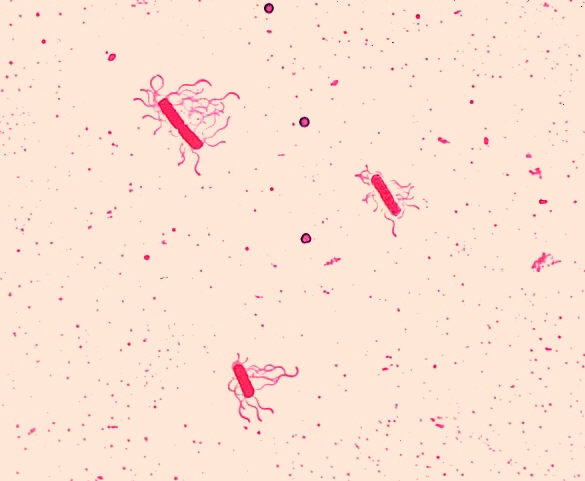
Image source: Wikipedia/Wikimedia
| Ecology, Host, and Life Cycle | |
|---|---|
| Oxygen requirements | Aerobe |
| Optimal temperature | 25 |
| Temperature range | Mesophilic |
| Habitat | Multiple |
| Biotic relationship | Free living |
| Host(s) | Not Available |
| Cell arrangement | Chains |
| Sporulation | Not Available |
| Energy source | Not Available |
| Pathogenicity | Not Available |
Gene Summary
Adenine Count
1795455 bp
Thymine Count
1800555 bp
Guanine Count
970126 bp
Cytosine Count
982015 bp
Genome Length
5548166 bp
Protein-coding Genes
5526 genes
Non-Coding Genes
105 genes
# of Chromosomes/Plasmids
1
Genes
| Name | Locus Tag | UniProt ID | Strand Orientation | Gene Start/End | Protein Molecular Weight |
|---|---|---|---|---|---|
| hypothetical protein | bcere0014_29690 | Not Available | Negative | 2950976 - 2951299 | 12463.8 |
| hypothetical protein | bcere0014_29700 | Not Available | Positive | 2951589 - 2951765 | 6625.42 |
| hypothetical protein | bcere0014_29710 | Not Available | Negative | 2951861 - 2951992 | 5187.56 |
| hypothetical protein | bcere0014_29720 | Not Available | Negative | 2952056 - 2952685 | 24168.3 |
| pyridoxal phosphate-dependent deaminase | bcere0014_29730 | Not Available | Negative | 2952815 - 2953810 | 35382.6 |
| phosphohydrolase | bcere0014_29740 | Not Available | Negative | 2954082 - 2955314 | 46432.7 |
| glyoxalase | bcere0014_29750 | Not Available | Negative | 2955715 - 2955930 | 8366.71 |
| glyoxalase | bcere0014_29760 | Not Available | Negative | 2955998 - 2956147 | 5732.01 |
| hypothetical protein | bcere0014_29770 | Not Available | Negative | 2956466 - 2957122 | 25261.3 |
| hypothetical protein | bcere0014_29780 | Not Available | Negative | 2957203 - 2957625 | 16355.5 |
Pathways
0 pathways
No pathways found
No metabolic pathways have been associated with this bacterium yet.
Health Effects
No health effects information available for this bacterium.






