
Kingdom
Bacillati
Phylum
Bacillota
Class
Bacilli
Order
Caryophanales
Family
Bacillaceae
Genus
Bacillus
Description
Taxonomy
| Kingdom | Bacillati |
|---|---|
| Phylum | Bacillota |
| Class | Bacilli |
| Order | Caryophanales |
| Family | Bacillaceae |
| Genus | Bacillus |
| Species | Bacillus cereus |
| Strain | BDRD-ST196 |
Profile
| Physiology | |
|---|---|
| Gram staining properties | Positive |
| Shape | Rod |
| Mobility | Yes |
| Flagellar presence | Yes |
| Number of membranes | 1 |
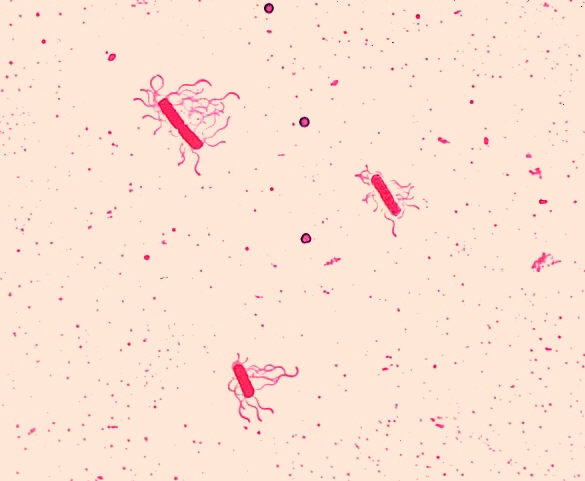
Image source: Wikipedia/Wikimedia
| Ecology, Host, and Life Cycle | |
|---|---|
| Oxygen requirements | Aerobe |
| Optimal temperature | 25 |
| Temperature range | Mesophilic |
| Habitat | Multiple |
| Biotic relationship | Free living |
| Host(s) | Not Available |
| Cell arrangement | Chains |
| Sporulation | Not Available |
| Energy source | Not Available |
| Pathogenicity | Not Available |
Gene Summary
Adenine Count
1795455 bp
Thymine Count
1800555 bp
Guanine Count
970126 bp
Cytosine Count
982015 bp
Genome Length
5548166 bp
Protein-coding Genes
5526 genes
Non-Coding Genes
105 genes
# of Chromosomes/Plasmids
1
Genes
| Name | Locus Tag | UniProt ID | Strand Orientation | Gene Start/End | Protein Molecular Weight |
|---|---|---|---|---|---|
| nuclease sbccd, d subunit | bcere0014_21120 | Not Available | Positive | 2114680 - 2115378 | 27069.0 |
| exonuclease | bcere0014_21130 | Not Available | Positive | 2115396 - 2118464 | 119641.0 |
| hypothetical protein | bcere0014_21140 | Not Available | Negative | 2118625 - 2118798 | 6085.19 |
| hypothetical protein | bcere0014_21150 | Not Available | Positive | 2119135 - 2119434 | 11294.9 |
| hypothetical protein | bcere0014_21160 | Not Available | Negative | 2119498 - 2119683 | 6873.29 |
| hypothetical protein | bcere0014_21170 | Not Available | Positive | 2120193 - 2120339 | 5410.65 |
| major facilitator superfamily mfs_1 | bcere0014_21180 | Not Available | Positive | 2120393 - 2121538 | 40775.9 |
| 2,3-dihydro-2,3-dihydroxybenzoate dehydrogenase | bcere0014_21190 | Not Available | Positive | 2122167 - 2122952 | 28015.6 |
| isochorismate synthase | bcere0014_21200 | Not Available | Positive | 2122979 - 2124178 | 44586.1 |
| 2,3-dihydroxybenzoate-amp ligase | bcere0014_21210 | Not Available | Positive | 2124191 - 2125807 | 59798.5 |
Pathways
0 pathways
No pathways found
No metabolic pathways have been associated with this bacterium yet.
Health Effects
No health effects information available for this bacterium.






