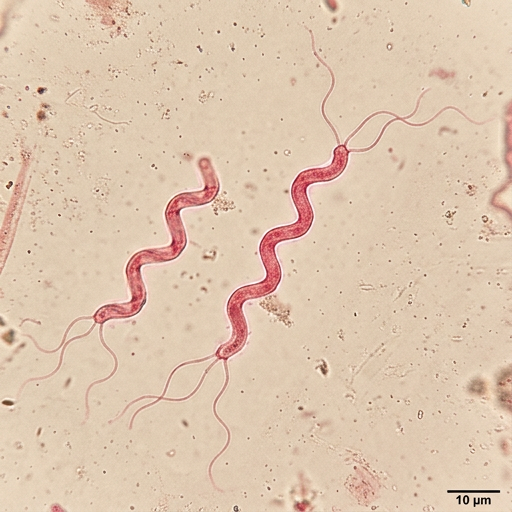
Spirosoma linguale DSM 74

Gram-negativeSpirillaNon-motileAerobe

Kingdom

Pseudomonadati

Phylum

Bacteroidota

Class

Cytophagia

Order

Cytophagales

Family

Cytophagaceae

Genus

Spirosoma

Description

Spirosoma linguale DSM 74 is a gram-negative, spiral-shaped bacterium that thrives optimally at mesophilic temperatures, is classified as a chemoheterotroph, and functions as a facultative anaerobe. This microorganism is found in a variety of environmental niches, including the human oral cavity; its presence reflects the dynamic microbial ecosystem that exists in and on human bodies.The gram-negative nature of Spirosoma linguale indicates that it has a thin peptidoglycan layer surrounded by an outer membrane containing lipopolysaccharides, which contributes to its distinctive staining characteristics and plays a vital role in its interaction with host organisms. Its spiral morphology allows for increased motility, which is advantageous for navigating through viscous environments such as mucosal surfaces. As a mesophilic organism, Spirosoma linguale exhibits growth preferences that align with moderate temperature ranges, typically between 20°C and 45°C. This temperature adaptability enables it to thrive in various habitats, aligning with the thermal conditions of the human oral cavity, which is often subject to fluctuating temperatures. Being a chemoheterotroph, Spirosoma linguale derives its energy from organic compounds, predominantly found in the microbial communities of the mouth. As a facultative anaerobe, it can grow in both the presence and absence of oxygen, allowing it to exploit diverse ecological niches and adjust its metabolic pathways depending on environmental conditions. A notable aspect of Spirosoma linguale is its potential role in oral health. Studies suggest that it may influence the balance of oral microbiota, possibly impacting conditions such as dental caries and periodontal disease. Its unique morphology and metabolic capabilities make it a subject of interest for researchers exploring microbial ecology and its implications for human health.

Taxonomy

KingdomPseudomonadati
PhylumBacteroidota
ClassCytophagia
OrderCytophagales
FamilyCytophagaceae
GenusSpirosoma
SpeciesSpirosoma linguale
StrainDSM 74

Profile

Physiology
Gram staining propertiesNegative
ShapeSpirilla
MobilityNo
Flagellar presenceYes
Number of membranes2
Image of Spirosoma linguale DSM 74
AI-generated image based on bacteria physiology
Ecology, Host, and Life Cycle
Oxygen requirementsAerobe
Optimal temperature20
Temperature rangeMesophilic
HabitatMultiple
Biotic relationshipFree living
Host(s)Not Available
Cell arrangementNot Available
SporulationNonsporulating
Energy sourceChemoorganotroph
PathogenicityNo

Genome Summary

Spirosoma linguale DSM 74 plasmid pSLIN04, complete sequence.

Gene Summary

Adenine Count

2597 bp

Thymine Count

2601 bp

Guanine Count

2344 bp

Cytosine Count

2423 bp

Genome Length

9965 bp

Protein-coding Genes

12 genes

Non-Coding Genes

0 genes

# of Chromosomes/Plasmids

9

Genes

NameLocus TagUniProt IDStrand OrientationGene Start/EndProtein Molecular Weight
sdr family oxidoreductaseSLIN_RS31640G9FRD6Positive7814404 - 781522229045.5
hypothetical proteinSLIN_RS31645Not AvailablePositive7815227 - 781603929928.1
hypothetical proteinSLIN_RS31650Not AvailablePositive7816293 - 78165268612.81
duf6132 family proteinSLIN_RS31655Not AvailablePositive7816513 - 78167137247.13
gh116 family glycosyl-hydrolaseSLIN_RS31660Not AvailableNegative7816962 - 781953595392.9
ragb/susd family nutrient uptake outer membrane proteinSLIN_RS31665Not AvailableNegative7819743 - 782122454341.7
tonb-dependent receptorSLIN_RS31670Not AvailableNegative7821239 - 7824427116108.0
hypothetical proteinSLIN_RS31675Not AvailableNegative7825046 - 782530910833.7
Trna-valNot AvailableNot AvailablePositive7825451 - 7825528Not Available
outer membrane beta-barrel proteinSLIN_RS31685Not AvailableNegative7825662 - 782647130637.6

Displaying genes 6691 – 6700 of 6884 in total

Metabolites

2045 records
Metabolite IDMetabolite nameStructureCAS number
BASm0000173(R)-3-Hydroxybutyric acidC4H8O3Chemical structure of (R)-3-Hydroxybutyric acid625-72-3
Average104.0473Da
Monoisotopic104.047344122Da
BASm0000237(R)-4'-phosphopantothenateC9H18NO8PChemical structure of (R)-4'-phosphopantothenateNot available
Average299.2149Da
Monoisotopic299.0770031Da
BASm00002502,5-didehydro-D-gluconateC6H7O7Chemical structure of 2,5-didehydro-D-gluconate53736-12-2
Average191.1156Da
Monoisotopic191.019177578Da
BASm00002512-dehydropantoateC6H9O4Chemical structure of 2-dehydropantoateNot available
Average145.1333Da
Monoisotopic145.050083776Da
BASm00002532-oxopent-4-enoateC5H5O3Chemical structure of 2-oxopent-4-enoateNot available
Average113.093Da
Monoisotopic113.024417601Da
BASm00002603alpha,7alpha-dihydroxy-12-oxo-5beta-cholanateC24H37O5Chemical structure of 3alpha,7alpha-dihydroxy-12-oxo-5beta-cholanateNot available
Average405.556Da
Monoisotopic405.264647871Da
BASm0000274aldehydo-D-galacturonateC6H9O7Chemical structure of aldehydo-D-galacturonateNot available
Average193.132Da
Monoisotopic193.0353762Da
BASm0000377(S)-malateC4H4O5Chemical structure of (S)-malateNot available
Average132.0716Da
Monoisotopic132.005873238Da
BASm00004283-oxoadipateC6H6O5Chemical structure of 3-oxoadipateNot available
Average158.11Da
Monoisotopic158.022620453Da
BASm0000503L-rhamnoseC6H12O5Chemical structure of L-rhamnose3615-41-6
Average164.1565Da
Monoisotopic164.0684735Da

Displaying 1–10 of 2045 metabolites

Health Effects

No health effects information available for this bacterium.