Kingdom
Pseudomonadati
Phylum
Pseudomonadota
Class
Gammaproteobacteria
Order
Enterobacterales
Family
Enterobacteriaceae
Genus
Escherichia
Description
Taxonomy
| Kingdom | Pseudomonadati |
|---|---|
| Phylum | Pseudomonadota |
| Class | Gammaproteobacteria |
| Order | Enterobacterales |
| Family | Enterobacteriaceae |
| Genus | Escherichia |
| Species | Escherichia coli |
| Strain | SMS-3-5 |
Profile
| Physiology | |
|---|---|
| Gram staining properties | Negative |
| Shape | Rod |
| Mobility | No |
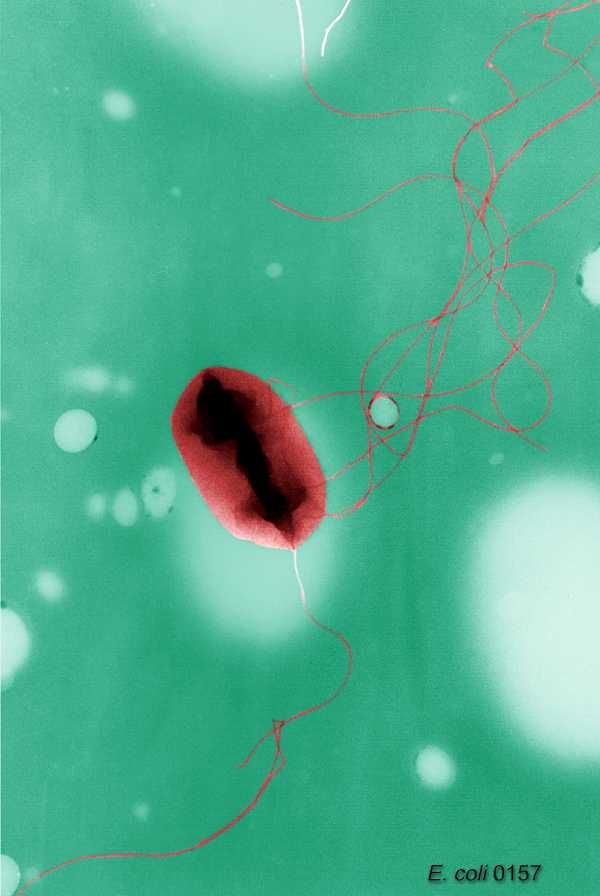
| Flagellar presence | Yes |
| Number of membranes | 2 |
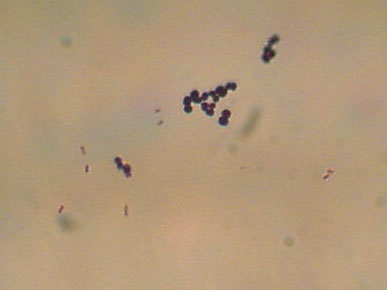
Image source: Wikipedia/Wikimedia
| Ecology, Host, and Life Cycle | |
|---|---|
| Oxygen requirements | Facultative anaerobe |
| Optimal temperature | 37 |
| Temperature range | Mesophilic |
| Habitat | Multiple |
| Biotic relationship | Free living |
| Host(s) | Not Available |
| Cell arrangement | Pairs - Singles |
| Sporulation | Nonsporulating |
| Energy source | Not Available |
| Pathogenicity | Not Available |
Genome Summary
Escherichia coli SMS-3-5 plasmid pSMS35_4, complete sequence.
Gene Summary
Adenine Count
984 bp
Thymine Count
1071 bp
Guanine Count
1035 bp
Cytosine Count
984 bp
Genome Length
4074 bp
Protein-coding Genes
3 genes
Non-Coding Genes
0 genes
# of Chromosomes/Plasmids
5
Genes
| Name | Locus Tag | UniProt ID | Strand Orientation | Gene Start/End | Protein Molecular Weight |
|---|---|---|---|---|---|
| 7-methyl-gtp pyrophosphatase | ECSMS35_RS10345 | Not Available | Positive | 2059932 - 2060516 | 21692.1 |
| 23s rrna pseudouridine(955/2504/2580) synthase rluc | ECSMS35_RS10350 | Not Available | Negative | 2060627 - 2061586 | 36037.8 |
| ribonuclease e | ECSMS35_RS10360 | Not Available | Positive | 2062159 - 2065332 | 117878.0 |
| duf1778 domain-containing protein | ECSMS35_RS10365 | Not Available | Positive | 2065466 - 2065759 | 11080.3 |
| gnat family n-acetyltransferase | ECSMS35_RS10370 | Not Available | Positive | 2065756 - 2066250 | 18085.1 |
| flagellar hook-associated protein flgl | ECSMS35_RS10375 | Not Available | Negative | 2066345 - 2067298 | 34282.9 |
| flagellar hook-associated protein flgk | ECSMS35_RS10380 | Not Available | Negative | 2067310 - 2068953 | 57947.1 |
| flagellar assembly peptidoglycan hydrolase flgj | ECSMS35_RS10385 | Not Available | Negative | 2069019 - 2069960 | 34510.2 |
| flagellar basal body p-ring protein flgi | ECSMS35_RS10390 | Not Available | Negative | 2069960 - 2071057 | 38200.0 |
| flagellar basal body l-ring protein flgh | ECSMS35_RS10395 | Not Available | Negative | 2071069 - 2071767 | 24602.8 |
Pathways
13113 pathways
Health Effects
No health effects information available for this bacterium.