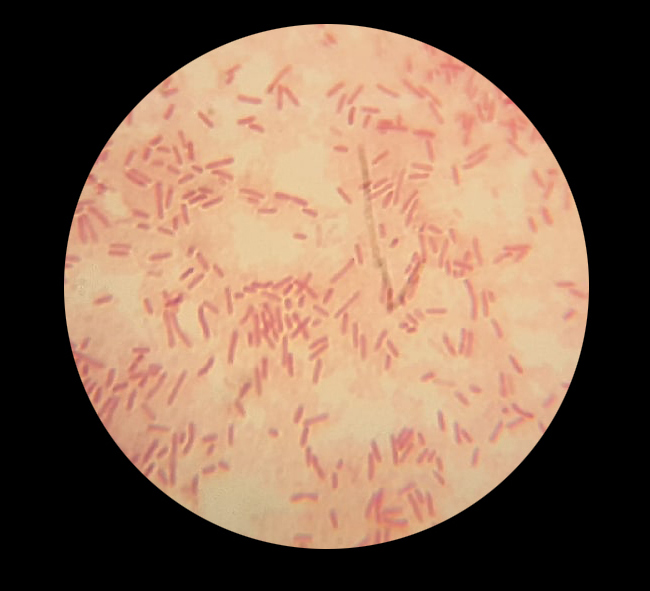
Salmonella enterica subsp. enterica serovar Newport str. SL254

Gram-negativeRodMotileFacultative anaerobe

Kingdom

Pseudomonadati

Phylum

Pseudomonadota

Class

Gammaproteobacteria

Order

Enterobacterales

Family

Enterobacteriaceae

Genus

Salmonella

Description

Salmonella enterica subsp. enterica serovar Newport str. SL254 is a gram-negative, rod-shaped bacterium that thrives at mesophilic temperatures, classified as a facultative anaerobe and a chemoheterotroph. This versatile microbe primarily resides in the intestines of warm-blooded animals, including humans, where it can cause gastrointestinal infections, but it can also be found in various environmental reservoirs such as soil, water, and contaminated food sources. As a gram-negative organism, Salmonella enterica possesses a thin peptidoglycan layer surrounded by an outer membrane rich in lipopolysaccharides, which contributes to its pathogenicity and ability to evade the host's immune response. The rod shape of the bacterium facilitates motility, allowing it to navigate through the viscous environment of the intestinal tract. Being mesophilic, it grows optimally at temperatures between 30°C and 37°C, aligning with the internal body temperature of its host.As a facultative anaerobe, SL254 can thrive in both aerobic and anaerobic environments, adapting its metabolic processes based on oxygen availability. Its classification as a chemoheterotroph indicates that it relies on organic compounds for carbon and energy, primarily deriving from the host’s nutrients during infections. This adaptability is critical for its survival in diverse environments and hosts. This particular strain of Salmonella enterica has garnered attention due to its antimicrobial resistance, particularly to commonly used antibiotics, posing challenges in clinical settings. Its ability to develop resistance mechanisms, such as efflux pumps and modified target sites, reflects a growing public health concern. Furthermore, serovar Newport has been implicated in several foodborne outbreaks, particularly associated with animal products such as poultry and beef, underscoring the importance of food safety measures in preventing transmission.

Taxonomy

KingdomPseudomonadati
PhylumPseudomonadota
ClassGammaproteobacteria
OrderEnterobacterales
FamilyEnterobacteriaceae
GenusSalmonella
SpeciesSalmonella enterica
StrainSL254

Profile

Physiology
Gram staining propertiesNegative
ShapeRod
MobilityYes
Flagellar presenceYes
Number of membranes2
Image of Salmonella enterica subsp. enterica serovar Newport str. SL254
Image source: Wikipedia/Wikimedia
Ecology, Host, and Life Cycle
Oxygen requirementsFacultative anaerobe
Optimal temperature37
Temperature rangeMesophilic
HabitatMultiple
Biotic relationshipFree living
Host(s)Not Available
Cell arrangementPairs - Singles
SporulationNonsporulating
Energy sourceChemoorganotroph
PathogenicityYes

Genome Summary

Salmonella enterica subsp. enterica serovar Newport str. SL254,

Gene Summary

Adenine Count

1154071 bp

Thymine Count

1152734 bp

Guanine Count

1260889 bp

Cytosine Count

1259947 bp

Genome Length

4827641 bp

Protein-coding Genes

4294 genes

Non-Coding Genes

440 genes

# of Chromosomes/Plasmids

3

Genes

NameLocus TagUniProt IDStrand OrientationGene Start/EndProtein Molecular Weight
cytidine deaminaseSNSL254_RS12315Not AvailablePositive2290390 - 229127431619.6
outer membrane permeability protein sanaSNSL254_RS12320Not AvailablePositive2291451 - 229217027377.6
duf2542 family proteinSNSL254_RS12325Not AvailablePositive2292167 - 22924129686.15
nad(p)-dependent oxidoreductaseSNSL254_RS12330Not AvailablePositive2292617 - 229385844667.6
nad-dependent dihydropyrimidine dehydrogenase subunit preaSNSL254_RS12335Not AvailablePositive2293852 - 229508745123.5
galactose/methyl galactoside abc transporter permease mglcSNSL254_RS12340Not AvailableNegative2295162 - 229617235609.4
galactose/methyl galactoside abc transporter atp-binding protein mglaSNSL254_RS12345Not AvailableNegative2296188 - 229770856457.8
galactose/glucose abc transporter substrate-binding protein mglbSNSL254_RS12350Not AvailableNegative2297842 - 229884035771.5
hth-type transcriptional regulator galsSNSL254_RS12355Not AvailableNegative2299339 - 230036136951.6
duf418 domain-containing protein yeibSNSL254_RS12360Not AvailableNegative2300511 - 230165342924.8

Displaying genes 2471 – 2480 of 4936 in total

Metabolites

2030 records
Metabolite IDMetabolite nameStructureCAS number
BASm0000217alpha-ribazoleC14H18N2O4Chemical structure of alpha-ribazoleNot available
Average278.3037Da
Monoisotopic278.126657074Da
BASm0000237(R)-4'-phosphopantothenateC9H18NO8PChemical structure of (R)-4'-phosphopantothenateNot available
Average299.2149Da
Monoisotopic299.0770031Da
BASm00002502,5-didehydro-D-gluconateC6H7O7Chemical structure of 2,5-didehydro-D-gluconate53736-12-2
Average191.1156Da
Monoisotopic191.019177578Da
BASm00002512-dehydropantoateC6H9O4Chemical structure of 2-dehydropantoateNot available
Average145.1333Da
Monoisotopic145.050083776Da
BASm00002532-oxopent-4-enoateC5H5O3Chemical structure of 2-oxopent-4-enoateNot available
Average113.093Da
Monoisotopic113.024417601Da
BASm00002603alpha,7alpha-dihydroxy-12-oxo-5beta-cholanateC24H37O5Chemical structure of 3alpha,7alpha-dihydroxy-12-oxo-5beta-cholanateNot available
Average405.556Da
Monoisotopic405.264647871Da
BASm0000274aldehydo-D-galacturonateC6H9O7Chemical structure of aldehydo-D-galacturonateNot available
Average193.132Da
Monoisotopic193.0353762Da
BASm0000377(S)-malateC4H4O5Chemical structure of (S)-malateNot available
Average132.0716Da
Monoisotopic132.005873238Da
BASm0000387(6R)-5,10-methylene-5,6,7,8-tetrahydrofolateC20H21N7O6Chemical structure of (6R)-5,10-methylene-5,6,7,8-tetrahydrofolateNot available
Average455.432Da
Monoisotopic455.1564286Da
BASm0000401(S)-2-succinylamino-6-oxoheptanedioateC11H12NO8Chemical structure of (S)-2-succinylamino-6-oxoheptanedioateNot available
Average286.218Da
Monoisotopic286.0579371Da

Displaying 1–10 of 2030 metabolites

Health Effects

No health effects information available for this bacterium.