Kingdom
Pseudomonadati
Phylum
Pseudomonadota
Class
Gammaproteobacteria
Order
Enterobacterales
Family
Enterobacteriaceae
Genus
Escherichia
Description
Taxonomy
| Kingdom | Pseudomonadati |
|---|---|
| Phylum | Pseudomonadota |
| Class | Gammaproteobacteria |
| Order | Enterobacterales |
| Family | Enterobacteriaceae |
| Genus | Escherichia |
| Species | Escherichia coli |
| Strain | O1 |
Profile
| Physiology | |
|---|---|
| Gram staining properties | Negative |
| Shape | Rod |
| Mobility | Yes |
| Flagellar presence | Yes |
| Number of membranes | 2 |

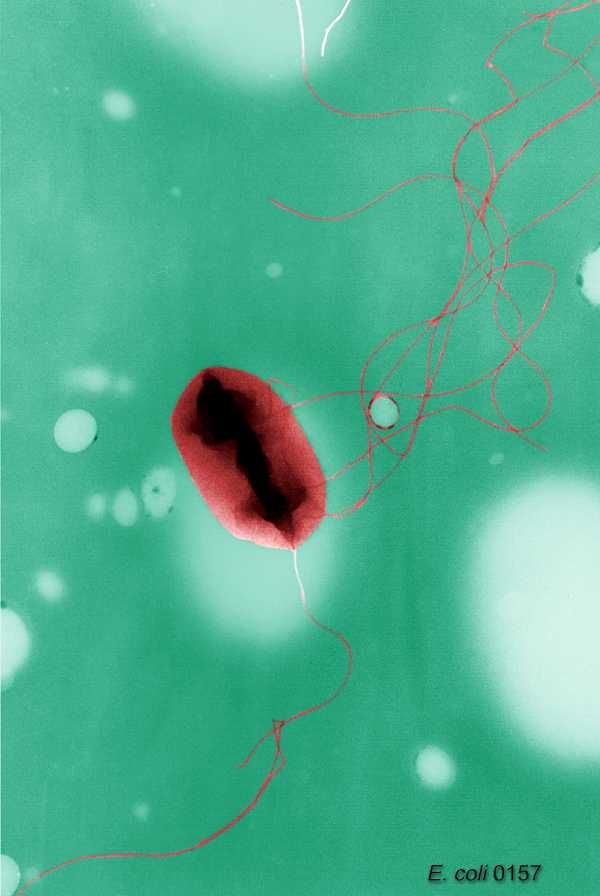
Image source: Wikipedia/Wikimedia
| Ecology, Host, and Life Cycle | |
|---|---|
| Oxygen requirements | Facultative anaerobe |
| Optimal temperature | 37 |
| Temperature range | Mesophilic |
| Habitat | HostAssociated |
| Biotic relationship | Free living |
| Host(s) | Not Available |
| Cell arrangement | Pairs - Singles |
| Sporulation | Nonsporulating |
| Energy source | Not Available |
| Pathogenicity | Not Available |
Genome Summary
Escherichia coli APEC O1 plasmid pAPEC-O1-R, complete sequence.
Gene Summary
Adenine Count
Not Available
Thymine Count
Not Available
Guanine Count
Not Available
Cytosine Count
Not Available
Genome Length
Not Available
Protein-coding Genes
Not Available
Non-Coding Genes
Not Available
# of Chromosomes/Plasmids
3
Genes
| Name | Locus Tag | UniProt ID | Strand Orientation | Gene Start/End | Protein Molecular Weight |
|---|---|---|---|---|---|
| cell division protein ftsq | APECO1_RS00505 | P06136 | Positive | 105578 - 106408 | 31421.6 |
| cell division protein ftsa | APECO1_RS00510 | P0ABH2 | Positive | 106405 - 107667 | 45332.7 |
| cell division protein ftsz | APECO1_RS00515 | P0A9A8 | Positive | 107728 - 108879 | 40326.4 |
| udp-3-o-acyl-n-acetylglucosamine deacetylase | APECO1_RS00520 | A7ZHI7 | Positive | 108980 - 109897 | 33957.8 |
| seca translation cis-regulator secm | APECO1_RS00525 | B7MAM0 | Positive | 110128 - 110640 | 18866.6 |
| preprotein translocase subunit seca | APECO1_RS00530 | B7MAM1 | Positive | 110702 - 113407 | 101997.0 |
| 8-oxo-dgtp diphosphatase mutt | APECO1_RS00535 | P08337 | Positive | 113467 - 113865 | 15122.0 |
| dna gyrase inhibitor yacg | APECO1_RS00540 | A7ZHJ2 | Negative | 113953 - 114150 | 7306.49 |
| cell division protein zapd | APECO1_RS00545 | B7UIF1 | Negative | 114160 - 114903 | 28279.3 |
| dephospho-coa kinase | APECO1_RS00550 | P0A6J0 | Negative | 114903 - 115523 | 22622.0 |
Pathways
12514 pathways
Health Effects
No health effects information available for this bacterium.