Kingdom
Pseudomonadati
Phylum
Pseudomonadota
Class
Gammaproteobacteria
Order
Enterobacterales
Family
Enterobacteriaceae
Genus
Escherichia
Description
Taxonomy
| Kingdom | Pseudomonadati |
|---|---|
| Phylum | Pseudomonadota |
| Class | Gammaproteobacteria |
| Order | Enterobacterales |
| Family | Enterobacteriaceae |
| Genus | Escherichia |
| Species | Escherichia coli |
| Strain | O1 |
Profile
| Physiology | |
|---|---|
| Gram staining properties | Negative |
| Shape | Rod |
| Mobility | Yes |
| Flagellar presence | Yes |
| Number of membranes | 2 |

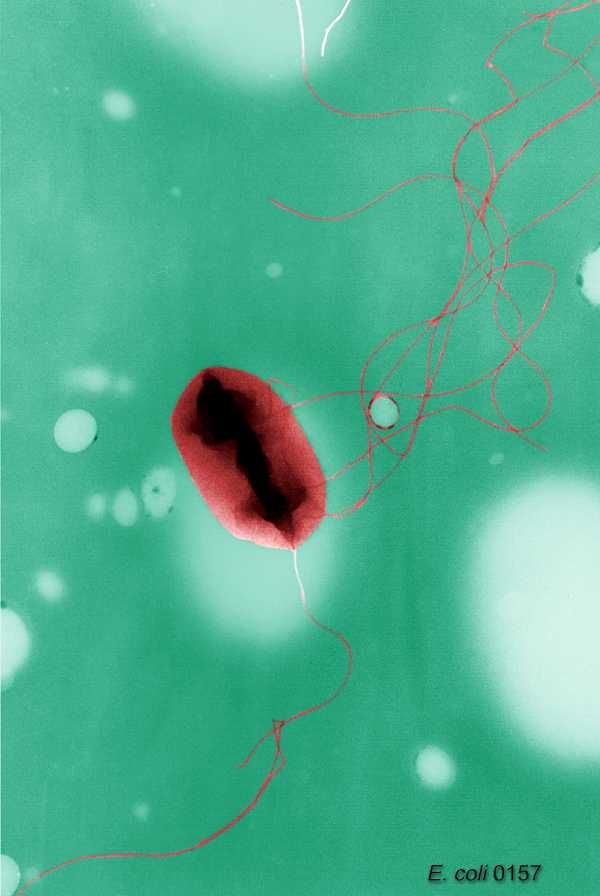
Image source: Wikipedia/Wikimedia
| Ecology, Host, and Life Cycle | |
|---|---|
| Oxygen requirements | Facultative anaerobe |
| Optimal temperature | 37 |
| Temperature range | Mesophilic |
| Habitat | HostAssociated |
| Biotic relationship | Free living |
| Host(s) | Not Available |
| Cell arrangement | Pairs - Singles |
| Sporulation | Nonsporulating |
| Energy source | Not Available |
| Pathogenicity | Not Available |
Genome Summary
Escherichia coli APEC O1 plasmid pAPEC-O1-R, complete sequence.
Gene Summary
Adenine Count
Not Available
Thymine Count
Not Available
Guanine Count
Not Available
Cytosine Count
Not Available
Genome Length
Not Available
Protein-coding Genes
Not Available
Non-Coding Genes
Not Available
# of Chromosomes/Plasmids
3
Genes
| Name | Locus Tag | UniProt ID | Strand Orientation | Gene Start/End | Protein Molecular Weight |
|---|---|---|---|---|---|
| 4-hydroxy-3-methylbut-2-enyl diphosphate reductase | APECO1_RS00145 | B7UI74 | Positive | 27768 - 28718 | 34721.4 |
| ribonucleoside hydrolase rihc | APECO1_RS00150 | B7MAF0 | Positive | 28784 - 29698 | 32601.7 |
| duf805 domain-containing protein | APECO1_RS00155 | Not Available | Positive | 29721 - 30086 | 13660.0 |
| 4-hydroxy-tetrahydrodipicolinate reductase | APECO1_RS00160 | B7MAF2 | Positive | 30247 - 31068 | 28772.4 |
| glutamine-hydrolyzing carbamoyl-phosphate synthase small subunit | APECO1_RS00175 | Q8FLB1 | Positive | 31524 - 32672 | 41417.4 |
| carbamoyl-phosphate synthase large subunit | APECO1_RS00180 | Q8FLB0 | Positive | 32690 - 35911 | 117930.0 |
| is200/is605-like element is200c family transposase | APECO1_RS00190 | P59697 | Positive | 36135 - 36593 | 18028.0 |
| carnitine metabolism transcriptional regulator caif | APECO1_RS00200 | P0AE58 | Positive | 36883 - 37278 | 15363.0 |
| carnitine operon protein caie | APECO1_RS00205 | B7MAF8 | Negative | 37397 - 37987 | 21160.6 |
| crotonobetainyl-coa hydratase | APECO1_RS00210 | Q0TLV3 | Negative | 37993 - 38778 | 28177.8 |
Pathways
12514 pathways
Health Effects
No health effects information available for this bacterium.