Kingdom
Pseudomonadati
Phylum
Pseudomonadota
Class
Gammaproteobacteria
Order
Enterobacterales
Family
Enterobacteriaceae
Genus
Escherichia
Description
Taxonomy
| Kingdom | Pseudomonadati |
|---|---|
| Phylum | Pseudomonadota |
| Class | Gammaproteobacteria |
| Order | Enterobacterales |
| Family | Enterobacteriaceae |
| Genus | Escherichia |
| Species | Escherichia coli |
| Strain | O1 |
Profile
| Physiology | |
|---|---|
| Gram staining properties | Negative |
| Shape | Rod |
| Mobility | Yes |
| Flagellar presence | Yes |
| Number of membranes | 2 |

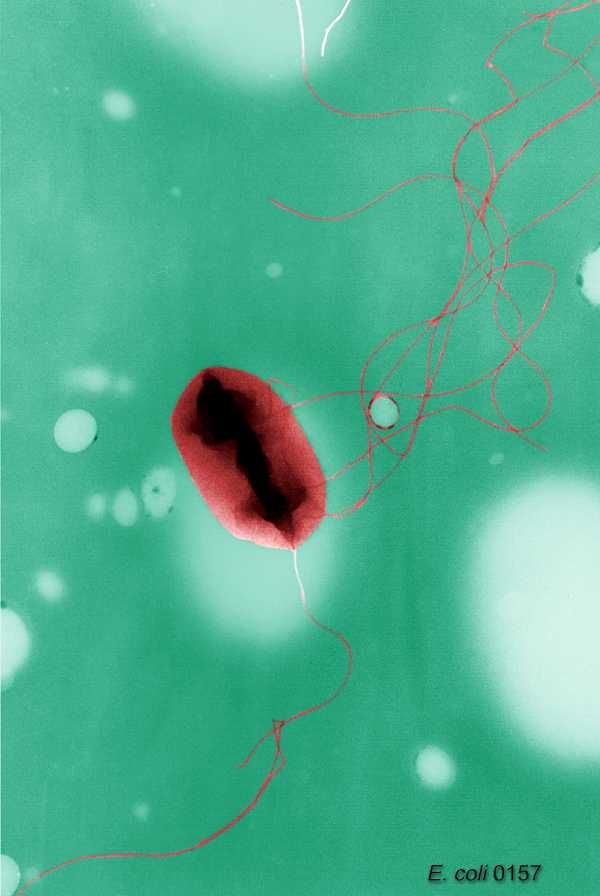
Image source: Wikipedia/Wikimedia
| Ecology, Host, and Life Cycle | |
|---|---|
| Oxygen requirements | Facultative anaerobe |
| Optimal temperature | 37 |
| Temperature range | Mesophilic |
| Habitat | HostAssociated |
| Biotic relationship | Free living |
| Host(s) | Not Available |
| Cell arrangement | Pairs - Singles |
| Sporulation | Nonsporulating |
| Energy source | Not Available |
| Pathogenicity | Not Available |
Genome Summary
Escherichia coli APEC O1 plasmid pAPEC-O1-R, complete sequence.
Gene Summary
Adenine Count
Not Available
Thymine Count
Not Available
Guanine Count
Not Available
Cytosine Count
Not Available
Genome Length
Not Available
Protein-coding Genes
Not Available
Non-Coding Genes
Not Available
# of Chromosomes/Plasmids
3
Genes
| Name | Locus Tag | UniProt ID | Strand Orientation | Gene Start/End | Protein Molecular Weight |
|---|---|---|---|---|---|
| ynam/ynft family protein | APECO1_RS31400 | P0DPO4 | Negative | 5048620 - 5048733 | 3983.04 |
| Hypothetical protein | APECO1_RS25500 | P58218 | Negative | 5049160 - 5049408 | 9392.14 |
| Attr | Not Available | Not Available | Positive | 5049676 - 5049689 | Not Available |
| thr operon leader peptide | APECO1_RS00005 | Not Available | Positive | 171 - 236 | 2138.61 |
| bifunctional aspartate kinase/homoserine dehydrogenase i | APECO1_RS00010 | P00561 | Positive | 317 - 2779 | 89125.5 |
| homoserine kinase | APECO1_RS00015 | A7ZH92 | Positive | 2781 - 3713 | 33611.6 |
| threonine synthase | APECO1_RS00020 | P00934 | Positive | 3714 - 5000 | 47068.4 |
| duf2502 domain-containing protein | APECO1_RS00030 | P75616 | Positive | 5214 - 5510 | 11610.7 |
| peroxide stress protein yaaa | APECO1_RS00035 | B7M9R9 | Negative | 5550 - 6326 | 29598.6 |
| sodium:alanine symporter family protein | APECO1_RS00040 | P30143 | Negative | 6396 - 7826 | 51682.0 |
Pathways
12514 pathways
Health Effects
No health effects information available for this bacterium.