Kingdom
Pseudomonadati
Phylum
Pseudomonadota
Class
Gammaproteobacteria
Order
Enterobacterales
Family
Enterobacteriaceae
Genus
Escherichia
Description
Taxonomy
| Kingdom | Pseudomonadati |
|---|---|
| Phylum | Pseudomonadota |
| Class | Gammaproteobacteria |
| Order | Enterobacterales |
| Family | Enterobacteriaceae |
| Genus | Escherichia |
| Species | Escherichia coli |
| Strain | O1 |
Profile
| Physiology | |
|---|---|
| Gram staining properties | Negative |
| Shape | Rod |
| Mobility | Yes |
| Flagellar presence | Yes |
| Number of membranes | 2 |

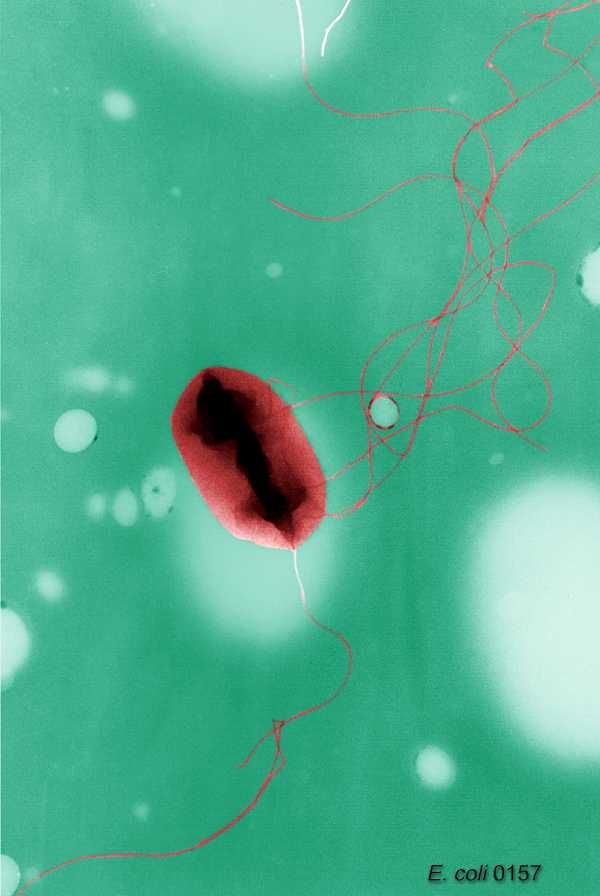
Image source: Wikipedia/Wikimedia
| Ecology, Host, and Life Cycle | |
|---|---|
| Oxygen requirements | Facultative anaerobe |
| Optimal temperature | 37 |
| Temperature range | Mesophilic |
| Habitat | HostAssociated |
| Biotic relationship | Free living |
| Host(s) | Not Available |
| Cell arrangement | Pairs - Singles |
| Sporulation | Nonsporulating |
| Energy source | Not Available |
| Pathogenicity | Not Available |
Genome Summary
Escherichia coli APEC O1 plasmid pAPEC-O1-R, complete sequence.
Gene Summary
Adenine Count
Not Available
Thymine Count
Not Available
Guanine Count
Not Available
Cytosine Count
Not Available
Genome Length
Not Available
Protein-coding Genes
Not Available
Non-Coding Genes
Not Available
# of Chromosomes/Plasmids
3
Genes
| Name | Locus Tag | UniProt ID | Strand Orientation | Gene Start/End | Protein Molecular Weight |
|---|---|---|---|---|---|
| hypothetical protein | APECO1_RS25225 | Not Available | Negative | 5005231 - 5006226 | 37874.8 |
| Valyl-trna synthetase | APECO1_RS32090 | Not Available | Negative | 5006794 - 5007033 | 9335.65 |
| Hypothetical protein | APECO1_RS25240 | P76515 | Negative | 5007414 - 5007776 | 13716.4 |
| Hypothetical protein | APECO1_RS25245 | Not Available | Negative | 5007767 - 5008303 | 20328.7 |
| Hypothetical protein | APECO1_RS25250 | P76513 | Negative | 5008431 - 5009255 | 30444.1 |
| Hypothetical protein | APECO1_RS25255 | P76512 | Negative | 5009321 - 5009683 | 13107.6 |
| Ci repressor | APECO1_RS25260 | Not Available | Negative | 5010406 - 5011098 | 25598.7 |
| Putative antirepressor cro | APECO1_RS25265 | Not Available | Positive | 5011196 - 5011456 | 9736.61 |
| Hypothetical protein | APECO1_RS25270 | P75976 | Positive | 5011449 - 5012000 | 20127.8 |
| Putative antirepressor | APECO1_RS32095 | Not Available | Positive | 5012146 - 5012325 | 7391.81 |
Pathways
12514 pathways
Health Effects
No health effects information available for this bacterium.