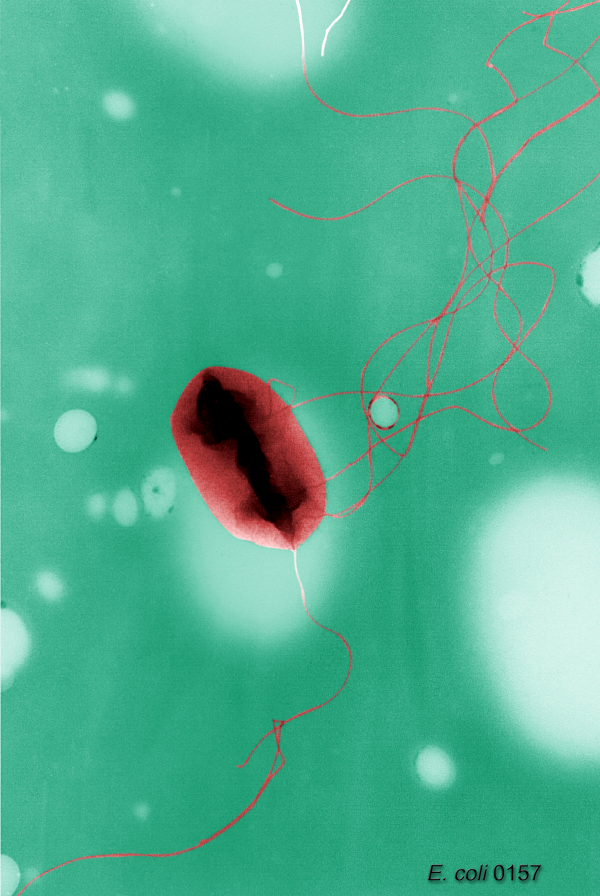
Escherichia coli O103:H2

Gram-negativeRodMotileFacultative anaerobe

Kingdom

Pseudomonadati

Phylum

Pseudomonadota

Class

Gammaproteobacteria

Order

Enterobacterales

Family

Enterobacteriaceae

Genus

Escherichia

Description

Escherichia coli O103:H2 is a Gram-negative, rod-shaped bacterium that typically appears in pairs or as individual cells. This strain thrives optimally at 37.0°C, which coincides with the body temperature of many mammals, suggesting its adaptation as a host-associated microbe. E. coli O103:H2 is characterized as a facultative anaerobe, indicating its ability to grow in both aerobic and anaerobic environments, allowing it to colonize diverse niches within host organisms. As a member of the Escherichia genus, E. coli O103:H2 occupies a significant ecological role in the gastrointestinal tract of warm-blooded animals. Its presence in such habitats underscores the importance of temperature and oxygen availability in shaping microbial communities within hosts. The ability to grow in varying oxygen levels enhances its survival in different microenvironments, such as within the gut where oxygen levels can fluctuate. Understanding the traits of E. coli O103:H2 may provide insights into its ecological interactions within the host microbiome, as well as its potential responses to environmental stresses. While specific pathogenicity or ecological roles of this strain are not detailed here, its adaptability to host-associated environments emphasizes the complexity of microbial life and the importance of studying diverse strains within the Escherichia genus.

Taxonomy

KingdomPseudomonadati
PhylumPseudomonadota
ClassGammaproteobacteria
OrderEnterobacterales
FamilyEnterobacteriaceae
GenusEscherichia
SpeciesEscherichia coli
StrainO103:H2

Profile

Physiology
Gram staining propertiesNegative
ShapeRod
MobilityYes
Flagellar presenceYes
Number of membranes2
Image of Escherichia coli O103:H2
Image source: Wikipedia/Wikimedia
Ecology, Host, and Life Cycle
Oxygen requirementsFacultative anaerobe
Optimal temperature37
Temperature rangeMesophilic
HabitatHostAssociated
Biotic relationshipFree living
Host(s)Not Available
Cell arrangementPairs - Singles
SporulationNot Available
Energy sourceNot Available
PathogenicityNot Available

Genome Summary

Escherichia coli O103:H2


Gene Summary

Adenine Count

18598 bp

Thymine Count

18787 bp

Guanine Count

18862 bp

Cytosine Count

16977 bp

Genome Length

73224 bp

Protein-coding Genes

77 genes

Non-Coding Genes

0 genes

# of Chromosomes/Plasmids

1

Genes

NameLocus TagUniProt IDStrand OrientationGene Start/EndProtein Molecular Weight
glycosyltransferase family 4 proteinCCU04_RS28170Not AvailablePositive1 - 110740797.1
phosphoethanolamine transferase cptaCCU04_RS27465Not AvailablePositive1197 - 291866236.1
lauroyl-kdo(2)-lipid iv(a) myristoyltransferaseCCU04_RS27470Not AvailablePositive2992 - 399037841.3
is66-like element accessory protein tnpaCCU04_RS27475Not AvailablePositive4175 - 44359529.49
is3 family transposaseCCU04_RS27485Not AvailableNegative4475 - 568846243.0
colicin m immunity proteinCCU04_RS27490Not AvailablePositive5940 - 629313735.5
integrase core domain-containing proteinCCU04_RS27495Not AvailableNegative6343 - 65045942.07
integrase core domain-containing proteinCCU04_RS28595Not AvailableNegative6504 - 66295016.29
enterohemolysin t1ss abc transporter subunit ehxdCCU04_RS27500Not AvailableNegative6696 - 813554526.8
enterohemolysin t1ss abc transporter permease/atpase ehxbCCU04_RS27505Not AvailableNegative8139 - 1025979780.6

Displaying genes 1 – 10 of 77 in total

Metabolites

4785 records
Metabolite IDMetabolite nameStructureCAS number
BASm0000173(R)-3-Hydroxybutyric acidC4H8O3Chemical structure of (R)-3-Hydroxybutyric acid625-72-3
Average104.0473Da
Monoisotopic104.047344122Da
BASm0000217alpha-ribazoleC14H18N2O4Chemical structure of alpha-ribazoleNot available
Average278.3037Da
Monoisotopic278.126657074Da
BASm0000237(R)-4'-phosphopantothenateC9H18NO8PChemical structure of (R)-4'-phosphopantothenateNot available
Average299.2149Da
Monoisotopic299.0770031Da
BASm0000238(R)-3-phenyllactateC9H9O3Chemical structure of (R)-3-phenyllactateNot available
Average165.169Da
Monoisotopic165.05571773Da
BASm00002482,3-dihydroxy-3-methylbutanoateC5H10O4Chemical structure of 2,3-dihydroxy-3-methylbutanoate1756-18-9
Average134.1305Da
Monoisotopic134.0579088Da
BASm00002502,5-didehydro-D-gluconateC6H7O7Chemical structure of 2,5-didehydro-D-gluconate53736-12-2
Average191.1156Da
Monoisotopic191.019177578Da
BASm00002512-dehydropantoateC6H9O4Chemical structure of 2-dehydropantoateNot available
Average145.1333Da
Monoisotopic145.050083776Da
BASm00002532-oxopent-4-enoateC5H5O3Chemical structure of 2-oxopent-4-enoateNot available
Average113.093Da
Monoisotopic113.024417601Da
BASm00002593alpha,12alpha-dihydroxy-7-oxo-5beta-cholanateC24H37O5Chemical structure of 3alpha,12alpha-dihydroxy-7-oxo-5beta-cholanateNot available
Average405.556Da
Monoisotopic405.264647871Da
BASm00002603alpha,7alpha-dihydroxy-12-oxo-5beta-cholanateC24H37O5Chemical structure of 3alpha,7alpha-dihydroxy-12-oxo-5beta-cholanateNot available
Average405.556Da
Monoisotopic405.264647871Da

Displaying 1–10 of 4785 metabolites

Health Effects

No health effects information available for this bacterium.