
Kingdom
Pseudomonadati
Phylum
Pseudomonadota
Class
Gammaproteobacteria
Order
Pseudomonadales
Family
Pseudomonadaceae
Genus
Pseudomonas
Description
Taxonomy
| Kingdom | Pseudomonadati |
|---|---|
| Phylum | Pseudomonadota |
| Class | Gammaproteobacteria |
| Order | Pseudomonadales |
| Family | Pseudomonadaceae |
| Genus | Pseudomonas |
| Species | Pseudomonas savastanoi |
| Strain | pv. nerii |
Profile
| Physiology | |
|---|---|
| Gram staining properties | Negative |
| Shape | Rod |
| Mobility | Yes |
| Flagellar presence | Yes |
| Number of membranes | 2 |
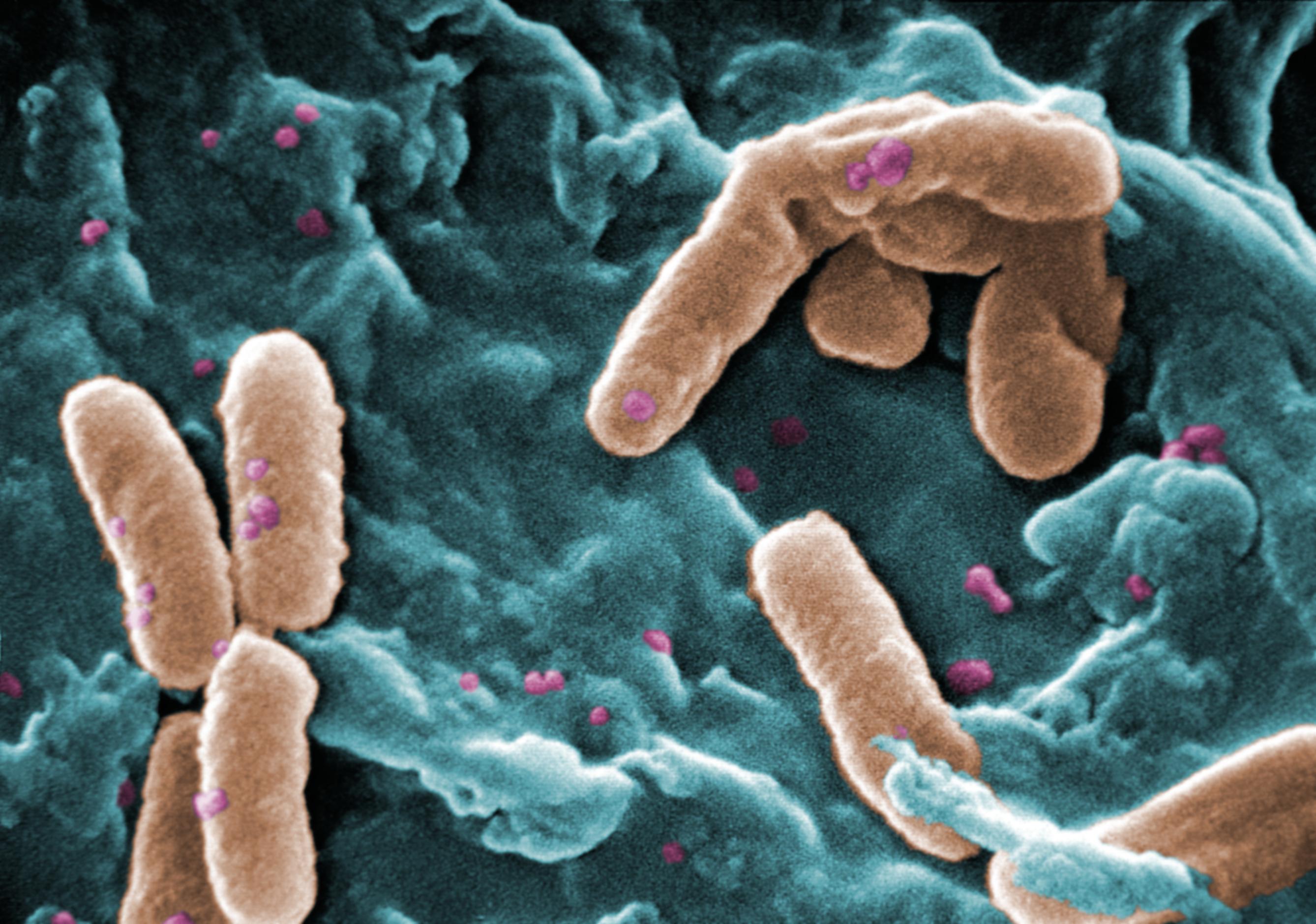
Image source: Wikipedia/Wikimedia
| Ecology, Host, and Life Cycle | |
|---|---|
| Oxygen requirements | Aerobe |
| Optimal temperature | 28 |
| Temperature range | Mesophilic |
| Habitat | Multiple |
| Biotic relationship | Free living |
| Host(s) | Nerium oleander |
| Cell arrangement | Singles |
| Sporulation | Not Available |
| Energy source | Heterotroph |
| Pathogenicity | Not Available |
Gene Summary
Adenine Count
1209283 bp
Thymine Count
1219036 bp
Guanine Count
1693618 bp
Cytosine Count
1677464 bp
Genome Length
5829603 bp
Protein-coding Genes
5304 genes
Non-Coding Genes
79 genes
# of Chromosomes/Plasmids
1
Genes
| Name | Locus Tag | UniProt ID | Strand Orientation | Gene Start/End | Protein Molecular Weight |
|---|---|---|---|---|---|
| ammonium transporter | ALP28_00706 | Not Available | Positive | 1726371 - 1727696 | 45749.9 |
| putative gluconolactonase/ major royal jelly protein | ALP28_100355 | Not Available | Positive | 1727752 - 1728912 | 41758.4 |
| transcriptional regulator, lysr family | ALP28_04185 | Not Available | Positive | 1728926 - 1729807 | 32060.6 |
| putative transposase | ALP28_101910 | Not Available | Negative | 1729864 - 1731411 | 58027.8 |
| isppu14, transposase orf2 | ALP28_04186 | Not Available | Negative | 1731493 - 1731828 | 12291.2 |
| hypothetical protein | ALP28_04187 | Not Available | Negative | 1731825 - 1732157 | 11996.7 |
| hypothetical protein | ALP28_01370 | Not Available | Positive | 1732216 - 1732464 | 9416.38 |
| hypothetical protein | ALP28_01371 | Not Available | Negative | 1732579 - 1732722 | 5384.48 |
| hypothetical protein | ALP28_01372 | Not Available | Negative | 1732793 - 1732987 | 7464.23 |
| relaxase | ALP28_100744 | Not Available | Negative | 1733097 - 1735240 | 78179.8 |
Pathways
0 pathways
No pathways found
No metabolic pathways have been associated with this bacterium yet.


