Kingdom
Pseudomonadati
Phylum
Pseudomonadota
Class
Gammaproteobacteria
Order
Pseudomonadales
Family
Pseudomonadaceae
Genus
Pseudomonas
Description
Taxonomy
| Kingdom | Pseudomonadati |
|---|---|
| Phylum | Pseudomonadota |
| Class | Gammaproteobacteria |
| Order | Pseudomonadales |
| Family | Pseudomonadaceae |
| Genus | Pseudomonas |
| Species | Pseudomonas savastanoi |
| Strain | pv. savastanoi |
Profile
| Physiology | |
|---|---|
| Gram staining properties | Negative |
| Shape | Rod |
| Mobility | Yes |
| Flagellar presence | Yes |
| Number of membranes | 2 |

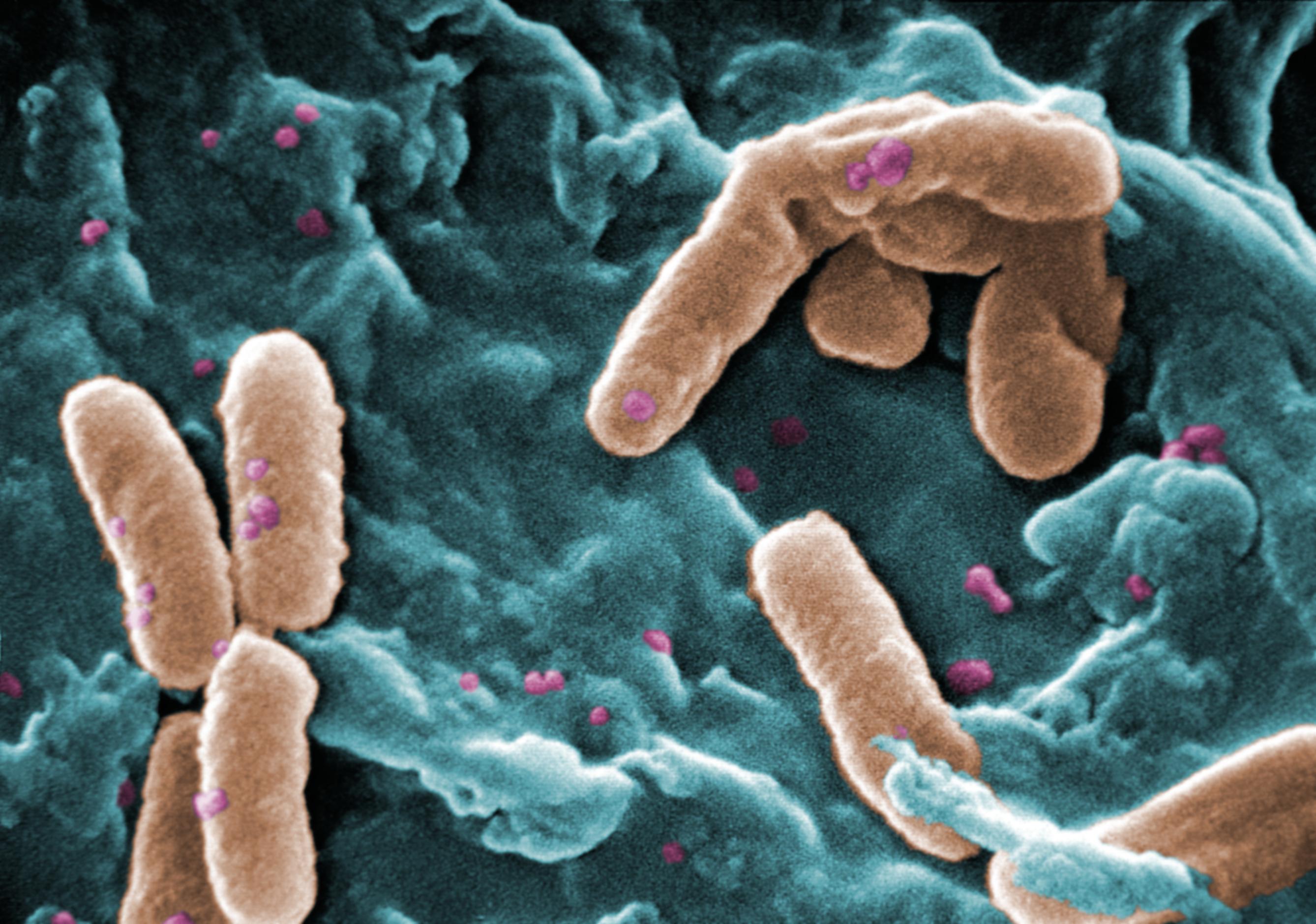
Image source: Wikipedia/Wikimedia
| Ecology, Host, and Life Cycle | |
|---|---|
| Oxygen requirements | Aerobe |
| Optimal temperature | 28 |
| Temperature range | Mesophilic |
| Habitat | Multiple |
| Biotic relationship | Free living |
| Host(s) | Olea europaea, Punica granatum, Fraxinus excelsior |
| Cell arrangement | Singles |
| Sporulation | Not Available |
| Energy source | Heterotroph |
| Pathogenicity | Not Available |
Gene Summary
Adenine Count
1220995 bp
Thymine Count
1215525 bp
Guanine Count
1683339 bp
Cytosine Count
1689136 bp
Genome Length
5833403 bp
Protein-coding Genes
5318 genes
Non-Coding Genes
163 genes
# of Chromosomes/Plasmids
1
Genes
| Name | Locus Tag | UniProt ID | Strand Orientation | Gene Start/End | Protein Molecular Weight |
|---|---|---|---|---|---|
| glycine betaine/carnitine/choline abc transporter atp-binding protein | ALQ55_01578 | Not Available | Negative | 2371183 - 2371350 | 6068.19 |
| hypothetical protein | ALQ55_100779 | Not Available | Negative | 2371477 - 2371620 | 5409.1 |
| l-proline/glycine/betaine abc transport atp-binding protein | ALQ55_04584 | Not Available | Negative | 2371904 - 2373112 | 44864.9 |
| glycine betaine/carnitine/choline abc transporter | ALQ55_01580 | Not Available | Negative | 2373070 - 2373723 | 22858.4 |
| glycine betaine/l-proline abc transporter, periplasmic substrate-binding protein | ALQ55_01581 | Not Available | Negative | 2373737 - 2374630 | 33260.9 |
| glycine betaine/carnitine/choline abc transporter | ALQ55_01582 | Not Available | Negative | 2374645 - 2375358 | 24802.6 |
| hypothetical protein | ALQ55_101024 | Not Available | Negative | 2375370 - 2375711 | 12065.6 |
| peptide chain release factor 3 | ALQ55_01583 | Not Available | Positive | 2375703 - 2377286 | 59693.4 |
| hypothetical protein | ALQ55_102838 | Not Available | Positive | 2377362 - 2377475 | 4147.91 |
| hypothetical protein | ALQ55_01584 | Not Available | Positive | 2377543 - 2377785 | 9300.25 |
Pathways
0 pathways
No pathways found
No metabolic pathways have been associated with this bacterium yet.
Health Effects
| Health Condition | Relation | Reference |
|---|---|---|
| Olive knot | Causes | PMC10420344 |
| Disease | Causes | PMC10420344 |
| Olive knot disease | Causes | PMC6638699 |
| Olive knot disease | Causes | PMC8435235 |
| Olive knot disease | Causes | PMC8815115 |
| Olive knot disease | Causes | PMC2901321 |