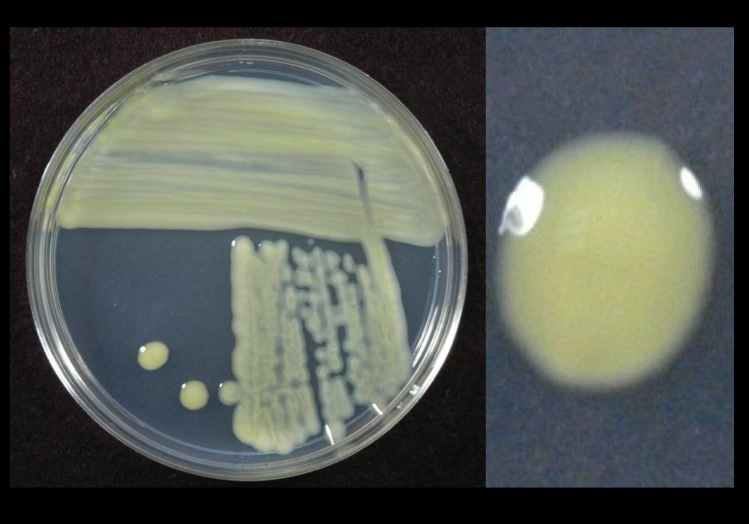
Xanthomonas oryzae pv. oryzae PXO99A

Gram-negativeRodMotileAerobe

Kingdom

Pseudomonadati

Phylum

Pseudomonadota

Class

Gammaproteobacteria

Order

Lysobacterales

Family

Lysobacteraceae

Genus

Xanthomonas

Description

The Xanthomonadaceae are a family of Gram negative bacteria belonging to the order Xanthomonadales in the gammaproteobacteria. They are typically characterized as environmental organisms and are found in soil and water, as well as plant tissues. Many Xanthomonadaceae, especially species from the genera Xanthomonas and Xylella, cause plant diseases. Only one, Stenotrophomonas maltophilia, has isolates known to be opportunistic human pathogens.Xanthomonas oryzae is a Gram-negative bacterium and is the causative agent of bacterial blight on rice. Bacterial blight is a major disease in rice producing countries where high-yielding rice cultivars are often highly susceptible to it. It is a vascular disease resulting in tannish-gray to white lesions along the leaf veins. In severely infested fields, bacterial blight can cause yield losses up to 50%. When it infects at the seedling stage, it causes a syndrome known as kresek, which can lead to nearly complete crop loss.PXO99A is a 5-azacytidine-resistant derivative of PXO99, which was isolated in the Philippines. Genotypically PXO99 is more similar to isolates from Nepal and India than to other Philippine isolates. In contrast to other fully-sequenced X.oryzae pv. oryzae strains MAFF and KACC, PXO99A is virulent toward a large number of rice varieties representing diverse genetic sources of resistance. Due to its amenability to genetic analysis, and its relatively broad cultivar specificity, PXO99A has been the focus of numerous studies of the molecular basis of bacterial blight and blight resistance (adapted from PubMed 18452608). (EBI Integr8)

Taxonomy

KingdomPseudomonadati
PhylumPseudomonadota
ClassGammaproteobacteria
OrderLysobacterales
FamilyLysobacteraceae
GenusXanthomonas
SpeciesXanthomonas oryzae
StrainPXO99A

Profile

Physiology
Gram staining propertiesNegative
ShapeRod
MobilityYes
Flagellar presenceYes
Number of membranes2
Image of Xanthomonas oryzae pv. oryzae PXO99A
AI-generated image based on bacteria physiology
Ecology, Host, and Life Cycle
Oxygen requirementsAerobe
Optimal temperatureNot Available
Temperature rangeMesophilic
HabitatHostAssociated
Biotic relationshipFree living
Host(s)Not Available
Cell arrangementNot Available
SporulationNot Available
Energy sourceNot Available
PathogenicityNo

Genome Summary

Xanthomonas oryzae pv. oryzae PXO99A, complete sequence.

Gene Summary

Adenine Count

954822 bp

Thymine Count

950334 bp

Guanine Count

1661178 bp

Cytosine Count

1672221 bp

Genome Length

5238555 bp

Protein-coding Genes

4626 genes

Non-Coding Genes

270 genes

# of Chromosomes/Plasmids

1

Genes

NameLocus TagUniProt IDStrand OrientationGene Start/EndProtein Molecular Weight
nadh-quinone oxidoreductase subunit cPXO_RS16455Not AvailableNegative3612688 - 361344027788.5
nuob/complex i 20 kda subunit family proteinPXO_RS16460Not AvailableNegative3613477 - 361403120445.1
nadh-quinone oxidoreductase subunit aPXO_RS16465Not AvailableNegative3614022 - 361437813646.2
Trna-leuNot AvailableNot AvailablePositive3614481 - 3614565Not Available
preprotein translocase subunit secgPXO_RS16475Not AvailableNegative3614615 - 361507615364.6
triose-phosphate isomerasePXO_RS16480Not AvailableNegative3615110 - 361586526152.2
sdr family nad(p)-dependent oxidoreductasePXO_RS16485Not AvailablePositive3615978 - 361677828895.0
Ncrna_class:otherNot AvailableNot AvailablePositive3616970 - 3617046Not Available
group i truncated hemoglobinPXO_RS16490Not AvailableNegative3617129 - 361755716107.5
tonb-dependent receptorPXO_RS27905Not AvailableNegative3617557 - 36176553420.01

Displaying genes 3351 – 3360 of 4896 in total

Metabolites

1812 records
Metabolite IDMetabolite nameStructureCAS number
BASm0000237(R)-4'-phosphopantothenateC9H18NO8PChemical structure of (R)-4'-phosphopantothenateNot available
Average299.2149Da
Monoisotopic299.0770031Da
BASm00002502,5-didehydro-D-gluconateC6H7O7Chemical structure of 2,5-didehydro-D-gluconate53736-12-2
Average191.1156Da
Monoisotopic191.019177578Da
BASm00002512-dehydropantoateC6H9O4Chemical structure of 2-dehydropantoateNot available
Average145.1333Da
Monoisotopic145.050083776Da
BASm00002532-oxopent-4-enoateC5H5O3Chemical structure of 2-oxopent-4-enoateNot available
Average113.093Da
Monoisotopic113.024417601Da
BASm00002603alpha,7alpha-dihydroxy-12-oxo-5beta-cholanateC24H37O5Chemical structure of 3alpha,7alpha-dihydroxy-12-oxo-5beta-cholanateNot available
Average405.556Da
Monoisotopic405.264647871Da
BASm0000274aldehydo-D-galacturonateC6H9O7Chemical structure of aldehydo-D-galacturonateNot available
Average193.132Da
Monoisotopic193.0353762Da
BASm0000377(S)-malateC4H4O5Chemical structure of (S)-malateNot available
Average132.0716Da
Monoisotopic132.005873238Da
BASm0000387(6R)-5,10-methylene-5,6,7,8-tetrahydrofolateC20H21N7O6Chemical structure of (6R)-5,10-methylene-5,6,7,8-tetrahydrofolateNot available
Average455.432Da
Monoisotopic455.1564286Da
BASm00004283-oxoadipateC6H6O5Chemical structure of 3-oxoadipateNot available
Average158.11Da
Monoisotopic158.022620453Da
BASm0000553biphenyl-2,3-diolC12H10O2Chemical structure of biphenyl-2,3-diolNot available
Average186.2066Da
Monoisotopic186.0680796Da

Displaying 1–10 of 1812 metabolites

Health Effects

No health effects information available for this bacterium.