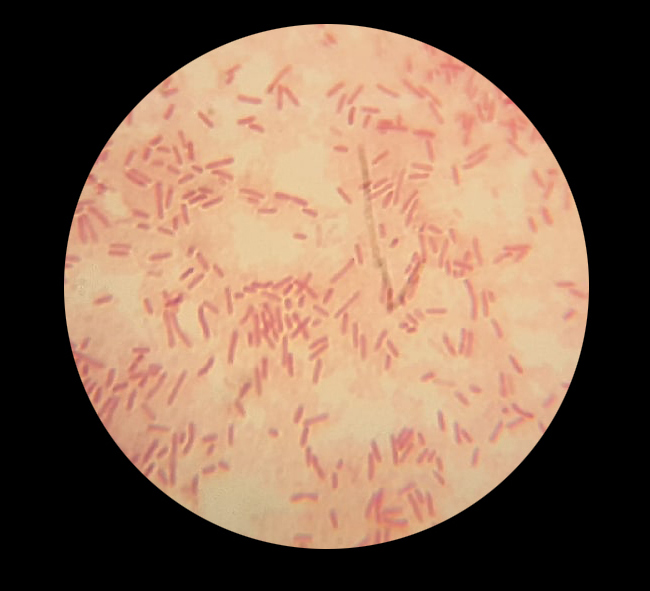
Salmonella enterica subsp. enterica serovar Choleraesuis str. SC-B67

Gram-negativeSpirillaNon-motileFacultative anaerobe

Kingdom

Pseudomonadati

Phylum

Pseudomonadota

Class

Gammaproteobacteria

Order

Enterobacterales

Family

Enterobacteriaceae

Genus

Salmonella

Description

Salmonella enterica subsp. enterica serovar Choleraesuis str. SC-B67 is a Gram-negative, rod-shaped bacterium that thrives in a temperature range of 35-37°C, making it a mesophilic organism. This microbe is classified as a chemoheterotroph, deriving its energy from organic compounds, and is known to be a facultative anaerobe, allowing it to survive in both aerobic and anaerobic environments.Being a member of the Salmonella enterica species, Choleraesuis has a significant role in human and animal health, as it is primarily associated with gastrointestinal infections. This bacterium can inhabit various body sites, including the intestines of warm-blooded animals, particularly pigs, which serve as common reservoirs. It can also be found in the environment, including contaminated water and soil, contributing to its transmission through food sources. The pathogenicity of Salmonella enterica serovar Choleraesuis is of particular concern; it is known to cause serious infections, leading to symptoms such as diarrhea, fever, and abdominal cramps. In severe cases, it can result in bloodstream infections, especially in immunocompromised individuals. This strain has shown resilience to a range of antimicrobial treatments, posing significant challenges in public health and veterinary contexts.Furthermore, recent studies have highlighted the potential of Choleraesuis to adapt to various host conditions, suggesting a complex interaction with the host's immune response. Understanding its genetic makeup and virulence factors is crucial for developing effective vaccines and treatments against infections it causes, making it a subject of ongoing research in microbiology and infectious disease management.

Taxonomy

KingdomPseudomonadati
PhylumPseudomonadota
ClassGammaproteobacteria
OrderEnterobacterales
FamilyEnterobacteriaceae
GenusSalmonella
SpeciesSalmonella enterica
Strainsubsp. enterica serovar Choleraesuis SC-B67

Profile

Physiology
Gram staining propertiesNegative
ShapeSpirilla
MobilityNo
Flagellar presenceYes
Number of membranes2
Image of Salmonella enterica subsp. enterica serovar Choleraesuis str. SC-B67
Image source: Wikipedia/Wikimedia
Ecology, Host, and Life Cycle
Oxygen requirementsFacultative anaerobe
Optimal temperature37
Temperature rangeMesophilic
HabitatHostAssociated
Biotic relationshipFree living
Host(s)Not Available
Cell arrangementChains - Singles
SporulationNot Available
Energy sourceChemoorganotroph
PathogenicityNot Available

Genome Summary

Salmonella enterica subsp. enterica serovar Choleraesuis str. SC-B67


Gene Summary

Adenine Count

1138651 bp

Thymine Count

1136633 bp

Guanine Count

1241357 bp

Cytosine Count

1239059 bp

Genome Length

4755700 bp

Protein-coding Genes

4279 genes

Non-Coding Genes

403 genes

# of Chromosomes/Plasmids

2

Genes

NameLocus TagUniProt IDStrand OrientationGene Start/EndProtein Molecular Weight
EndonucleaseSCH_RS01730Not AvailableNegative377698 - 37832424127.7
Hypothetical proteinSCH_RS24585Not AvailableNegative378311 - 3784876875.53
Abc2SCH_RS01735Not AvailableNegative378498 - 37879111627.7
EndonucleaseSCH_RS01740Not AvailableNegative378809 - 37935720670.4
Ssdna binding proteinSCH_RS01745Not AvailableNegative379366 - 37987218761.1
Putative dna-binding protein erfSCH_RS01750Not AvailableNegative379873 - 38058026738.3
Arf proteinSCH_RS27330Not AvailableNegative380577 - 3807205532.26
Kil proteinSCH_RS01760Not AvailableNegative380710 - 3808987143.34
C3SCH_RS24590Not AvailableNegative380879 - 3810375761.11
Hypothetical proteinSCH_RS01765Not AvailableNegative381244 - 3814447837.84

Displaying genes 11 – 20 of 4850 in total

Pathways

0 pathways

No pathways found

No metabolic pathways have been associated with this bacterium yet.

Metabolites

248 records
Metabolite IDMetabolite nameStructureCAS number
BASm0000217alpha-ribazoleC14H18N2O4Chemical structure of alpha-ribazoleNot available
Average278.3037Da
Monoisotopic278.126657074Da
BASm0000237(R)-4'-phosphopantothenateC9H18NO8PChemical structure of (R)-4'-phosphopantothenateNot available
Average299.2149Da
Monoisotopic299.0770031Da
BASm00002512-dehydropantoateC6H9O4Chemical structure of 2-dehydropantoateNot available
Average145.1333Da
Monoisotopic145.050083776Da
BASm0000274aldehydo-D-galacturonateC6H9O7Chemical structure of aldehydo-D-galacturonateNot available
Average193.132Da
Monoisotopic193.0353762Da
BASm0000377(S)-malateC4H4O5Chemical structure of (S)-malateNot available
Average132.0716Da
Monoisotopic132.005873238Da
BASm0000387(6R)-5,10-methylene-5,6,7,8-tetrahydrofolateC20H21N7O6Chemical structure of (6R)-5,10-methylene-5,6,7,8-tetrahydrofolateNot available
Average455.432Da
Monoisotopic455.1564286Da
BASm0000401(S)-2-succinylamino-6-oxoheptanedioateC11H12NO8Chemical structure of (S)-2-succinylamino-6-oxoheptanedioateNot available
Average286.218Da
Monoisotopic286.0579371Da
BASm0000503L-rhamnoseC6H12O5Chemical structure of L-rhamnose3615-41-6
Average164.1565Da
Monoisotopic164.0684735Da
BASm00008763-hydroxypyruvateC3H3O4Chemical structure of 3-hydroxypyruvateNot available
Average103.054Da
Monoisotopic103.003682157Da
BASm0000893crotonobetaineC7H13NO2Chemical structure of crotonobetaine927-89-9
Average143.1836Da
Monoisotopic143.0946287Da

Displaying 1–10 of 248 metabolites

Health Effects

No health effects information available for this bacterium.