Kingdom
Pseudomonadati
Phylum
Spirochaetota
Class
Leptospiria
Order
Leptospirales
Family
Leptospiraceae
Genus
Leptospira
Description
Taxonomy
| Kingdom | Pseudomonadati |
|---|---|
| Phylum | Spirochaetota |
| Class | Leptospiria |
| Order | Leptospirales |
| Family | Leptospiraceae |
| Genus | Leptospira |
| Species | Leptospira borgpetersenii |
| Strain | serovar Ballum 56604 |
Profile
| Physiology | |
|---|---|
| Gram staining properties | Negative |
| Shape | Spirilla |
| Mobility | No |
| Flagellar presence | Yes |
| Number of membranes | 2 |

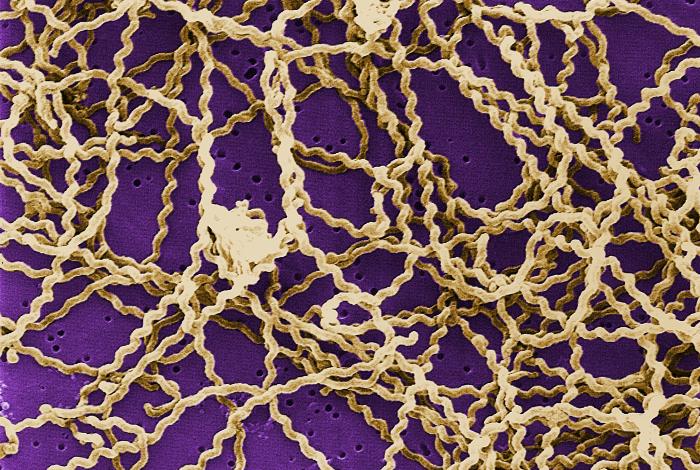
Image source: Wikipedia/Wikimedia
| Ecology, Host, and Life Cycle | |
|---|---|
| Oxygen requirements | Aerobe |
| Optimal temperature | Not Available |
| Temperature range | Mesophilic |
| Habitat | HostAssociated |
| Biotic relationship | Free living |
| Host(s) | Not Available |
| Cell arrangement | Not Available |
| Sporulation | Nonsporulating |
| Energy source | Not Available |
| Pathogenicity | Not Available |
Genome Summary
Leptospira borgpetersenii serovar Ballum strain 56604 plasmid
Gene Summary
Adenine Count
20553 bp
Thymine Count
18032 bp
Guanine Count
13102 bp
Cytosine Count
13748 bp
Genome Length
65435 bp
Protein-coding Genes
56 genes
Non-Coding Genes
1 genes
# of Chromosomes/Plasmids
4
Genes
| Name | Locus Tag | UniProt ID | Strand Orientation | Gene Start/End | Protein Molecular Weight |
|---|---|---|---|---|---|
| atp-dependent dna helicase recq | LBBP_RS12660 | Not Available | Negative | 2813148 - 2814596 | 55874.9 |
| exodeoxyribonuclease v subunit gamma | LBBP_RS12665 | Not Available | Positive | 2814701 - 2818096 | 131628.0 |
| exodeoxyribonuclease v subunit beta | LBBP_RS12670 | Not Available | Positive | 2818093 - 2821257 | 123036.0 |
| exodeoxyribonuclease v subunit alpha | LBBP_RS12675 | Not Available | Positive | 2821257 - 2823104 | 70264.7 |
| abc transporter atp-binding protein | LBBP_RS12680 | Not Available | Positive | 2823446 - 2824381 | 34751.5 |
| abc transporter permease | LBBP_RS12685 | Not Available | Positive | 2824378 - 2825139 | 28100.4 |
| sdr family nad(p)-dependent oxidoreductase | LBBP_RS12690 | Not Available | Positive | 2825241 - 2826116 | 32529.4 |
| hypothetical protein | LBBP_RS22045 | Not Available | Negative | 2826302 - 2826595 | 11479.9 |
| comec/rec2 family competence protein | LBBP_RS12700 | Not Available | Positive | 2826582 - 2828501 | 74162.1 |
| 16s rrna (adenine(1518)-n(6)/adenine(1519)-n(6))- dimethyltransferase rsma | LBBP_RS12705 | Not Available | Positive | 2828464 - 2829369 | 34165.7 |
Pathways
0 pathways
No pathways found
No metabolic pathways have been associated with this bacterium yet.
Health Effects
No health effects information available for this bacterium.