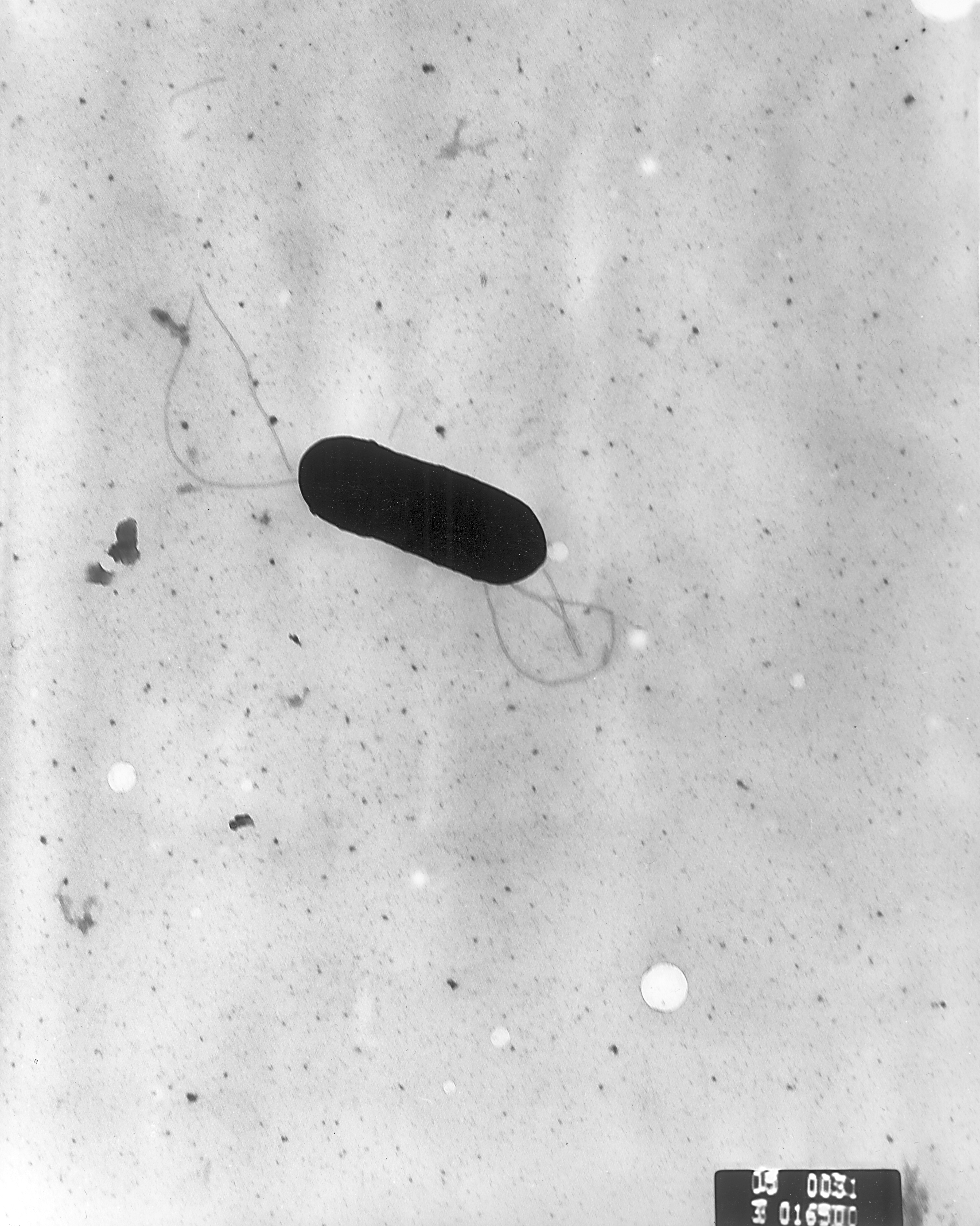
Listeria innocua Clip11262

Gram-positiveRodMotileFacultative anaerobe

Kingdom

Bacillati

Phylum

Bacillota

Class

Bacilli

Order

Caryophanales

Family

Listeriaceae

Genus

Listeria

Description

Listeria are mainly soil bacteria, though as a pathogen they are food-borne. They are intracellular pathogens that use actin filaments within the host cell for their motility. L. monocytogenes is the causative agent of listeriosis.The genomes of both Listeria monocytogenes and Listeria innocua have been sequenced. The genome of Listeria monocytogenes is 2,944,528 bp long with 2853 open reading frames and a G+C content of 39%. The genome of Listeria innocua is 3,011,209 bp long with 2973 open reading frames and a G+C content of 37%. Surprisingly, many encoded proteins are similar to those of the soil bacterium Bacillus subtilis. L. monocytogenes has a single circular chromosome, while L. innocua contains an additional plasmid of 81,905 bp.The ability of Listeria to inhabit a wide range of environments coincides with the presence of 331 genes encoding different transport proteins, comprising 11.6% of the total gene compliment of L. monocytogenes. Listeria also has an extensive regulatory repertoire occupying 7.3% of the total genome.Listeria are non spore-forming, nonbranching, Gram-positive rods that occur individually or form short chains. Listeria are able to produce adenosine triphosphate thorugh a complete respiratory chain, and have several fermentation pathways. This coincides with their lifestyle as microaerophilic, facultative anaerobes. Listeria are intecellular pathogens that use host-produced actin filaments for motility within the host cell. The bacteria propel themselves through the cytoplasm of an infected cell using a tail composed of actin.Listeria colonies are small, smooth and blueish-gray. Their optimum growth temperature is between 30 and 37 degrees Celsius, but growth can occur at temperatures as low as 4 degrees Celsius, but the generation time is longer. Listeria is widely distributed throughout the environment, inhabiting soil, decaying vegetable matter, sewage, water, animal feed, fresh and frozen poultry, processed meats, raw milk, cheese, and humans. But primary habitats are considered to be soil and decaying vegetable matter, living as a saprophyte. Listeria can also survive in many extreme conditions that it encounters during its lifespan, such as high salt concentrations, high pH, and high temperature. Both pathogenic and innocuous forms of listeria have this ability. Listeria spp. also form biofilms, which allow them to attach to solid surfaces where they proliferate and become extremely difficult to remove.Listeria monocytogenes is the etiological agent of listeriosis. L. monocytogenes is a food-borne pathogen, which, as mentioned earlier, can survive normal refrigeration processes. It can cause severe disease in immunocompromised individuals, and pregnant women. Listeria is an intracellular pathogen where they co-opt the cell's machinery, and travel through the blood stream, once they make it through the gastrointestinal tract. After ingestion of contaminated food, Listeria migrates from the intestinal lumen to the central nervous system, and the fetoplacental unit. The clinical manifestations of listeriosis include meningitis, meningoencephalitis, septicemia, abortion, perinatal infection, and gastroenteritis. Listeria is capable of infecting macrophages, which aquire the pathogen through phagocytosis, or epithelial cells, which are infected when listeria induces cytoskeletal changes and plasma membrane extensions. (From http://microbewiki.kenyon.edu/index.php/Listeria) (MicrobeWiki: Listeria)

Taxonomy

KingdomBacillati
PhylumBacillota
ClassBacilli
OrderCaryophanales
FamilyListeriaceae
GenusListeria
SpeciesListeria innocua
StrainClip11262

Profile

Physiology
Gram staining propertiesPositive
ShapeRod
MobilityYes
Flagellar presenceYes
Number of membranes1
Image of Listeria innocua Clip11262
Ecology, Host, and Life Cycle
Oxygen requirementsFacultative anaerobe
Optimal temperature30
Temperature rangeMesophilic
HabitatMultiple
Biotic relationshipFree living
Host(s)Not Available
Cell arrangementChains - Singles
SporulationNonsporulating
Energy sourceChemoorganotroph
PathogenicityNo

Genome Summary

Listeria innocua Clip11262

Accession NumberNC_003212.1

Gene Summary

Adenine Count

941651 bp

Thymine Count

942192 bp

Guanine Count

559189 bp

Cytosine Count

568176 bp

Genome Length

3011208 bp

Protein-coding Genes

2706 genes

Non-Coding Genes

435 genes

# of Chromosomes/Plasmids

2

Genes

NameLocus TagUniProtStrandCoordinatesMolecular Weight
AttlNot AvailableNot Available+76060 - 76107Not Available
IntegraseLIN_RS00370A8F7B4-76209 - 7741146101.6
hypothetical proteinLIN_RS00375Not Available-77476 - 7812623658.0
hypothetical proteinLIN_RS16215Not Available-78181 - 783486480.95
Gp33LIN_RS00385P96631-78505 - 7898118201.2
Xre family transcriptional regulatorLIN_RS00390Not Available+79154 - 793577702.31
Gp37LIN_RS00395Not Available+79378 - 796449865.09
Hypothetical proteinLIN_RS00400Not Available+79869 - 800637290.77
Gp40LIN_RS00405Not Available+80075 - 803118864.56
Hypothetical proteinLIN_RS00410Not Available+80308 - 8058910670.0

Displaying genes 1 – 10 of 3227 in total

Pathways

0 pathways

No pathways found

No metabolic pathways have been associated with this bacterium yet.

Metabolites

186 records
Metabolite IDMetabolite nameStructureCAS number
BASm0000217alpha-ribazoleC14H18N2O4Chemical structure of alpha-ribazoleNot available
Average278.3037Da
Monoisotopic278.126657074Da
BASm0000237(R)-4'-phosphopantothenateC9H18NO8PChemical structure of (R)-4'-phosphopantothenateNot available
Average299.2149Da
Monoisotopic299.0770031Da
BASm00002512-dehydropantoateC6H9O4Chemical structure of 2-dehydropantoateNot available
Average145.1333Da
Monoisotopic145.050083776Da
BASm0000377(S)-malateC4H4O5Chemical structure of (S)-malateNot available
Average132.0716Da
Monoisotopic132.005873238Da
BASm0000387(6R)-5,10-methylene-5,6,7,8-tetrahydrofolateC20H21N7O6Chemical structure of (6R)-5,10-methylene-5,6,7,8-tetrahydrofolateNot available
Average455.432Da
Monoisotopic455.1564286Da
BASm0000400(R)-10-hydroxyoctadecanoateC18H35O3Chemical structure of (R)-10-hydroxyoctadecanoateNot available
Average299.476Da
Monoisotopic299.2591686Da
BASm0000503L-rhamnoseC6H12O5Chemical structure of L-rhamnose3615-41-6
Average164.1565Da
Monoisotopic164.0684735Da
BASm00005275-oxopentanoateC5H7O3Chemical structure of 5-oxopentanoateNot available
Average115.109Da
Monoisotopic115.040067665Da
BASm00006985-dehydro-2-deoxy-D-gluconateC6H9O6Chemical structure of 5-dehydro-2-deoxy-D-gluconateNot available
Average177.133Da
Monoisotopic177.04046159Da
BASm00007164-methylsulfanyl-2-oxobutanoateC5H7O3SChemical structure of 4-methylsulfanyl-2-oxobutanoateNot available
Average147.17Da
Monoisotopic147.012138839Da

Displaying 1–10 of 186 metabolites