Kingdom
Pseudomonadati
Phylum
Pseudomonadota
Class
Gammaproteobacteria
Order
Enterobacterales
Family
Enterobacteriaceae
Genus
Salmonella
Description
Taxonomy
| Kingdom | Pseudomonadati |
|---|---|
| Phylum | Pseudomonadota |
| Class | Gammaproteobacteria |
| Order | Enterobacterales |
| Family | Enterobacteriaceae |
| Genus | Salmonella |
| Species | Salmonella enterica |
| Strain | subsp. enterica serovar Paratyphi B var. L tartrate + |
Profile
| Physiology | |
|---|---|
| Gram staining properties | Negative |
| Shape | Spirilla |
| Mobility | No |
| Flagellar presence | Yes |
| Number of membranes | 2 |

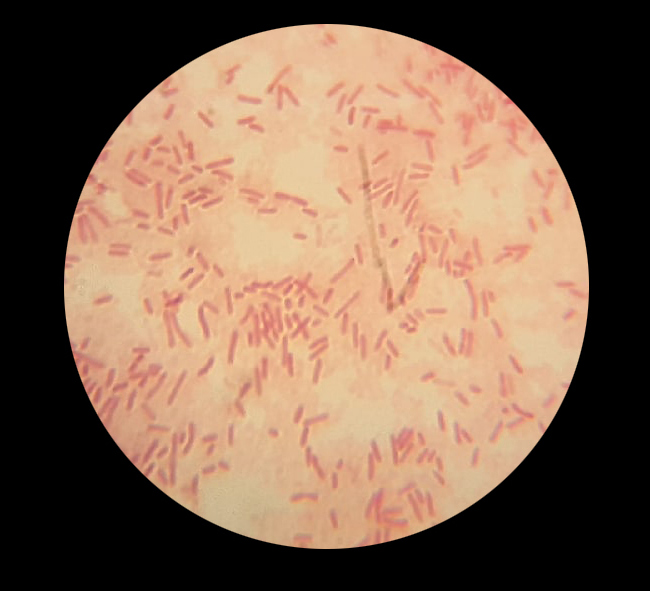
Image source: Wikipedia/Wikimedia
| Ecology, Host, and Life Cycle | |
|---|---|
| Oxygen requirements | Microaerophilic |
| Optimal temperature | 37 |
| Temperature range | Mesophilic |
| Habitat | HostAssociated |
| Biotic relationship | Free living |
| Host(s) | Not Available |
| Cell arrangement | Chains - Singles |
| Sporulation | Not Available |
| Energy source | Chemoorganotroph |
| Pathogenicity | Not Available |
Gene Summary
Adenine Count
1140977 bp
Thymine Count
1137426 bp
Guanine Count
1231524 bp
Cytosine Count
1247211 bp
Genome Length
4757138 bp
Protein-coding Genes
4427 genes
Non-Coding Genes
225 genes
# of Chromosomes/Plasmids
1
Genes
| Name | Locus Tag | UniProt ID | Strand Orientation | Gene Start/End | Protein Molecular Weight |
|---|---|---|---|---|---|
| carnitine operon protein caie | E2F06_17265 | Not Available | Positive | 3510247 - 3510843 | 21333.8 |
| carnitine metabolism transcriptional regulator caif | E2F06_17270 | Not Available | Negative | 3510921 - 3511316 | 15410.0 |
| carbamoyl-phosphate synthase large subunit | E2F06_17275 | Not Available | Negative | 3511590 - 3514817 | 118132.0 |
| carbamoyl-phosphate synthase small subunit | E2F06_17280 | Not Available | Negative | 3514836 - 3515984 | 41697.6 |
| 4-hydroxy-tetrahydrodipicolinate reductase | E2F06_17290 | Not Available | Negative | 3516849 - 3517670 | 28879.8 |
| triphosphoribosyl-dephospho-coa synthase citg | E2F06_17295 | Not Available | Negative | 3517850 - 3518758 | 32852.5 |
| citrate lyase holo-[acyl-carrier protein] synthase | E2F06_17300 | Not Available | Negative | 3518736 - 3519287 | 20877.3 |
| citrate lyase subunit alpha | E2F06_17305 | Not Available | Negative | 3519287 - 3520807 | 54553.4 |
| citrate (pro-3s)-lyase subunit beta | E2F06_17310 | Not Available | Negative | 3520818 - 3521687 | 31389.7 |
| citrate lyase acyl carrier protein | E2F06_17315 | Not Available | Negative | 3521684 - 3521977 | 10457.8 |
Pathways
0 pathways
No pathways found
No metabolic pathways have been associated with this bacterium yet.
Health Effects
No health effects information available for this bacterium.