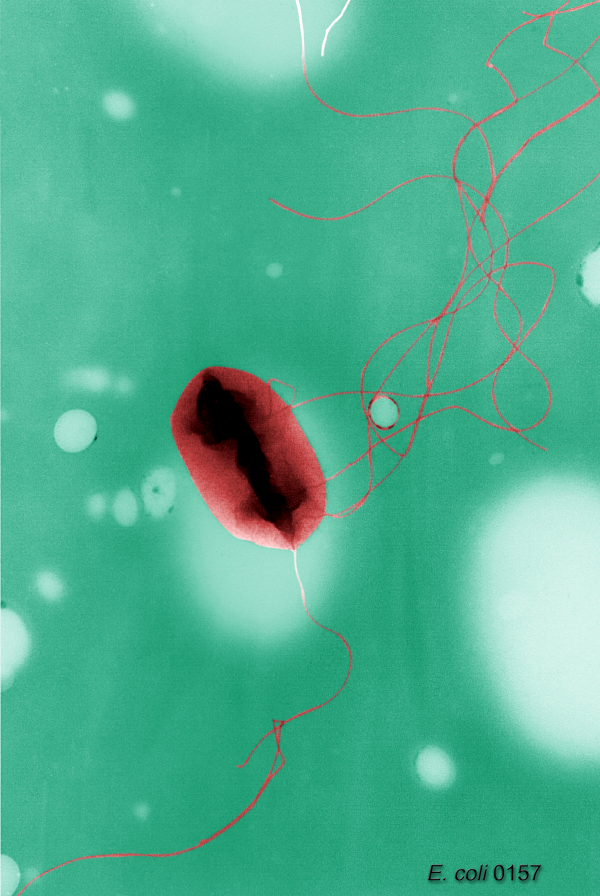
Escherichia coli CFT073

Gram-negativeRodMotileFacultative anaerobe

Kingdom

Pseudomonadati

Phylum

Pseudomonadota

Class

Gammaproteobacteria

Order

Enterobacterales

Family

Enterobacteriaceae

Genus

Escherichia

Description

Escherichia coli CFT073 is a mesophilic microbe, preferring temperatures between 20°C and 40°C, and is classified as a heterotroph, meaning it utilizes organic compounds as its energy source. This microbe is incapable of producing its own food through photosynthesis, relying instead on the breakdown of existing organic matter. Its energy production is primarily attributed to the breakdown of glucose, which is converted into ATP through cellular respiration. Gram-staining of E. coli CFT073 reveals a characteristic Gram-negative cell, consisting of an outer membrane and a thin peptidoglycan layer. The bacterium's shape is rod-shaped, also known as bacillary, with rounded ends. As a ubiquitous microbe, E. coli CFT073 can be found inhabiting various body sites, including the gastrointestinal tract of animals and humans, as well as soil, water, and plant surfaces. In terms of oxygen preference, E. coli CFT073 is a facultative anaerobe, meaning it can grow in both the presence and absence of oxygen. Additionally, it exhibits aerotolerance, allowing it to survive in environments with varying oxygen levels. This adaptability allows the microbe to thrive in a range of ecological niches, from the aerobic environments of the human gut to the anaerobic environments of soil and water. Lastly, it's worth noting that E. coli CFT073 is commonly used as a model organism in scientific research, particularly in the study of urinary tract infections. Its ability to form biofilms on bladder and kidney surfaces makes it a significant pathogen in human health, and its genetic tractability has facilitated the discovery of novel therapeutic targets.

Taxonomy

KingdomPseudomonadati
PhylumPseudomonadota
ClassGammaproteobacteria
OrderEnterobacterales
FamilyEnterobacteriaceae
GenusEscherichia
SpeciesEscherichia coli
StrainCFT073

Profile

Physiology
Gram staining propertiesNegative
ShapeRod
MobilityYes
Flagellar presenceYes
Number of membranes2
Image of Escherichia coli CFT073
Image source: Wikipedia/Wikimedia
Ecology, Host, and Life Cycle
Oxygen requirementsFacultative anaerobe
Optimal temperature37
Temperature rangeMesophilic
HabitatHostAssociated
Biotic relationshipFree living
Host(s)Not Available
Cell arrangementPairs - Singles
SporulationNonsporulating
Energy sourceNot Available
PathogenicityNot Available

Genome Summary

Escherichia coli CFT073, complete sequence.

Gene Summary

Adenine Count

1297551 bp

Thymine Count

1293044 bp

Guanine Count

1319228 bp

Cytosine Count

1321325 bp

Genome Length

5231428 bp

Protein-coding Genes

4748 genes

Non-Coding Genes

349 genes

# of Chromosomes/Plasmids

1

Genes

NameLocus TagUniProt IDStrand OrientationGene Start/EndProtein Molecular Weight
serine endoprotease degqC_RS18905P39099Positive3804224 - 380559147249.0
outer membrane-stress sensor serine endopeptidase degsC_RS18910P0AEE4Positive3805681 - 380674837656.6
malate dehydrogenaseC_RS18915A7ZSD0Negative3806811 - 380774932339.2
transcriptional regulator argrC_RS18920B7UJW9Positive3808184 - 380865417009.5
peroxide/acid stress response protein yhcnC_RS18925P64615Positive3809018 - 38092819196.89
barstar family proteinC_RS18930P64618Negative3809336 - 380960810796.7
p-hydroxybenzoic acid efflux pump subunit aaebC_RS18935Q8FD51Negative3809700 - 381166773596.9
p-hydroxybenzoic acid efflux pump subunit aaeaC_RS18940B7UJX3Negative3811673 - 381260534762.5
p-hydroxybenzoic acid efflux pump operon protein aaexC_RS18945B7UJX4Negative3812613 - 38128167847.01
hth-type transcriptional activator aaerC_RS18950P67664Positive3812999 - 381392834518.1

Displaying genes 3731 – 3740 of 5097 in total

Metabolites

4934 records
Metabolite IDMetabolite nameStructureCAS number
BASm0000173(R)-3-Hydroxybutyric acidC4H8O3Chemical structure of (R)-3-Hydroxybutyric acid625-72-3
Average104.0473Da
Monoisotopic104.047344122Da
BASm0000217alpha-ribazoleC14H18N2O4Chemical structure of alpha-ribazoleNot available
Average278.3037Da
Monoisotopic278.126657074Da
BASm0000237(R)-4'-phosphopantothenateC9H18NO8PChemical structure of (R)-4'-phosphopantothenateNot available
Average299.2149Da
Monoisotopic299.0770031Da
BASm0000238(R)-3-phenyllactateC9H9O3Chemical structure of (R)-3-phenyllactateNot available
Average165.169Da
Monoisotopic165.05571773Da
BASm00002482,3-dihydroxy-3-methylbutanoateC5H10O4Chemical structure of 2,3-dihydroxy-3-methylbutanoate1756-18-9
Average134.1305Da
Monoisotopic134.0579088Da
BASm00002502,5-didehydro-D-gluconateC6H7O7Chemical structure of 2,5-didehydro-D-gluconate53736-12-2
Average191.1156Da
Monoisotopic191.019177578Da
BASm00002512-dehydropantoateC6H9O4Chemical structure of 2-dehydropantoateNot available
Average145.1333Da
Monoisotopic145.050083776Da
BASm00002532-oxopent-4-enoateC5H5O3Chemical structure of 2-oxopent-4-enoateNot available
Average113.093Da
Monoisotopic113.024417601Da
BASm00002593alpha,12alpha-dihydroxy-7-oxo-5beta-cholanateC24H37O5Chemical structure of 3alpha,12alpha-dihydroxy-7-oxo-5beta-cholanateNot available
Average405.556Da
Monoisotopic405.264647871Da
BASm00002603alpha,7alpha-dihydroxy-12-oxo-5beta-cholanateC24H37O5Chemical structure of 3alpha,7alpha-dihydroxy-12-oxo-5beta-cholanateNot available
Average405.556Da
Monoisotopic405.264647871Da

Displaying 1–10 of 4934 metabolites

Health Effects

Health ConditionRelationReference
Urinary tract infectionCausesPMC4922710

Displaying health effects 1 – 1 of 1 in total