Kingdom
Pseudomonadati
Phylum
Pseudomonadota
Class
Gammaproteobacteria
Order
Enterobacterales
Family
Enterobacteriaceae
Genus
Salmonella
Description
Taxonomy
| Kingdom | Pseudomonadati |
|---|---|
| Phylum | Pseudomonadota |
| Class | Gammaproteobacteria |
| Order | Enterobacterales |
| Family | Enterobacteriaceae |
| Genus | Salmonella |
| Species | Salmonella enterica |
| Strain | subsp. enterica serovar Mbandaka |
Profile
| Physiology | |
|---|---|
| Gram staining properties | Negative |
| Shape | Spirilla |
| Mobility | No |
| Flagellar presence | Yes |
| Number of membranes | 2 |

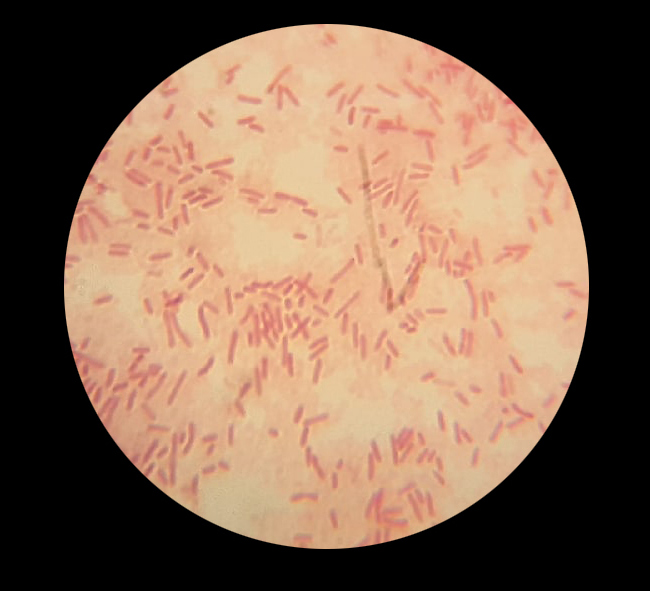
Image source: Wikipedia/Wikimedia
| Ecology, Host, and Life Cycle | |
|---|---|
| Oxygen requirements | Microaerophilic |
| Optimal temperature | 37 |
| Temperature range | Mesophilic |
| Habitat | HostAssociated |
| Biotic relationship | Free living |
| Host(s) | Not Available |
| Cell arrangement | Chains - Singles |
| Sporulation | Not Available |
| Energy source | Chemoorganotroph |
| Pathogenicity | Not Available |
Gene Summary
Adenine Count
1195866 bp
Thymine Count
1200125 bp
Guanine Count
1298679 bp
Cytosine Count
1301185 bp
Genome Length
4995865 bp
Protein-coding Genes
4543 genes
Non-Coding Genes
587 genes
# of Chromosomes/Plasmids
1
Genes
| Name | Locus Tag | UniProt ID | Strand Orientation | Gene Start/End | Protein Molecular Weight |
|---|---|---|---|---|---|
| glutamine--fructose-6-phosphate transaminase (isomerizing) | D5G38_13150 | Not Available | Positive | 2579551 - 2581380 | 66796.2 |
| sgrr family transcriptional regulator | D5G38_13155 | Not Available | Negative | 2581530 - 2583287 | 67424.4 |
| shikimate 5-dehydrogenase | D5G38_13160 | Not Available | Positive | 2583382 - 2584200 | 29573.4 |
| pts fructose transporter subunit iibc | D5G38_13165 | Not Available | Positive | 2584249 - 2585622 | 46901.4 |
| phosphate abc transporter substrate-binding protein psts | D5G38_13170 | Not Available | Positive | 2585788 - 2586828 | 36848.4 |
| phosphate abc transporter permease pstc | D5G38_13175 | Not Available | Positive | 2586964 - 2587923 | 34181.0 |
| phosphate abc transporter permease psta | D5G38_13180 | Not Available | Positive | 2587923 - 2588813 | 32282.8 |
| phosphate abc transporter atp-binding protein | D5G38_13185 | Not Available | Positive | 2588900 - 2589673 | 29017.9 |
| phosphate transport system regulator phou | D5G38_13190 | Not Available | Positive | 2589688 - 2590413 | 27450.2 |
| 6-phosphogluconate phosphatase | D5G38_13195 | Not Available | Negative | 2590508 - 2591173 | 24669.9 |
Pathways
0 pathways
No pathways found
No metabolic pathways have been associated with this bacterium yet.
Health Effects
No health effects information available for this bacterium.