Kingdom
Pseudomonadati
Phylum
Pseudomonadota
Class
Gammaproteobacteria
Order
Enterobacterales
Family
Enterobacteriaceae
Genus
Salmonella
Description
Taxonomy
| Kingdom | Pseudomonadati |
|---|---|
| Phylum | Pseudomonadota |
| Class | Gammaproteobacteria |
| Order | Enterobacterales |
| Family | Enterobacteriaceae |
| Genus | Salmonella |
| Species | Salmonella enterica |
| Strain | subsp. enterica serovar Mbandaka |
Profile
| Physiology | |
|---|---|
| Gram staining properties | Negative |
| Shape | Spirilla |
| Mobility | No |
| Flagellar presence | Yes |
| Number of membranes | 2 |

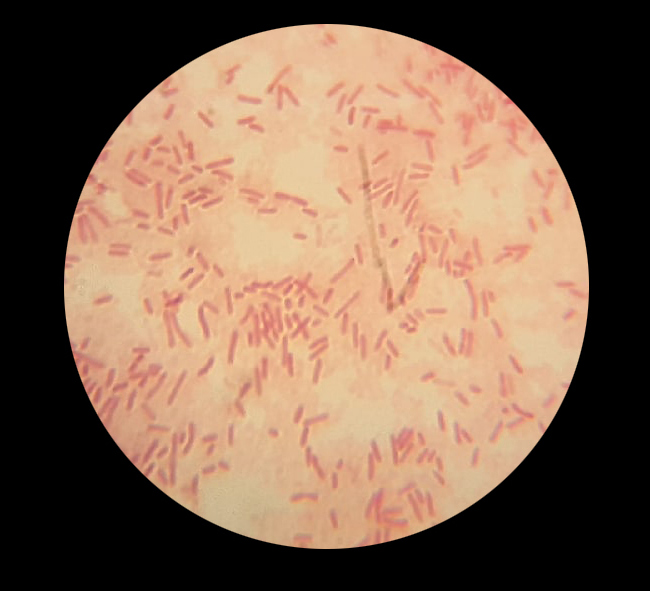
Image source: Wikipedia/Wikimedia
| Ecology, Host, and Life Cycle | |
|---|---|
| Oxygen requirements | Microaerophilic |
| Optimal temperature | 37 |
| Temperature range | Mesophilic |
| Habitat | HostAssociated |
| Biotic relationship | Free living |
| Host(s) | Not Available |
| Cell arrangement | Chains - Singles |
| Sporulation | Not Available |
| Energy source | Chemoorganotroph |
| Pathogenicity | Not Available |
Gene Summary
Adenine Count
1195866 bp
Thymine Count
1200125 bp
Guanine Count
1298679 bp
Cytosine Count
1301185 bp
Genome Length
4995865 bp
Protein-coding Genes
4543 genes
Non-Coding Genes
587 genes
# of Chromosomes/Plasmids
1
Genes
| Name | Locus Tag | UniProt ID | Strand Orientation | Gene Start/End | Protein Molecular Weight |
|---|---|---|---|---|---|
| hydrogenase maturation nickel metallochaperone hypa | D5G38_12360 | Not Available | Negative | 2415910 - 2416251 | 12674.3 |
| atp/gtp-binding protein | D5G38_12365 | Not Available | Negative | 2416264 - 2417151 | 32918.8 |
| hydrogenase-1 operon protein hyaf2 | D5G38_12370 | Not Available | Negative | 2417139 - 2418200 | 39513.1 |
| hydrogenase | D5G38_12375 | Not Available | Negative | 2418218 - 2418628 | 15209.3 |
| hypc/hybg/hupf family hydrogenase formation chaperone | D5G38_12380 | Not Available | Negative | 2418625 - 2418924 | 10767.0 |
| hyad/hybd family hydrogenase maturation endopeptidase | D5G38_12385 | Not Available | Negative | 2418924 - 2419532 | 22086.6 |
| ni/fe-hydrogenase, b-type cytochrome subunit | D5G38_12390 | Not Available | Negative | 2419538 - 2420281 | 29359.8 |
| nickel-dependent hydrogenase large subunit | D5G38_12395 | Not Available | Negative | 2420232 - 2422034 | 66868.7 |
| twin-arginine translocation signal domain-containing protein | D5G38_12400 | Not Available | Negative | 2422037 - 2423140 | 40050.0 |
| linear amide c-n hydrolase | D5G38_12405 | Not Available | Positive | 2423558 - 2424649 | 40239.7 |
Pathways
0 pathways
No pathways found
No metabolic pathways have been associated with this bacterium yet.
Health Effects
No health effects information available for this bacterium.