Kingdom
Pseudomonadati
Phylum
Campylobacterota
Class
Epsilonproteobacteria
Order
Campylobacterales
Family
Helicobacteraceae
Genus
Helicobacter
Description
Taxonomy
| Kingdom | Pseudomonadati |
|---|---|
| Phylum | Campylobacterota |
| Class | Epsilonproteobacteria |
| Order | Campylobacterales |
| Family | Helicobacteraceae |
| Genus | Helicobacter |
| Species | Helicobacter pylori |
| Strain | NCTC 11637 = CCUG 17874 = ATCC 43504 = JCM 12093 |
Profile
| Physiology | |
|---|---|
| Gram staining properties | Negative |
| Shape | Spirilla |
| Mobility | No |
| Flagellar presence | Yes |
| Number of membranes | 2 |

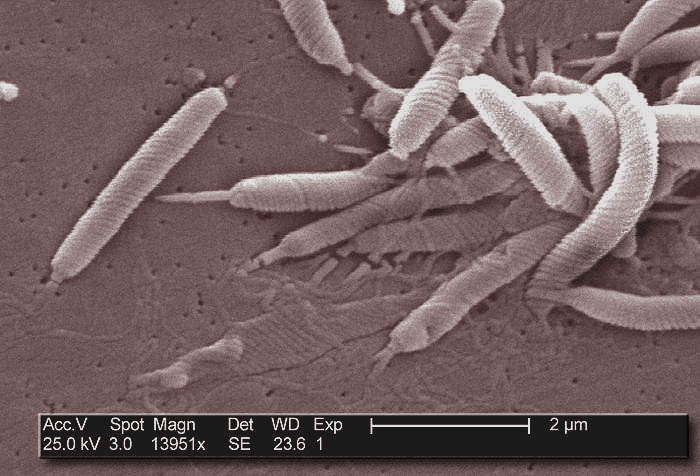
Image source: Wikipedia/Wikimedia
| Ecology, Host, and Life Cycle | |
|---|---|
| Oxygen requirements | Microaerophilic |
| Optimal temperature | 37 |
| Temperature range | Mesophilic |
| Habitat | HostAssociated |
| Biotic relationship | Free living |
| Host(s) | Not Available |
| Cell arrangement | Singles |
| Sporulation | Not Available |
| Energy source | Not Available |
| Pathogenicity | Not Available |
Genome Summary
Helicobacter pylori NCTC 11637 = CCUG 17874 = ATCC 43504 = JCM
Gene Summary
Adenine Count
486636 bp
Thymine Count
489707 bp
Guanine Count
314117 bp
Cytosine Count
310053 bp
Genome Length
1600513 bp
Protein-coding Genes
1633 genes
Non-Coding Genes
39 genes
# of Chromosomes/Plasmids
2
Genes
| Name | Locus Tag | UniProt ID | Strand Orientation | Gene Start/End | Protein Molecular Weight |
|---|---|---|---|---|---|
| response regulator | HP17_02397 | Not Available | Negative | 896209 - 897105 | 35162.5 |
| bifunctional 2-c-methyl-d-erythritol 4-phosphate cytidylyltransferase/2-c-methyl-d-erythritol 2,4-cyclodiphosphate synthase protein | HP17_02402 | Not Available | Negative | 897127 - 898347 | 45500.0 |
| protease do | HP17_02407 | Not Available | Negative | 898369 - 899799 | 51692.3 |
| amino acid permease | HP17_02412 | Not Available | Negative | 899843 - 900573 | 26947.6 |
| amino acid permease | HP17_02417 | Not Available | Negative | 900574 - 901254 | 24853.8 |
| phosphatidylglycerophosphate synthase | HP17_02422 | Not Available | Negative | 901469 - 902008 | 20211.4 |
| hypothetical protein | HP17_02427 | Not Available | Negative | 902005 - 902613 | 22690.8 |
| 7-alpha-hydroxysteroid dehydrogenase | HP17_02432 | Not Available | Negative | 902623 - 903411 | 28657.3 |
| dihydrodipicolinate synthase | HP17_02437 | Not Available | Negative | 903408 - 904310 | 33183.4 |
| protease (pqqe) | HP17_02442 | Not Available | Negative | 904325 - 904870 | 20251.2 |
Pathways
0 pathways
No pathways found
No metabolic pathways have been associated with this bacterium yet.
Health Effects
No health effects information available for this bacterium.