Kingdom
Pseudomonadati
Phylum
Campylobacterota
Class
Epsilonproteobacteria
Order
Campylobacterales
Family
Helicobacteraceae
Genus
Helicobacter
Description
Taxonomy
| Kingdom | Pseudomonadati |
|---|---|
| Phylum | Campylobacterota |
| Class | Epsilonproteobacteria |
| Order | Campylobacterales |
| Family | Helicobacteraceae |
| Genus | Helicobacter |
| Species | Helicobacter pylori |
| Strain | NCTC 11637 = CCUG 17874 = ATCC 43504 = JCM 12093 |
Profile
| Physiology | |
|---|---|
| Gram staining properties | Negative |
| Shape | Spirilla |
| Mobility | No |
| Flagellar presence | Yes |
| Number of membranes | 2 |

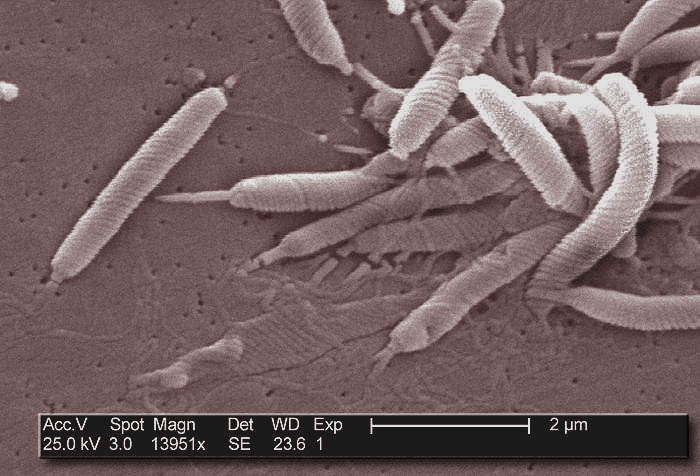
Image source: Wikipedia/Wikimedia
| Ecology, Host, and Life Cycle | |
|---|---|
| Oxygen requirements | Microaerophilic |
| Optimal temperature | 37 |
| Temperature range | Mesophilic |
| Habitat | HostAssociated |
| Biotic relationship | Free living |
| Host(s) | Not Available |
| Cell arrangement | Singles |
| Sporulation | Not Available |
| Energy source | Not Available |
| Pathogenicity | Not Available |
Genome Summary
Helicobacter pylori NCTC 11637 = CCUG 17874 = ATCC 43504 = JCM
Gene Summary
Adenine Count
486636 bp
Thymine Count
489707 bp
Guanine Count
314117 bp
Cytosine Count
310053 bp
Genome Length
1600513 bp
Protein-coding Genes
1633 genes
Non-Coding Genes
39 genes
# of Chromosomes/Plasmids
2
Genes
| Name | Locus Tag | UniProt ID | Strand Orientation | Gene Start/End | Protein Molecular Weight |
|---|---|---|---|---|---|
| flagellar biosynthesis protein flha | HP17_02297 | Not Available | Negative | 878105 - 880306 | 80813.5 |
| 30s ribosomal protein s15 | HP17_02302 | Not Available | Positive | 880442 - 880714 | 10390.9 |
| hypothetical protein | HP17_02307 | Not Available | Positive | 880744 - 882033 | 49590.1 |
| 3-dehydroquinate dehydratase | HP17_02312 | Not Available | Positive | 882162 - 882665 | 18484.5 |
| x-pro aminopeptidase | HP17_02317 | Not Available | Positive | 882679 - 883752 | 40670.3 |
| 2-amino-4-hydroxy-6- hydroxymethyldihydropteridine pyrophosphokinase | HP17_02322 | Not Available | Positive | 883749 - 884240 | 19271.8 |
| flagellar biosynthesis regulator flhf | HP17_02327 | Not Available | Positive | 884237 - 885613 | 52309.0 |
| flagellar biosynthesis protein flhg | HP17_02332 | Not Available | Positive | 885610 - 886494 | 32026.8 |
| hypothetical protein | HP17_02337 | Not Available | Positive | 886499 - 886813 | 11966.6 |
| flagellar biosynthesis sigma factor | HP17_02342 | Not Available | Positive | 886791 - 887558 | 29427.4 |
Pathways
0 pathways
No pathways found
No metabolic pathways have been associated with this bacterium yet.
Health Effects
No health effects information available for this bacterium.