Kingdom
Pseudomonadati
Phylum
Pseudomonadota
Class
Gammaproteobacteria
Order
Enterobacterales
Family
Enterobacteriaceae
Genus
Salmonella
Description
Taxonomy
| Kingdom | Pseudomonadati |
|---|---|
| Phylum | Pseudomonadota |
| Class | Gammaproteobacteria |
| Order | Enterobacterales |
| Family | Enterobacteriaceae |
| Genus | Salmonella |
| Species | Salmonella enterica |
| Strain | subsp. enterica serovar Typhi |
Profile
| Physiology | |
|---|---|
| Gram staining properties | Negative |
| Shape | Spirilla |
| Mobility | No |
| Flagellar presence | Yes |
| Number of membranes | 2 |

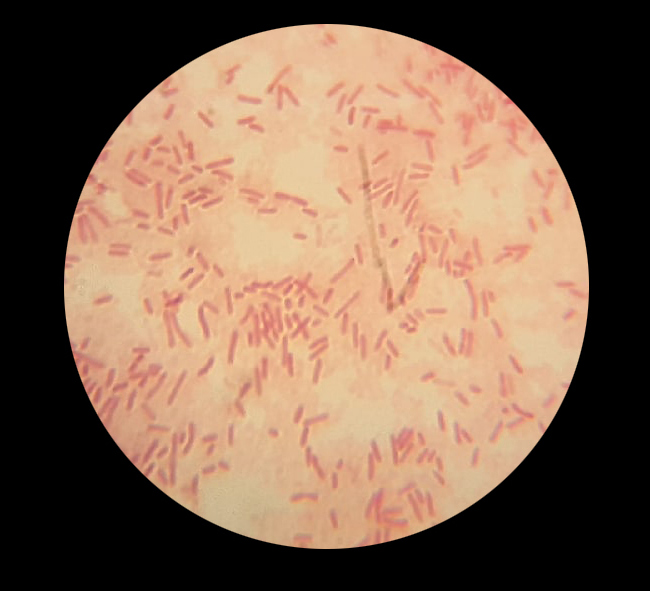
Image source: Wikipedia/Wikimedia
| Ecology, Host, and Life Cycle | |
|---|---|
| Oxygen requirements | Facultative anaerobe |
| Optimal temperature | 37 |
| Temperature range | Mesophilic |
| Habitat | HostAssociated |
| Biotic relationship | Free living |
| Host(s) | Homo sapiens, Pteropodidae |
| Cell arrangement | Chains - Singles |
| Sporulation | Not Available |
| Energy source | Chemoorganotroph |
| Pathogenicity | Not Available |
Genome Summary
Salmonella enterica subsp. enterica serovar Typhi strain 5330
Gene Summary
Adenine Count
1162507 bp
Thymine Count
1167175 bp
Guanine Count
1269439 bp
Cytosine Count
1257253 bp
Genome Length
4856374 bp
Protein-coding Genes
4272 genes
Non-Coding Genes
451 genes
# of Chromosomes/Plasmids
7
Genes
| Name | Locus Tag | UniProt ID | Strand Orientation | Gene Start/End | Protein Molecular Weight |
|---|---|---|---|---|---|
| re/si-specific nad(p)(+) transhydrogenase subunit beta | E3D88_00040 | Not Available | Negative | 4190 - 5578 | 48872.2 |
| re/si-specific nad(p)(+) transhydrogenase subunit alpha | E3D88_00045 | Not Available | Negative | 5589 - 7118 | 54239.1 |
| duf1471 domain-containing protein | E3D88_00050 | Not Available | Positive | 7645 - 8589 | 33945.1 |
| Ncrna_class:other | Not Available | Not Available | Positive | 7652 - 7835 | Not Available |
| Ncrna_class:srp_rna | Not Available | Not Available | Positive | 9466 - 9562 | Not Available |
| Ncrna_class:other | Not Available | Not Available | Positive | 43603 - 43739 | Not Available |
| hypothetical protein | E3D88_00330 | Not Available | Negative | 45774 - 46073 | 11454.5 |
| porin omps2 | E3D88_00335 | Not Available | Positive | 46190 - 47341 | 42185.1 |
| amidohydrolase | E3D88_00340 | Not Available | Positive | 47494 - 49200 | 61442.0 |
| two-component system sensor histidine kinase rstb | E3D88_00345 | Not Available | Positive | 49311 - 50612 | 49243.0 |
Pathways
0 pathways
No pathways found
No metabolic pathways have been associated with this bacterium yet.
Health Effects
| Health Condition | Relation | Reference |
|---|---|---|
| Acute cholecystitis | Causes | PMC10442058 |
| Typhoid fever | Causes | PMC7845599 |
| Typhoid fever | Causes | PMC10178548 |
| Enteric fever | Causes | PMC10178548 |
| Bloodstream infections | Causes | PMC10178548 |
| Typhoid | Causes | PMC9967847 |