Kingdom
Pseudomonadati
Phylum
Pseudomonadota
Class
Gammaproteobacteria
Order
Pseudomonadales
Family
Pseudomonadaceae
Genus
Pseudomonas
Description
Taxonomy
| Kingdom | Pseudomonadati |
|---|---|
| Phylum | Pseudomonadota |
| Class | Gammaproteobacteria |
| Order | Pseudomonadales |
| Family | Pseudomonadaceae |
| Genus | Pseudomonas |
| Species | Pseudomonas savastanoi |
| Strain | No strain |
Profile
| Physiology | |
|---|---|
| Gram staining properties | Negative |
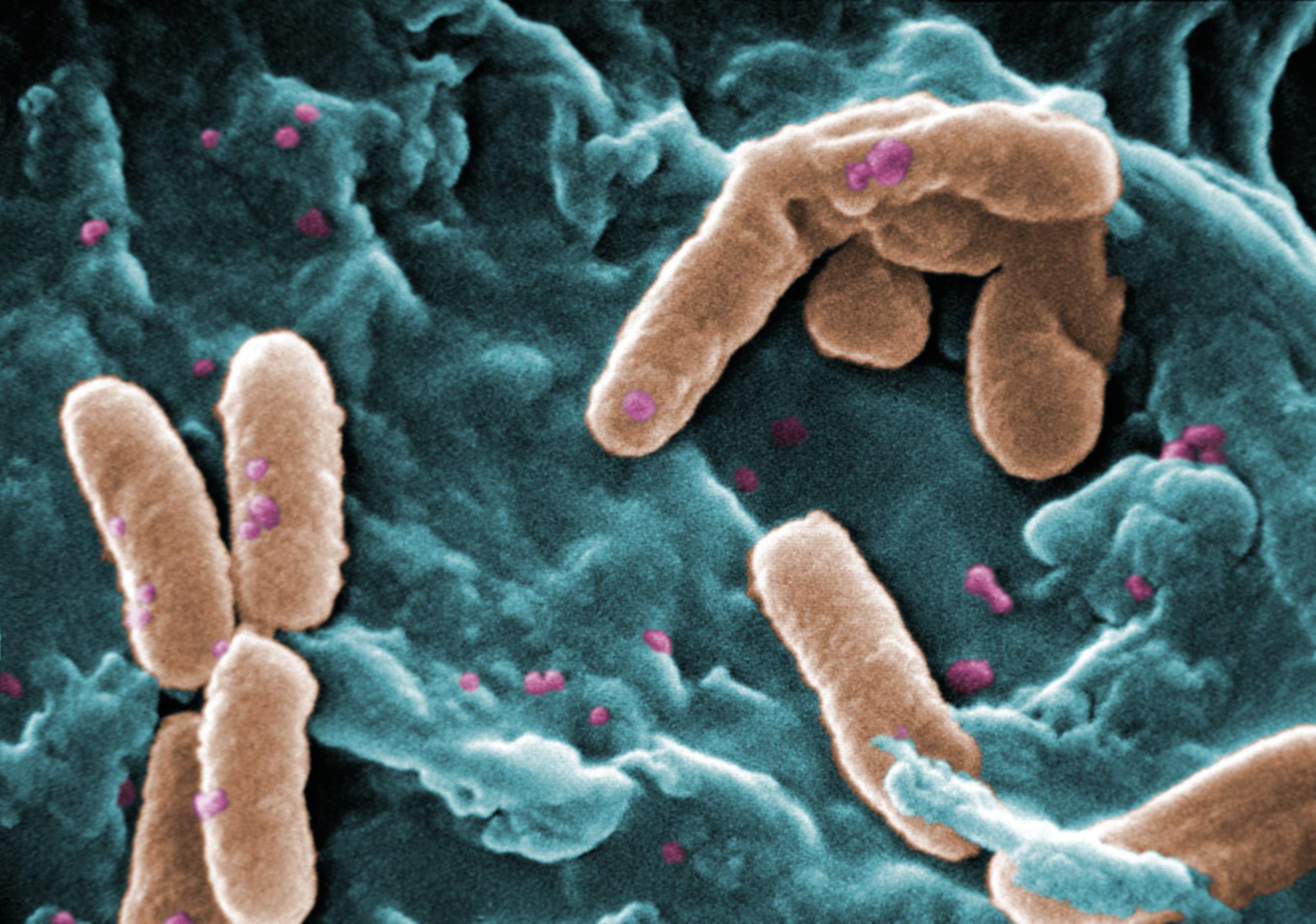
| Shape | Rod |
| Mobility | Yes |
| Flagellar presence | Yes |
| Number of membranes | 2 |

Image source: Wikipedia/Wikimedia
| Ecology, Host, and Life Cycle | |
|---|---|
| Oxygen requirements | Aerobe |
| Optimal temperature | 28 |
| Temperature range | Mesophilic |
| Habitat | Multiple |
| Biotic relationship | Free living |
| Host(s) | Actinidia deliciosa, Actinidia chinensis, Olea europaea |
| Cell arrangement | Singles |
| Sporulation | Not Available |
| Energy source | Heterotroph |
| Pathogenicity | Not Available |
Genome Summary
Pseudomonas savastanoi strain ICMP 11899 PcuICMP11899_Contig_362,
Gene Summary
Adenine Count
1272868 bp
Thymine Count
1284391 bp
Guanine Count
1790098 bp
Cytosine Count
1776610 bp
Genome Length
6173846 bp
Protein-coding Genes
5050 genes
Non-Coding Genes
67 genes
# of Chromosomes/Plasmids
5
Genes
| Name | Locus Tag | UniProt ID | Strand Orientation | Gene Start/End | Protein Molecular Weight |
|---|---|---|---|---|---|
| 2-isopropylmalate synthase | ALP17_04827 | Not Available | Negative | 5531425 - 5533098 | 61659.8 |
| m32 family metallpeptidase | ALP17_04372 | Not Available | Negative | 5533465 - 5534289 | 29406.5 |
| exodeoxyribonuclease 7 large subunit | ALP17_04829 | Not Available | Negative | 5534297 - 5535712 | 52596.8 |
| hypothetical protein | ALP17_04373 | Not Available | Positive | 5535808 - 5536356 | 20660.5 |
| hypothetical protein | ALP17_105594 | Not Available | Negative | 5536283 - 5536468 | 6845.06 |
| inosine-5'-monophosphate dehydrogenase | ALP17_04374 | Not Available | Positive | 5536451 - 5537920 | 51976.0 |
| gmp synthase | ALP17_04375 | Not Available | Positive | 5538026 - 5539603 | 58147.0 |
| atp-binding protein | ALP17_03096 | Not Available | Positive | 5539885 - 5542602 | 102078.0 |
| hypothetical protein | ALP17_108670 | Not Available | Positive | 5542611 - 5543012 | 15240.6 |
| hypothetical protein | ALP17_109848 | Not Available | Positive | 5544039 - 5544290 | 8906.56 |
Pathways
0 pathways
No pathways found
No metabolic pathways have been associated with this bacterium yet.
Health Effects
| Health Condition | Relation | Reference |
|---|---|---|
| Olive knot | Causes | PMC10420344 |
| Olive knot disease | Causes | PMC10420344 |
| Olive knot disease | Causes | PMC6638699 |
| Bacterial canker of kiwifruit | Causes | PMC8815115 |
| Disease of the ornamental plant mandevilla spp. | Causes | PMC8815115 |
| Bacterial canker | Causes | PMC8815115 |
| Bacterial canker disease | Causes | PMC8815115 |