Kingdom
Pseudomonadati
Phylum
Pseudomonadota
Class
Gammaproteobacteria
Order
Pseudomonadales
Family
Pseudomonadaceae
Genus
Pseudomonas
Description
Taxonomy
| Kingdom | Pseudomonadati |
|---|---|
| Phylum | Pseudomonadota |
| Class | Gammaproteobacteria |
| Order | Pseudomonadales |
| Family | Pseudomonadaceae |
| Genus | Pseudomonas |
| Species | Pseudomonas savastanoi |
| Strain | No strain |
Profile
| Physiology | |
|---|---|
| Gram staining properties | Negative |
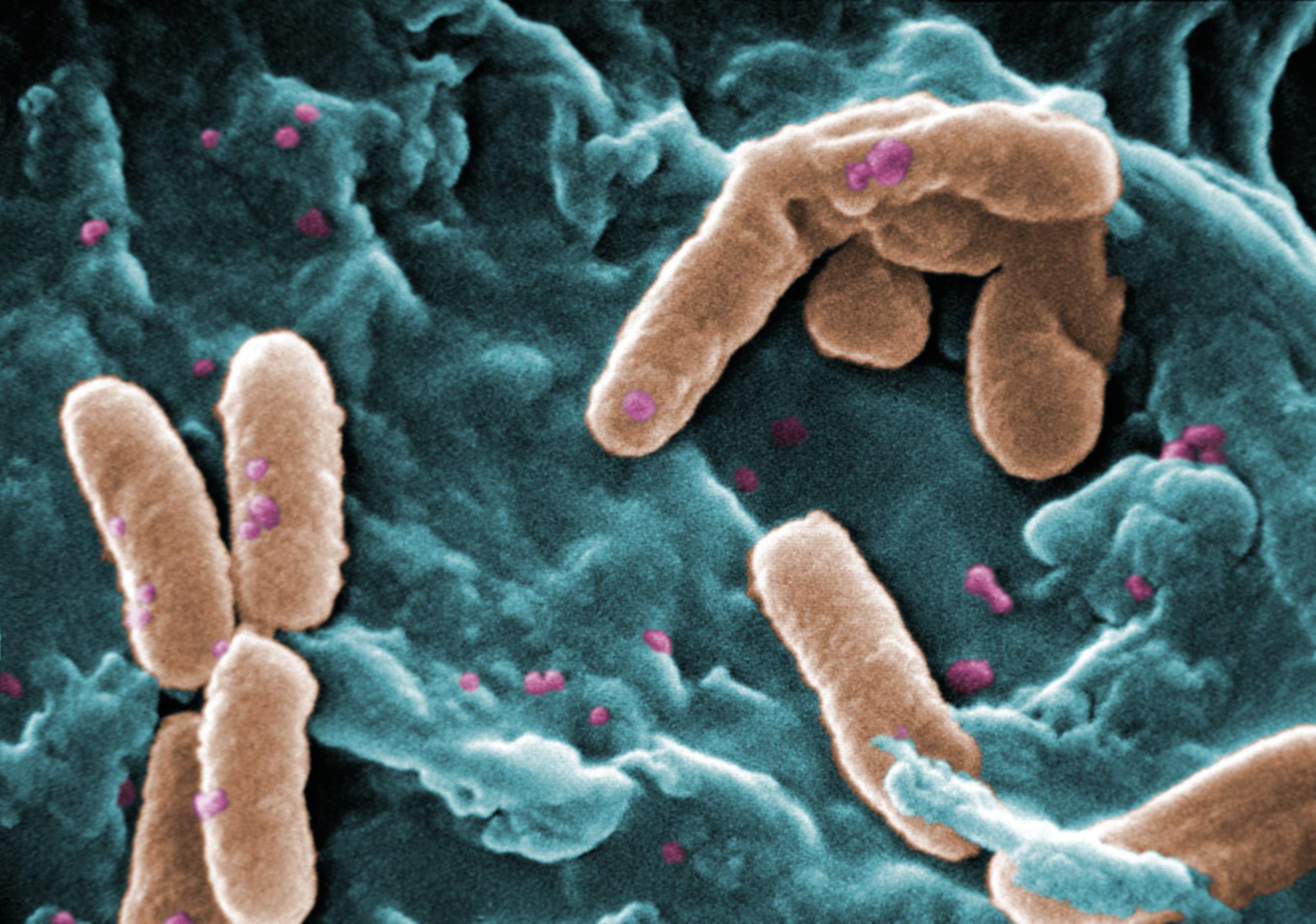
| Shape | Rod |
| Mobility | Yes |
| Flagellar presence | Yes |
| Number of membranes | 2 |

Image source: Wikipedia/Wikimedia
| Ecology, Host, and Life Cycle | |
|---|---|
| Oxygen requirements | Aerobe |
| Optimal temperature | 28 |
| Temperature range | Mesophilic |
| Habitat | Multiple |
| Biotic relationship | Free living |
| Host(s) | Actinidia deliciosa, Actinidia chinensis, Olea europaea |
| Cell arrangement | Singles |
| Sporulation | Not Available |
| Energy source | Heterotroph |
| Pathogenicity | Not Available |
Genome Summary
Pseudomonas savastanoi strain ICMP 11899 PcuICMP11899_Contig_362,
Gene Summary
Adenine Count
1272868 bp
Thymine Count
1284391 bp
Guanine Count
1790098 bp
Cytosine Count
1776610 bp
Genome Length
6173846 bp
Protein-coding Genes
5050 genes
Non-Coding Genes
67 genes
# of Chromosomes/Plasmids
5
Genes
| Name | Locus Tag | UniProt ID | Strand Orientation | Gene Start/End | Protein Molecular Weight |
|---|---|---|---|---|---|
| arsenate reductase | ALP17_01392 | Not Available | Negative | 3517513 - 3517872 | 13177.1 |
| thioredoxin | ALP17_01391 | Not Available | Positive | 3517996 - 3518463 | 16874.3 |
| sigma factor regulatory protein fecr/pupr family | ALP17_01106 | Not Available | Negative | 3518841 - 3519818 | 35353.3 |
| rna polymerase sigma-70 factor, ecf subfamily | ALP17_02303 | Not Available | Negative | 3519815 - 3520411 | 22291.9 |
| hypothetical protein | ALP17_01108 | Not Available | Positive | 3520521 - 3520865 | 12065.2 |
| hypothetical protein | ALP17_01109 | Not Available | Positive | 3520862 - 3522427 | 57536.6 |
| iron uptake protein | ALP17_101429 | Not Available | Positive | 3522385 - 3522759 | 13457.0 |
| transcriptional regulator, arac family | ALP17_01110 | Not Available | Negative | 3522748 - 3523623 | 32342.8 |
| membrane protein | ALP17_01111 | Not Available | Positive | 3523604 - 3524662 | 37832.3 |
| d-isomer specific 2-hydroxyacid dehydrogenase | ALP17_01113 | Not Available | Negative | 3524699 - 3525673 | 35436.6 |
Pathways
0 pathways
No pathways found
No metabolic pathways have been associated with this bacterium yet.
Health Effects
| Health Condition | Relation | Reference |
|---|---|---|
| Olive knot | Causes | PMC10420344 |
| Olive knot disease | Causes | PMC10420344 |
| Olive knot disease | Causes | PMC6638699 |
| Bacterial canker of kiwifruit | Causes | PMC8815115 |
| Disease of the ornamental plant mandevilla spp. | Causes | PMC8815115 |
| Bacterial canker | Causes | PMC8815115 |
| Bacterial canker disease | Causes | PMC8815115 |