Kingdom
Pseudomonadati
Phylum
Pseudomonadota
Class
Gammaproteobacteria
Order
Pseudomonadales
Family
Pseudomonadaceae
Genus
Pseudomonas
Description
Taxonomy
| Kingdom | Pseudomonadati |
|---|---|
| Phylum | Pseudomonadota |
| Class | Gammaproteobacteria |
| Order | Pseudomonadales |
| Family | Pseudomonadaceae |
| Genus | Pseudomonas |
| Species | Pseudomonas savastanoi |
| Strain | No strain |
Profile
| Physiology | |
|---|---|
| Gram staining properties | Negative |
| Shape | Rod |
| Mobility | Yes |
| Flagellar presence | Yes |
| Number of membranes | 2 |

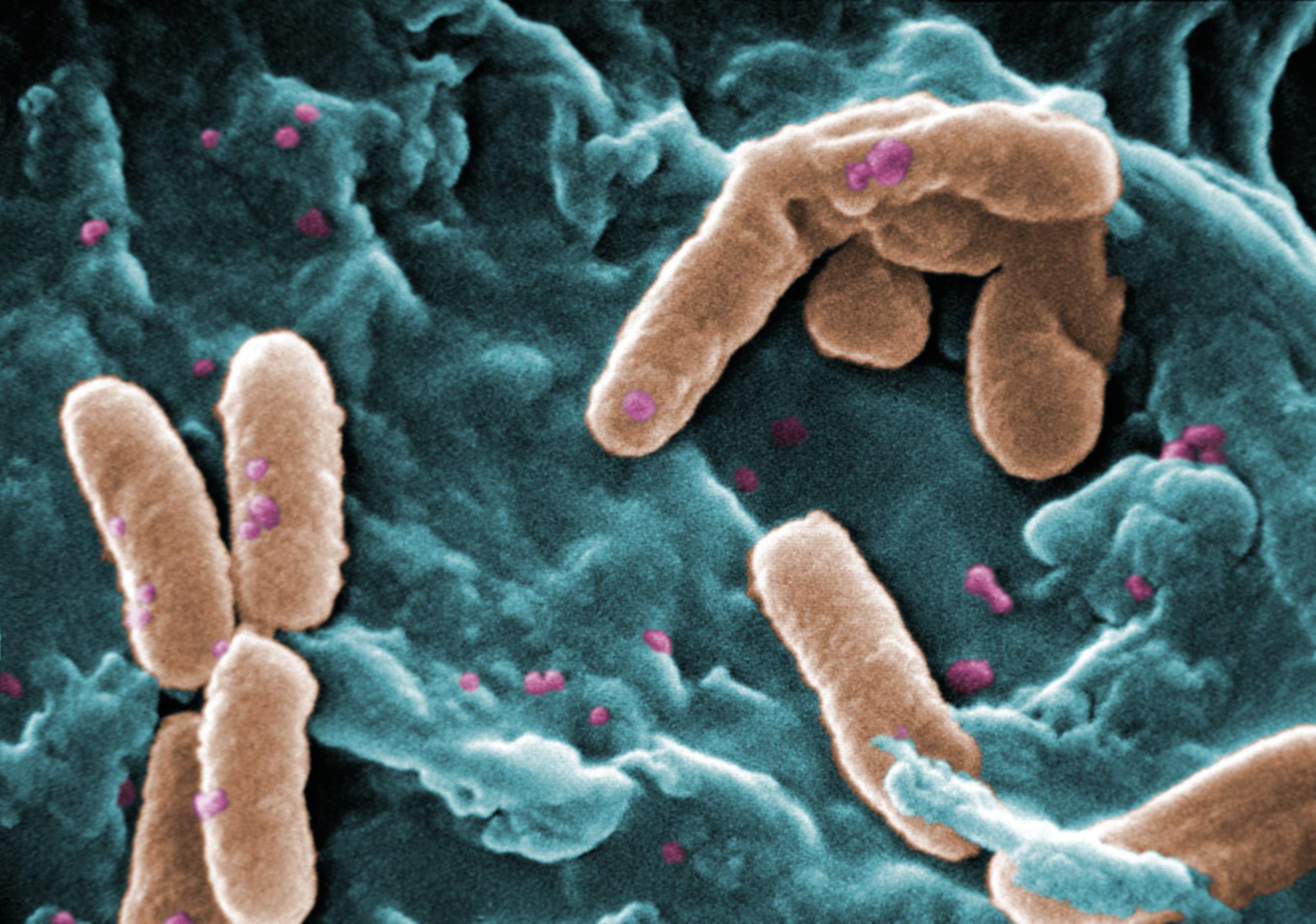
Image source: Wikipedia/Wikimedia
| Ecology, Host, and Life Cycle | |
|---|---|
| Oxygen requirements | Aerobe |
| Optimal temperature | 28 |
| Temperature range | Mesophilic |
| Habitat | Multiple |
| Biotic relationship | Free living |
| Host(s) | Actinidia deliciosa, Actinidia chinensis, Olea europaea |
| Cell arrangement | Singles |
| Sporulation | Not Available |
| Energy source | Heterotroph |
| Pathogenicity | Not Available |
Genome Summary
Pseudomonas savastanoi strain ICMP 11899 PcuICMP11899_Contig_362,
Gene Summary
Adenine Count
1272868 bp
Thymine Count
1284391 bp
Guanine Count
1790098 bp
Cytosine Count
1776610 bp
Genome Length
6173846 bp
Protein-coding Genes
5050 genes
Non-Coding Genes
67 genes
# of Chromosomes/Plasmids
5
Genes
| Name | Locus Tag | UniProt ID | Strand Orientation | Gene Start/End | Protein Molecular Weight |
|---|---|---|---|---|---|
| putative tonb system transport protein | ALP51_01481 | Not Available | Positive | 5039376 - 5042201 | 100944.0 |
| bacterial extracellular solute-binding protein | ALP51_01482 | Not Available | Positive | 5043082 - 5043768 | 25031.0 |
| solute-binding family 5 protein | ALP51_01483 | Not Available | Positive | 5043737 - 5044150 | 14972.9 |
| peptide abc transporter permease | ALP51_01484 | Not Available | Positive | 5044152 - 5044254 | 3686.94 |
| peptide abc transporter, permease protein | ALP51_01485 | Not Available | Positive | 5044391 - 5045197 | 29716.7 |
| peptide abc transporter permease | ALP51_01486 | Not Available | Positive | 5045197 - 5046219 | 37777.3 |
| peptide abc transporter atp-binding protein | ALP51_01487 | Not Available | Positive | 5046221 - 5047828 | 59223.1 |
| methyl-accepting chemotaxis protein | ALP51_04641 | Not Available | Negative | 5047832 - 5049328 | 53596.3 |
| hypothetical protein | ALP51_101665 | Not Available | Positive | 5049299 - 5049469 | 6720.03 |
| transposase | ALP51_01488 | Not Available | Positive | 5049894 - 5050352 | 17627.6 |
Pathways
0 pathways
No pathways found
No metabolic pathways have been associated with this bacterium yet.
Health Effects
| Health Condition | Relation | Reference |
|---|---|---|
| Olive knot | Causes | PMC10420344 |
| Olive knot disease | Causes | PMC10420344 |
| Olive knot disease | Causes | PMC6638699 |
| Bacterial canker of kiwifruit | Causes | PMC8815115 |
| Disease of the ornamental plant mandevilla spp. | Causes | PMC8815115 |
| Bacterial canker | Causes | PMC8815115 |
| Bacterial canker disease | Causes | PMC8815115 |