Kingdom
Pseudomonadati
Phylum
Pseudomonadota
Class
Gammaproteobacteria
Order
Pseudomonadales
Family
Pseudomonadaceae
Genus
Pseudomonas
Description
Taxonomy
| Kingdom | Pseudomonadati |
|---|---|
| Phylum | Pseudomonadota |
| Class | Gammaproteobacteria |
| Order | Pseudomonadales |
| Family | Pseudomonadaceae |
| Genus | Pseudomonas |
| Species | Pseudomonas savastanoi |
| Strain | No strain |
Profile
| Physiology | |
|---|---|
| Gram staining properties | Negative |
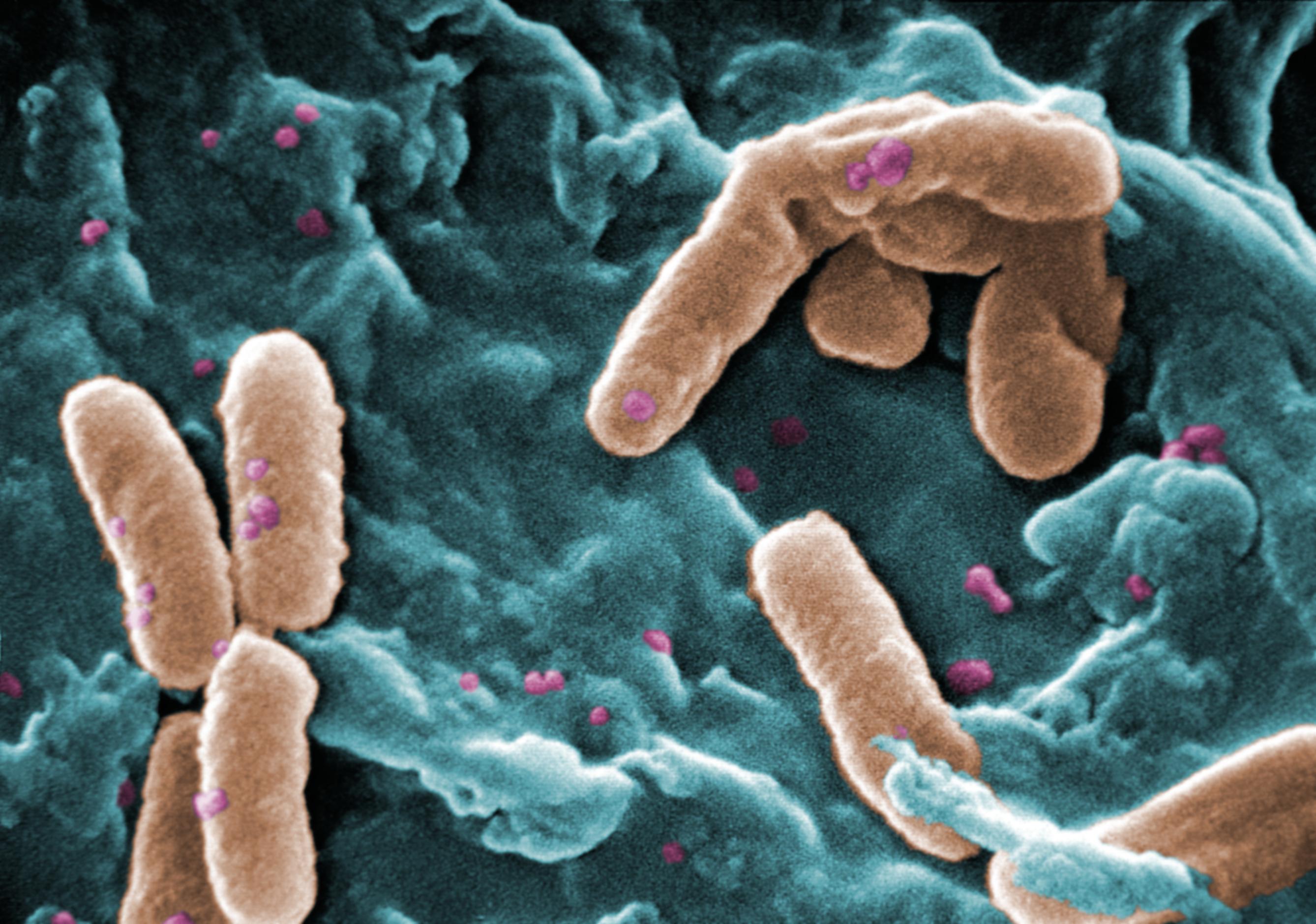
| Shape | Rod |
| Mobility | Yes |
| Flagellar presence | Yes |
| Number of membranes | 2 |

Image source: Wikipedia/Wikimedia
| Ecology, Host, and Life Cycle | |
|---|---|
| Oxygen requirements | Aerobe |
| Optimal temperature | 28 |
| Temperature range | Mesophilic |
| Habitat | Multiple |
| Biotic relationship | Free living |
| Host(s) | Actinidia deliciosa, Actinidia chinensis, Olea europaea |
| Cell arrangement | Singles |
| Sporulation | Not Available |
| Energy source | Heterotroph |
| Pathogenicity | Not Available |
Genome Summary
Pseudomonas savastanoi strain ICMP 11899 PcuICMP11899_Contig_362,
Gene Summary
Adenine Count
1272868 bp
Thymine Count
1284391 bp
Guanine Count
1790098 bp
Cytosine Count
1776610 bp
Genome Length
6173846 bp
Protein-coding Genes
5050 genes
Non-Coding Genes
67 genes
# of Chromosomes/Plasmids
5
Genes
| Name | Locus Tag | UniProt ID | Strand Orientation | Gene Start/End | Protein Molecular Weight |
|---|---|---|---|---|---|
| allophanate hydrolase | ALP16_03280 | Not Available | Positive | 1773694 - 1775508 | 64497.3 |
| hypothetical protein | ALP16_03281 | Not Available | Positive | 1775651 - 1778956 | 122444.0 |
| hypothetical protein | ALP16_03282 | Not Available | Positive | 1779013 - 1779237 | 7913.38 |
| pseudouridine synthase | ALP16_03283 | Not Available | Positive | 1779273 - 1779965 | 25949.1 |
| citrate transporter | ALP16_102142 | Not Available | Negative | 1780312 - 1781604 | 46145.1 |
| thiamine biosynthesis lipoprotein apbe | ALP16_03922 | Not Available | Positive | 1781982 - 1783013 | 37551.3 |
| soluble pyridine nucleotide transhydrogenase | ALP16_03923 | Not Available | Positive | 1783180 - 1784574 | 50784.5 |
| putative glycerophosphoryl diester phosphodiesterase | ALP16_100002 | Not Available | Negative | 1784637 - 1785279 | 24057.9 |
| hypothetical protein | ALP16_03924 | Not Available | Negative | 1785352 - 1785939 | 21573.6 |
| lipoprotein releasing system transmembrane protein lolc | ALP16_03925 | Not Available | Positive | 1786042 - 1787292 | 45407.2 |
Pathways
0 pathways
No pathways found
No metabolic pathways have been associated with this bacterium yet.
Health Effects
| Health Condition | Relation | Reference |
|---|---|---|
| Olive knot | Causes | PMC10420344 |
| Olive knot disease | Causes | PMC10420344 |
| Olive knot disease | Causes | PMC6638699 |
| Bacterial canker of kiwifruit | Causes | PMC8815115 |
| Disease of the ornamental plant mandevilla spp. | Causes | PMC8815115 |
| Bacterial canker | Causes | PMC8815115 |
| Bacterial canker disease | Causes | PMC8815115 |