Kingdom
Bacillati
Phylum
Bacillota
Class
Bacilli
Order
Caryophanales
Family
Bacillaceae
Genus
Bacillus
Description
Taxonomy
| Kingdom | Bacillati |
|---|---|
| Phylum | Bacillota |
| Class | Bacilli |
| Order | Caryophanales |
| Family | Bacillaceae |
| Genus | Bacillus |
| Species | Bacillus anthracis |
| Strain | No strain |
Profile
| Physiology | |
|---|---|
| Gram staining properties | Positive |
| Shape | Rod |
| Mobility | No |
| Flagellar presence | Yes |
| Number of membranes | 1 |

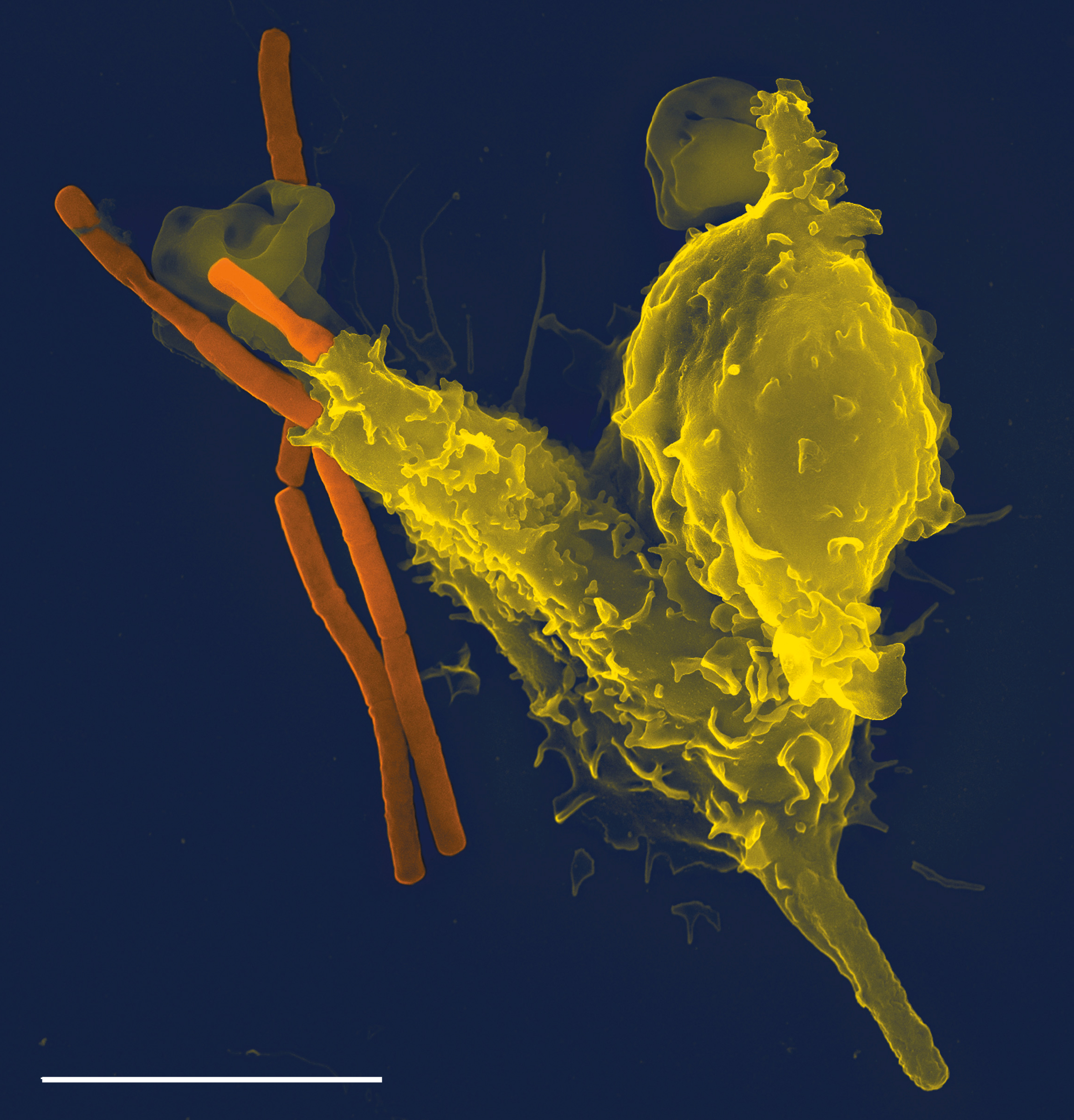
Image source: Wikipedia/Wikimedia
| Ecology, Host, and Life Cycle | |
|---|---|
| Oxygen requirements | Facultative anaerobe |
| Optimal temperature | 37 |
| Temperature range | Mesophilic |
| Habitat | Soil |
| Biotic relationship | Free living |
| Host(s) | Homo sapiens, Bos, Metazoa |
| Cell arrangement | Not Available |
| Sporulation | Sporulating |
| Energy source | Chemoheterotroph |
| Pathogenicity | Animal |
Genome Summary
NZ_CP029323.1
Gene Summary
Adenine Count
Not Available
Thymine Count
Not Available
Guanine Count
Not Available
Cytosine Count
Not Available
Genome Length
Not Available
Protein-coding Genes
5214 genes
Non-Coding Genes
307 genes
# of Chromosomes/Plasmids
6
Genes
| Name | Locus Tag | UniProt ID | Strand Orientation | Gene Start/End | Protein Molecular Weight |
|---|---|---|---|---|---|
| dna integration/recombination/inversion protein | CN907_25705 | Not Available | Positive | 4732792 - 4733541 | 28865.2 |
| hypothetical protein | CN907_25710 | Not Available | Negative | 4733693 - 4733881 | 6775.19 |
| rna chaperone hfq | CN907_25720 | Not Available | Negative | 4734528 - 4734710 | 6866.5 |
| gnat family n-acetyltransferase | CN907_25730 | Not Available | Positive | 4735613 - 4736119 | 20141.8 |
| transcriptional regulator | CN907_25735 | Not Available | Positive | 4736794 - 4737147 | 13150.9 |
| dna mismatch repair protein | CN907_25740 | Not Available | Positive | 4737149 - 4737589 | 16598.9 |
| sodium-independent anion transporter | CN907_25745 | Not Available | Positive | 4737724 - 4739487 | 63376.1 |
| d-alanine--poly(phosphoribitol) ligase subunit 2 | CN907_25750 | Not Available | Positive | 4739845 - 4740084 | 9163.94 |
| alkylphosphonate utilization protein | CN907_25755 | Not Available | Positive | 4740217 - 4740558 | 12469.8 |
| chemotaxis protein | CN907_25760 | Not Available | Positive | 4741944 - 4743536 | 58114.4 |
Pathways
0 pathways
No pathways found
No metabolic pathways have been associated with this bacterium yet.
Health Effects
| Health Condition | Relation | Reference |
|---|---|---|
| Anthrax | Causes | PMC4987991 |
| Anthrax | Causes | PMC6842932 |
| Anthrax | Causes | PMC11302227 |
| Anthrax | Causes | PMC11877637 |
| Anthrax | Causes | PMC5241308 |
| Anthrax | Causes | PMC6542083 |
| Anthrax | Causes | PMC8504768 |
| Anthrax-like disease | Causes | PMC8504768 |
| Anthrax | Causes | PMC7464528 |
| Anthrax | Causes | PMC1800911 |