Kingdom
Bacillati
Phylum
Bacillota
Class
Bacilli
Order
Caryophanales
Family
Bacillaceae
Genus
Bacillus
Description
Taxonomy
| Kingdom | Bacillati |
|---|---|
| Phylum | Bacillota |
| Class | Bacilli |
| Order | Caryophanales |
| Family | Bacillaceae |
| Genus | Bacillus |
| Species | Bacillus anthracis |
| Strain | No strain |
Profile
| Physiology | |
|---|---|
| Gram staining properties | Positive |
| Shape | Rod |
| Mobility | No |
| Flagellar presence | Yes |
| Number of membranes | 1 |

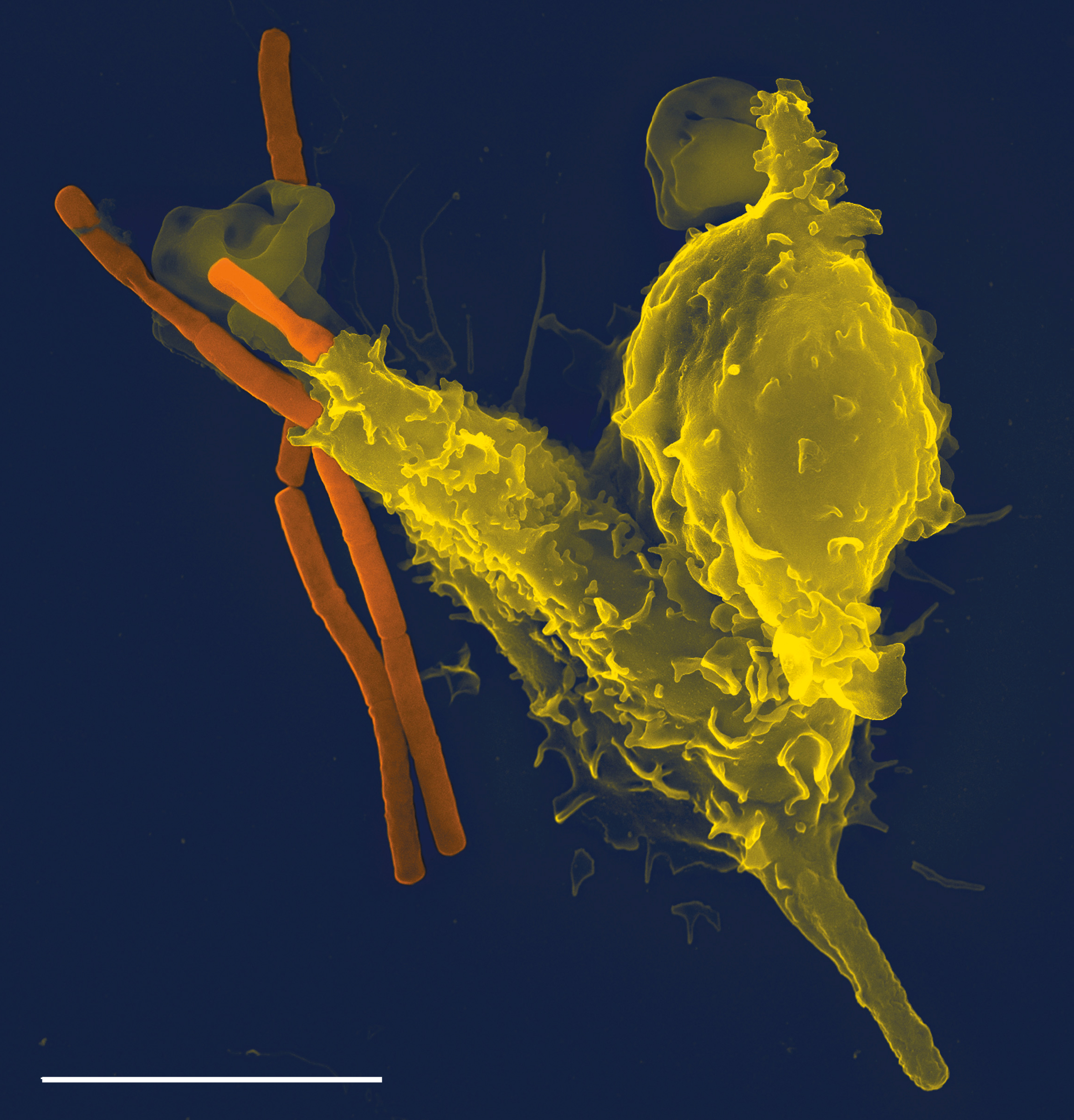
Image source: Wikipedia/Wikimedia
| Ecology, Host, and Life Cycle | |
|---|---|
| Oxygen requirements | Facultative anaerobe |
| Optimal temperature | 37 |
| Temperature range | Mesophilic |
| Habitat | Soil |
| Biotic relationship | Free living |
| Host(s) | Homo sapiens, Bos, Metazoa |
| Cell arrangement | Not Available |
| Sporulation | Sporulating |
| Energy source | Chemoheterotroph |
| Pathogenicity | Animal |
Genome Summary
NZ_CP029323.1
Gene Summary
Adenine Count
Not Available
Thymine Count
Not Available
Guanine Count
Not Available
Cytosine Count
Not Available
Genome Length
Not Available
Protein-coding Genes
5214 genes
Non-Coding Genes
307 genes
# of Chromosomes/Plasmids
6
Genes
| Name | Locus Tag | UniProt ID | Strand Orientation | Gene Start/End | Protein Molecular Weight |
|---|---|---|---|---|---|
| transcriptional regulator | CN907_25085 | Not Available | Positive | 4604313 - 4604615 | 11338.7 |
| copper chaperone | CN907_25090 | Not Available | Positive | 4604819 - 4605025 | 7293.66 |
| copper-translocating p-type atpase | CN907_25095 | Not Available | Positive | 4605121 - 4607547 | 87112.5 |
| gnat family n-acetyltransferase | CN907_25100 | Not Available | Positive | 4607694 - 4608173 | 18782.3 |
| hu family dna-binding protein | CN907_25105 | Not Available | Negative | 4608194 - 4608466 | 9729.71 |
| formate/nitrite transporter | CN907_25110 | Not Available | Negative | 4608608 - 4609423 | 29731.2 |
| metallophosphoesterase | CN907_25115 | Not Available | Positive | 4609620 - 4610513 | 33633.0 |
| peptidase m20 | CN907_25120 | Not Available | Positive | 4610623 - 4611819 | 43919.9 |
| hypothetical protein | CN907_25125 | Not Available | Positive | 4611965 - 4613809 | 69944.3 |
| gaba permease | CN907_25140 | Not Available | Positive | 4615335 - 4616729 | 50322.0 |
Pathways
0 pathways
No pathways found
No metabolic pathways have been associated with this bacterium yet.
Health Effects
| Health Condition | Relation | Reference |
|---|---|---|
| Anthrax | Causes | PMC4987991 |
| Anthrax | Causes | PMC6842932 |
| Anthrax | Causes | PMC11302227 |
| Anthrax | Causes | PMC11877637 |
| Anthrax | Causes | PMC5241308 |
| Anthrax | Causes | PMC6542083 |
| Anthrax | Causes | PMC8504768 |
| Anthrax-like disease | Causes | PMC8504768 |
| Anthrax | Causes | PMC7464528 |
| Anthrax | Causes | PMC1800911 |