Kingdom
Bacillati
Phylum
Bacillota
Class
Bacilli
Order
Caryophanales
Family
Bacillaceae
Genus
Bacillus
Description
Taxonomy
| Kingdom | Bacillati |
|---|---|
| Phylum | Bacillota |
| Class | Bacilli |
| Order | Caryophanales |
| Family | Bacillaceae |
| Genus | Bacillus |
| Species | Bacillus anthracis |
| Strain | No strain |
Profile
| Physiology | |
|---|---|
| Gram staining properties | Positive |
| Shape | Rod |
| Mobility | No |
| Flagellar presence | Yes |
| Number of membranes | 1 |

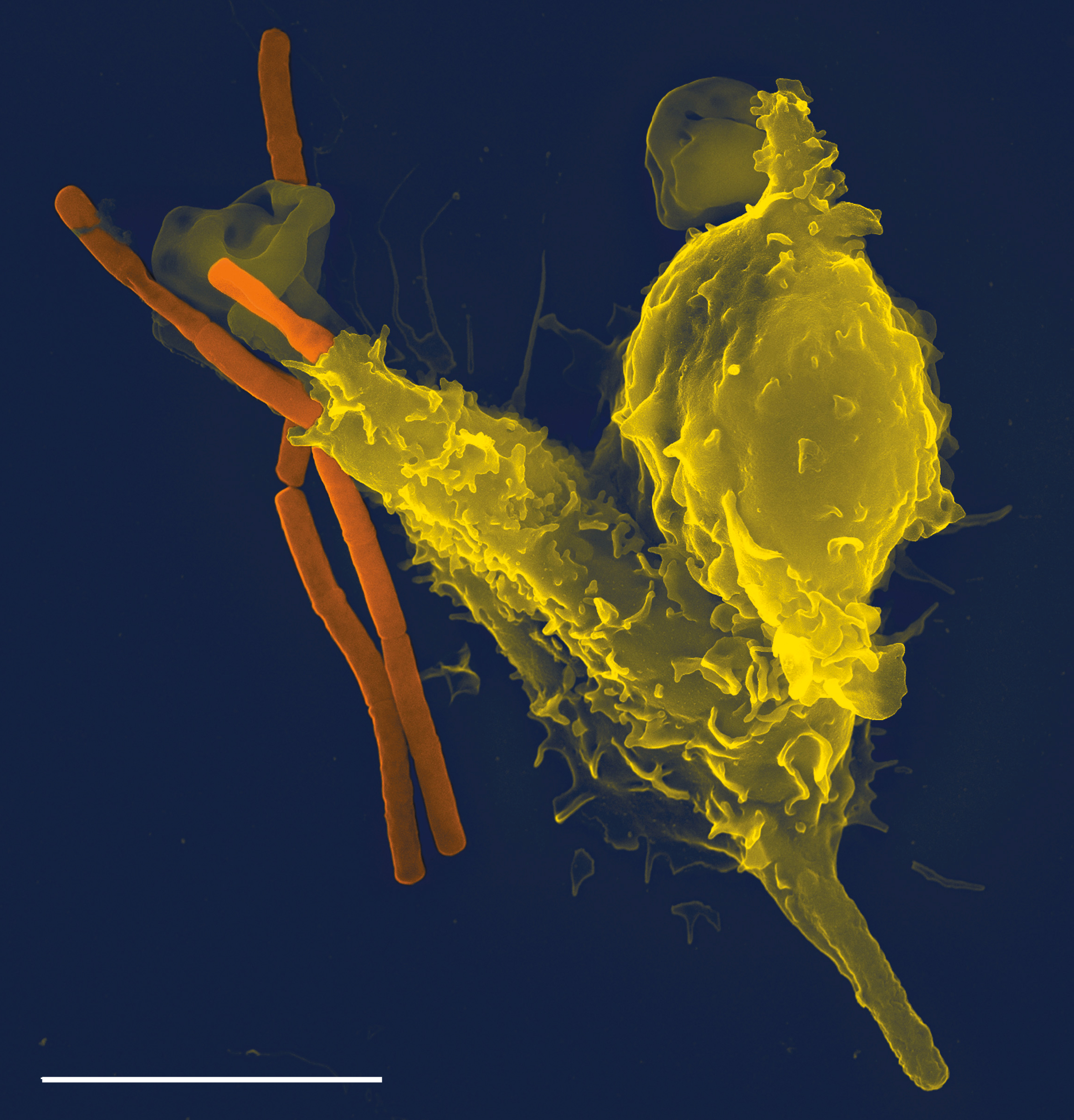
Image source: Wikipedia/Wikimedia
| Ecology, Host, and Life Cycle | |
|---|---|
| Oxygen requirements | Facultative anaerobe |
| Optimal temperature | 37 |
| Temperature range | Mesophilic |
| Habitat | Soil |
| Biotic relationship | Free living |
| Host(s) | Homo sapiens, Bos, Metazoa |
| Cell arrangement | Not Available |
| Sporulation | Sporulating |
| Energy source | Chemoheterotroph |
| Pathogenicity | Animal |
Genome Summary
NZ_CP029323.1
Gene Summary
Adenine Count
Not Available
Thymine Count
Not Available
Guanine Count
Not Available
Cytosine Count
Not Available
Genome Length
Not Available
Protein-coding Genes
5214 genes
Non-Coding Genes
307 genes
# of Chromosomes/Plasmids
6
Genes
| Name | Locus Tag | UniProt ID | Strand Orientation | Gene Start/End | Protein Molecular Weight |
|---|---|---|---|---|---|
| rna helicase | CN907_17395 | Not Available | Negative | 3192037 - 3193377 | 49990.3 |
| hypothetical protein | CN907_17400 | Not Available | Negative | 3193451 - 3193720 | 10877.4 |
| mbl fold metallo-hydrolase | CN907_17405 | Not Available | Negative | 3193880 - 3194566 | 26096.5 |
| hypothetical protein | CN907_17410 | Not Available | Positive | 3194913 - 3195377 | 17538.2 |
| hypothetical protein | CN907_17415 | Not Available | Negative | 3195877 - 3196428 | 19900.0 |
| duf1232 domain-containing protein | CN907_17420 | Not Available | Positive | 3197028 - 3197357 | 12313.4 |
| tetracycline resistance mfs efflux pump | CN907_17425 | Not Available | Negative | 3197636 - 3198871 | 44443.6 |
| marr family transcriptional regulator | CN907_17430 | Not Available | Negative | 3198977 - 3199447 | 18553.2 |
| threonine ammonia-lyase | CN907_17435 | Not Available | Negative | 3199679 - 3200680 | 35711.3 |
| glycerol-3-phosphate 1-o-acyltransferase plsy | CN907_17445 | Not Available | Negative | 3202412 - 3202960 | 20030.4 |
Pathways
0 pathways
No pathways found
No metabolic pathways have been associated with this bacterium yet.
Health Effects
| Health Condition | Relation | Reference |
|---|---|---|
| Anthrax | Causes | PMC4987991 |
| Anthrax | Causes | PMC6842932 |
| Anthrax | Causes | PMC11302227 |
| Anthrax | Causes | PMC11877637 |
| Anthrax | Causes | PMC5241308 |
| Anthrax | Causes | PMC6542083 |
| Anthrax | Causes | PMC8504768 |
| Anthrax-like disease | Causes | PMC8504768 |
| Anthrax | Causes | PMC7464528 |
| Anthrax | Causes | PMC1800911 |