Kingdom
Bacillati
Phylum
Bacillota
Class
Bacilli
Order
Caryophanales
Family
Bacillaceae
Genus
Bacillus
Description
Taxonomy
| Kingdom | Bacillati |
|---|---|
| Phylum | Bacillota |
| Class | Bacilli |
| Order | Caryophanales |
| Family | Bacillaceae |
| Genus | Bacillus |
| Species | Bacillus anthracis |
| Strain | No strain |
Profile
| Physiology | |
|---|---|
| Gram staining properties | Positive |
| Shape | Rod |
| Mobility | No |
| Flagellar presence | Yes |
| Number of membranes | 1 |

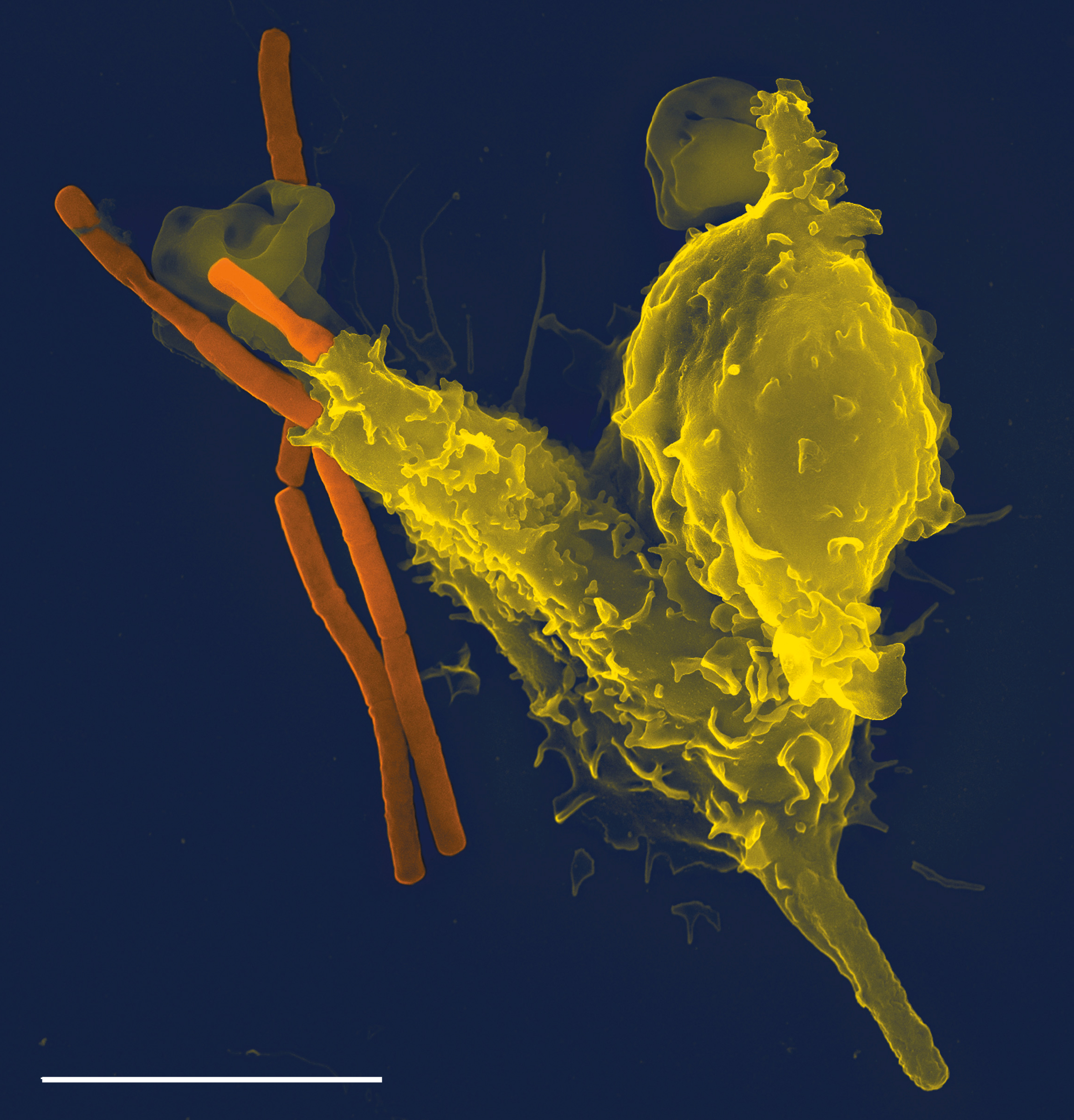
Image source: Wikipedia/Wikimedia
| Ecology, Host, and Life Cycle | |
|---|---|
| Oxygen requirements | Facultative anaerobe |
| Optimal temperature | 37 |
| Temperature range | Mesophilic |
| Habitat | Soil |
| Biotic relationship | Free living |
| Host(s) | Homo sapiens, Bos, Metazoa |
| Cell arrangement | Not Available |
| Sporulation | Sporulating |
| Energy source | Chemoheterotroph |
| Pathogenicity | Animal |
Genome Summary
NZ_CP029323.1
Gene Summary
Adenine Count
Not Available
Thymine Count
Not Available
Guanine Count
Not Available
Cytosine Count
Not Available
Genome Length
Not Available
Protein-coding Genes
5214 genes
Non-Coding Genes
307 genes
# of Chromosomes/Plasmids
6
Genes
| Name | Locus Tag | UniProt ID | Strand Orientation | Gene Start/End | Protein Molecular Weight |
|---|---|---|---|---|---|
| gamma-aminobutyrate permease | CN504_21155 | Not Available | Negative | 3943296 - 3943442 | 5176.59 |
| cell wall hydrolase | CN504_21160 | Not Available | Positive | 3943879 - 3945525 | 60384.8 |
| d-alanyl-d-alanine carboxypeptidase | CN504_21165 | Not Available | Negative | 3946073 - 3946816 | 27837.1 |
| hypothetical protein | CN504_21175 | Not Available | Negative | 3947529 - 3947765 | 9315.01 |
| hypothetical protein | CN504_21180 | Not Available | Negative | 3948023 - 3948286 | 9823.78 |
| hypothetical protein | CN504_21190 | Not Available | Negative | 3949625 - 3950164 | 20209.5 |
| cpbp family intramembrane metalloprotease | CN504_21195 | Not Available | Negative | 3950290 - 3950994 | 27083.0 |
| tqxa domain-containing protein | CN504_21200 | Not Available | Negative | 3951267 - 3954548 | 120593.0 |
| yip1 family protein | CN504_21210 | Not Available | Positive | 3955769 - 3956419 | 24490.6 |
| hypothetical protein | CN504_21215 | Not Available | Positive | 3956628 - 3956987 | 13282.9 |
Pathways
0 pathways
No pathways found
No metabolic pathways have been associated with this bacterium yet.
Health Effects
| Health Condition | Relation | Reference |
|---|---|---|
| Anthrax | Causes | PMC4987991 |
| Anthrax | Causes | PMC6842932 |
| Anthrax | Causes | PMC11302227 |
| Anthrax | Causes | PMC11877637 |
| Anthrax | Causes | PMC5241308 |
| Anthrax | Causes | PMC6542083 |
| Anthrax | Causes | PMC8504768 |
| Anthrax-like disease | Causes | PMC8504768 |
| Anthrax | Causes | PMC7464528 |
| Anthrax | Causes | PMC1800911 |