Kingdom
Bacillati
Phylum
Bacillota
Class
Bacilli
Order
Caryophanales
Family
Bacillaceae
Genus
Bacillus
Description
Taxonomy
| Kingdom | Bacillati |
|---|---|
| Phylum | Bacillota |
| Class | Bacilli |
| Order | Caryophanales |
| Family | Bacillaceae |
| Genus | Bacillus |
| Species | Bacillus anthracis |
| Strain | No strain |
Profile
| Physiology | |
|---|---|
| Gram staining properties | Positive |
| Shape | Rod |
| Mobility | No |
| Flagellar presence | Yes |
| Number of membranes | 1 |

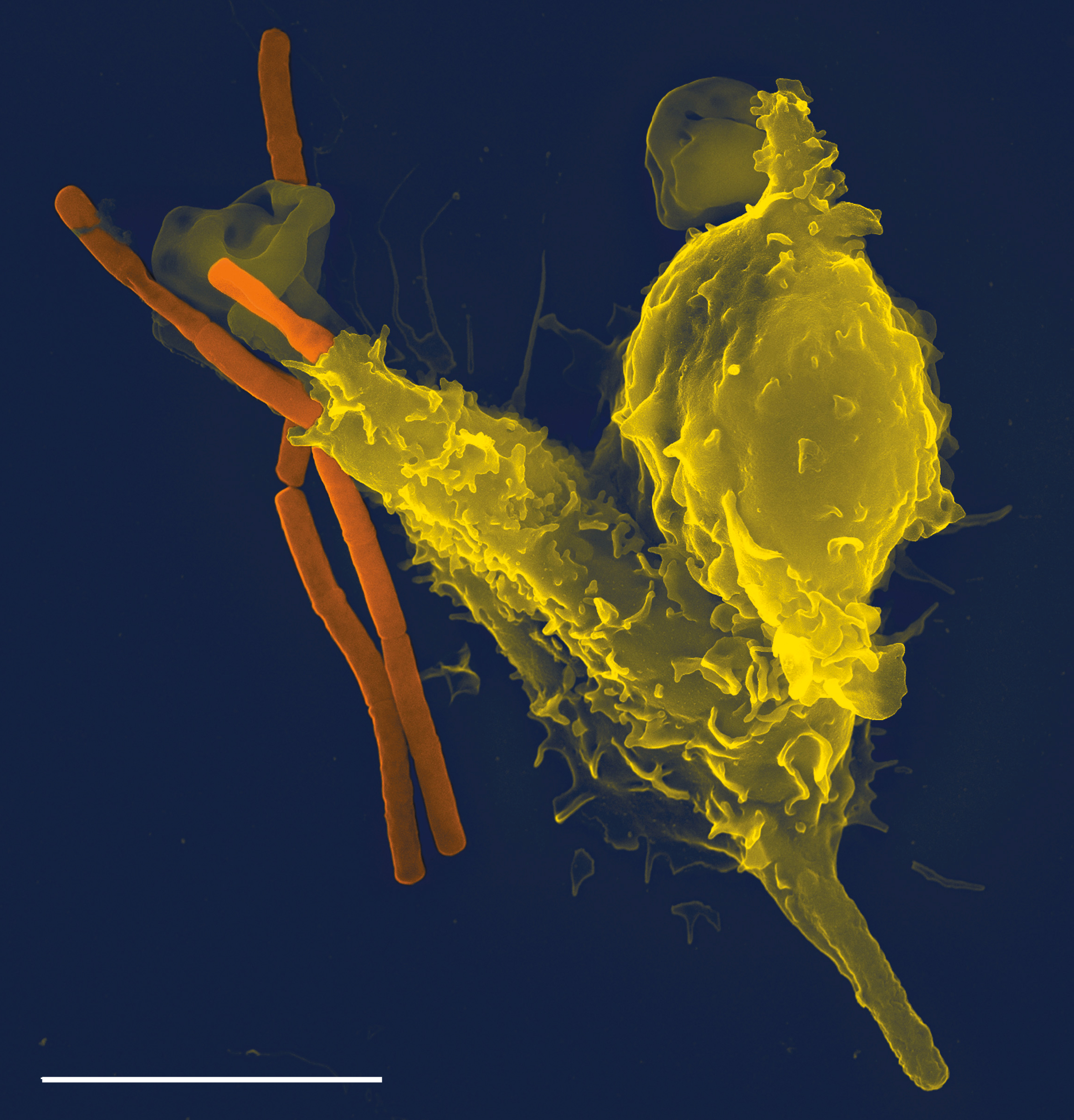
Image source: Wikipedia/Wikimedia
| Ecology, Host, and Life Cycle | |
|---|---|
| Oxygen requirements | Facultative anaerobe |
| Optimal temperature | 37 |
| Temperature range | Mesophilic |
| Habitat | Soil |
| Biotic relationship | Free living |
| Host(s) | Homo sapiens, Bos, Metazoa |
| Cell arrangement | Not Available |
| Sporulation | Sporulating |
| Energy source | Chemoheterotroph |
| Pathogenicity | Animal |
Genome Summary
NZ_CP029323.1
Gene Summary
Adenine Count
Not Available
Thymine Count
Not Available
Guanine Count
Not Available
Cytosine Count
Not Available
Genome Length
Not Available
Protein-coding Genes
5214 genes
Non-Coding Genes
307 genes
# of Chromosomes/Plasmids
6
Genes
| Name | Locus Tag | UniProt ID | Strand Orientation | Gene Start/End | Protein Molecular Weight |
|---|---|---|---|---|---|
| nitronate monooxygenase | CN504_20495 | Not Available | Positive | 3839870 - 3840964 | 39594.8 |
| d-alanyl-lipoteichoic acid biosynthesis protein dltd | CN504_20500 | Not Available | Negative | 3840982 - 3842157 | 45605.2 |
| d-alanine--poly(phosphoribitol) ligase subunit 2 | CN504_20505 | Not Available | Negative | 3842154 - 3842393 | 9261.98 |
| d-alanyl-lipoteichoic acid biosynthesis protein dltb | CN504_20510 | Not Available | Negative | 3842462 - 3843628 | 45592.9 |
| d-alanine--poly(phosphoribitol) ligase subunit 1 | CN504_20515 | Not Available | Negative | 3843625 - 3845139 | 56593.1 |
| teichoic acid d-ala incorporation-associated protein dltx | CN504_20520 | Not Available | Negative | 3845152 - 3845343 | 7720.41 |
| n-acyl-l-amino acid amidohydrolase | CN504_20525 | Not Available | Positive | 3845636 - 3846805 | 43153.8 |
| hypothetical protein | CN504_20530 | Not Available | Positive | 3847032 - 3847208 | 7072.58 |
| flavodoxin | CN504_20535 | Not Available | Positive | 3847201 - 3847647 | 16207.1 |
| hypothetical protein | CN504_20540 | Not Available | Positive | 3847672 - 3848445 | 30645.4 |
Pathways
0 pathways
No pathways found
No metabolic pathways have been associated with this bacterium yet.
Health Effects
| Health Condition | Relation | Reference |
|---|---|---|
| Anthrax | Causes | PMC4987991 |
| Anthrax | Causes | PMC6842932 |
| Anthrax | Causes | PMC11302227 |
| Anthrax | Causes | PMC11877637 |
| Anthrax | Causes | PMC5241308 |
| Anthrax | Causes | PMC6542083 |
| Anthrax | Causes | PMC8504768 |
| Anthrax-like disease | Causes | PMC8504768 |
| Anthrax | Causes | PMC7464528 |
| Anthrax | Causes | PMC1800911 |