Kingdom
Bacillati
Phylum
Bacillota
Class
Bacilli
Order
Caryophanales
Family
Bacillaceae
Genus
Bacillus
Description
Taxonomy
| Kingdom | Bacillati |
|---|---|
| Phylum | Bacillota |
| Class | Bacilli |
| Order | Caryophanales |
| Family | Bacillaceae |
| Genus | Bacillus |
| Species | Bacillus anthracis |
| Strain | No strain |
Profile
| Physiology | |
|---|---|
| Gram staining properties | Positive |
| Shape | Rod |
| Mobility | No |
| Flagellar presence | Yes |
| Number of membranes | 1 |

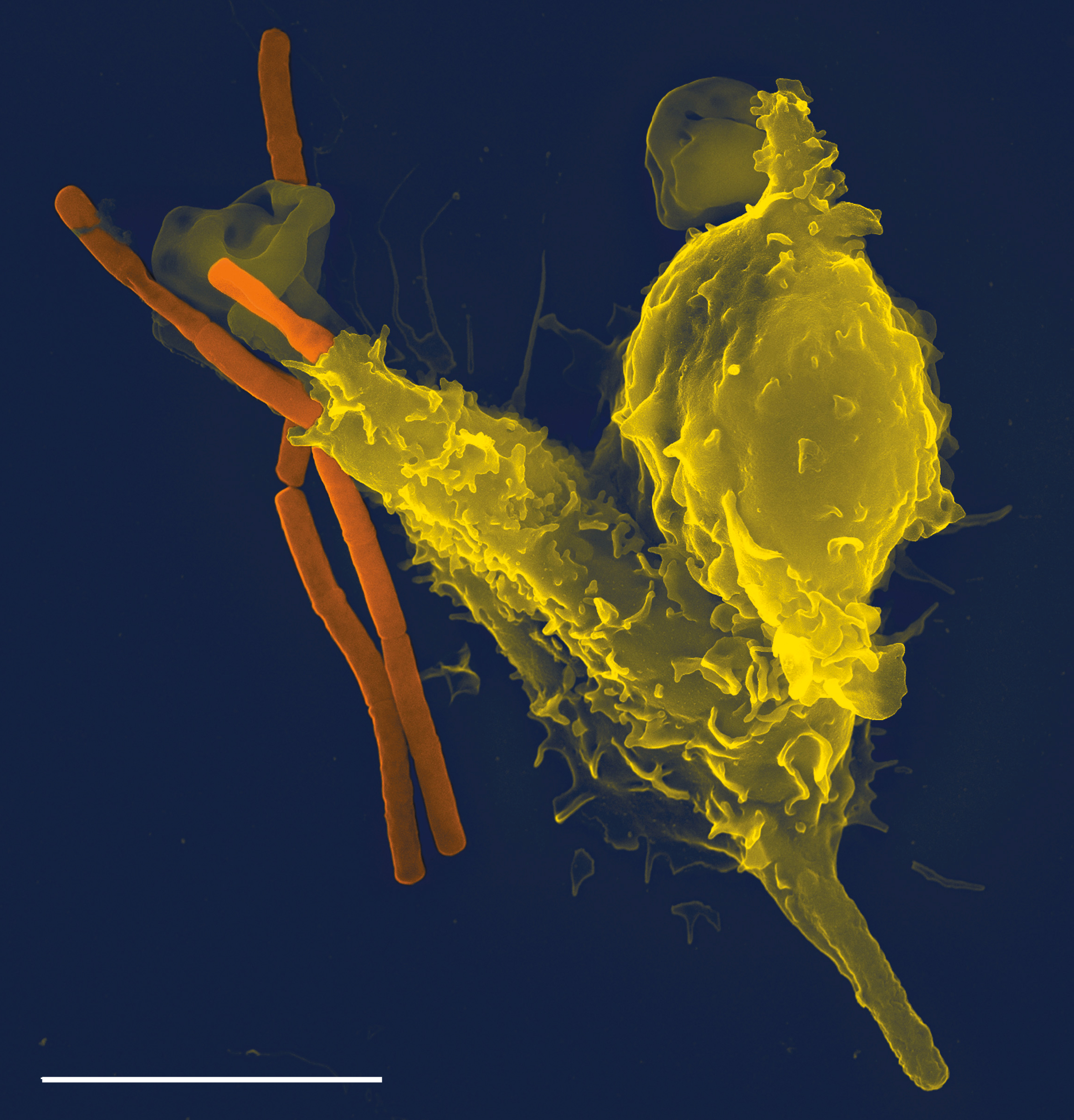
Image source: Wikipedia/Wikimedia
| Ecology, Host, and Life Cycle | |
|---|---|
| Oxygen requirements | Facultative anaerobe |
| Optimal temperature | 37 |
| Temperature range | Mesophilic |
| Habitat | Soil |
| Biotic relationship | Free living |
| Host(s) | Homo sapiens, Bos, Metazoa |
| Cell arrangement | Not Available |
| Sporulation | Sporulating |
| Energy source | Chemoheterotroph |
| Pathogenicity | Animal |
Genome Summary
NZ_CP029323.1
Gene Summary
Adenine Count
Not Available
Thymine Count
Not Available
Guanine Count
Not Available
Cytosine Count
Not Available
Genome Length
Not Available
Protein-coding Genes
5214 genes
Non-Coding Genes
307 genes
# of Chromosomes/Plasmids
6
Genes
| Name | Locus Tag | UniProt ID | Strand Orientation | Gene Start/End | Protein Molecular Weight |
|---|---|---|---|---|---|
| hypothetical protein | CN504_19880 | Not Available | Negative | 3732510 - 3733343 | 31288.3 |
| zinc ribbon domain-containing protein | CN504_19885 | Not Available | Positive | 3733540 - 3734325 | 28320.0 |
| zinc ribbon domain-containing protein | CN504_19890 | Not Available | Positive | 3734345 - 3735580 | 46743.9 |
| hypothetical protein | CN504_19895 | Not Available | Negative | 3735620 - 3736048 | 15162.8 |
| hypothetical protein | CN504_19900 | Not Available | Positive | 3736151 - 3736246 | 3847.9 |
| coa-disulfide reductase | CN504_19905 | Not Available | Positive | 3736248 - 3737582 | 49454.5 |
| gnat family n-acetyltransferase | CN504_19910 | Not Available | Positive | 3737683 - 3738171 | 19145.1 |
| duf3908 domain-containing protein | CN504_19915 | Not Available | Positive | 3738318 - 3738728 | 15858.9 |
| class i sam-dependent methyltransferase | CN504_19920 | Not Available | Negative | 3738759 - 3739349 | 22444.3 |
| nadh oxidase | CN504_19925 | Not Available | Negative | 3739441 - 3740982 | 58887.0 |
Pathways
0 pathways
No pathways found
No metabolic pathways have been associated with this bacterium yet.
Health Effects
| Health Condition | Relation | Reference |
|---|---|---|
| Anthrax | Causes | PMC4987991 |
| Anthrax | Causes | PMC6842932 |
| Anthrax | Causes | PMC11302227 |
| Anthrax | Causes | PMC11877637 |
| Anthrax | Causes | PMC5241308 |
| Anthrax | Causes | PMC6542083 |
| Anthrax | Causes | PMC8504768 |
| Anthrax-like disease | Causes | PMC8504768 |
| Anthrax | Causes | PMC7464528 |
| Anthrax | Causes | PMC1800911 |