Kingdom
Bacillati
Phylum
Bacillota
Class
Bacilli
Order
Caryophanales
Family
Bacillaceae
Genus
Bacillus
Description
Taxonomy
| Kingdom | Bacillati |
|---|---|
| Phylum | Bacillota |
| Class | Bacilli |
| Order | Caryophanales |
| Family | Bacillaceae |
| Genus | Bacillus |
| Species | Bacillus anthracis |
| Strain | No strain |
Profile
| Physiology | |
|---|---|
| Gram staining properties | Positive |
| Shape | Rod |
| Mobility | No |
| Flagellar presence | Yes |
| Number of membranes | 1 |

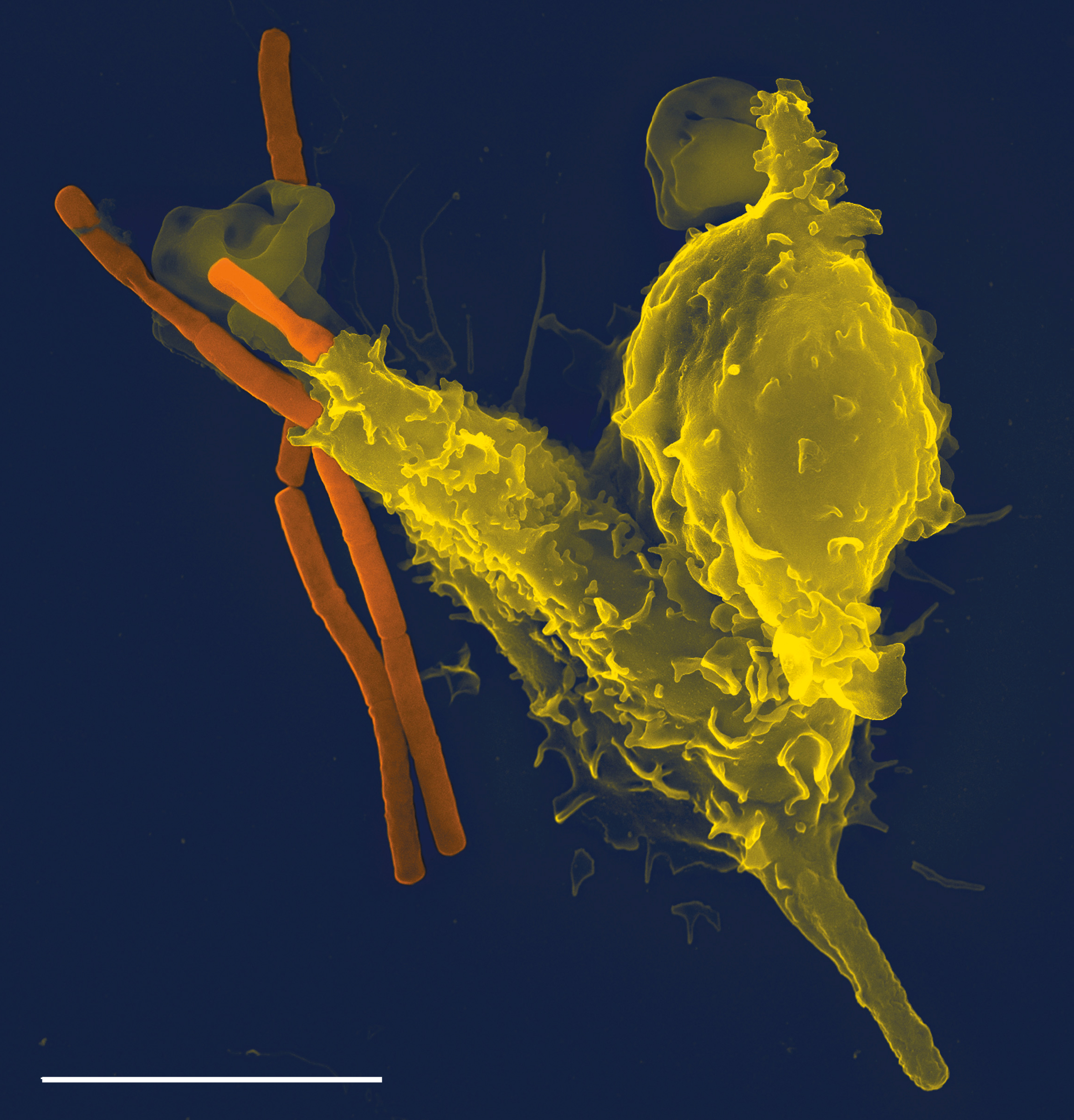
Image source: Wikipedia/Wikimedia
| Ecology, Host, and Life Cycle | |
|---|---|
| Oxygen requirements | Facultative anaerobe |
| Optimal temperature | 37 |
| Temperature range | Mesophilic |
| Habitat | Soil |
| Biotic relationship | Free living |
| Host(s) | Homo sapiens, Bos, Metazoa |
| Cell arrangement | Not Available |
| Sporulation | Sporulating |
| Energy source | Chemoheterotroph |
| Pathogenicity | Animal |
Genome Summary
NZ_CP029323.1
Gene Summary
Adenine Count
Not Available
Thymine Count
Not Available
Guanine Count
Not Available
Cytosine Count
Not Available
Genome Length
Not Available
Protein-coding Genes
5214 genes
Non-Coding Genes
307 genes
# of Chromosomes/Plasmids
6
Genes
| Name | Locus Tag | UniProt ID | Strand Orientation | Gene Start/End | Protein Molecular Weight |
|---|---|---|---|---|---|
| hypothetical protein | CN504_19300 | Not Available | Negative | 3633065 - 3633196 | 4908.18 |
| dna alkylation repair protein | CN504_19305 | Not Available | Negative | 3633367 - 3634080 | 28156.1 |
| hypothetical protein | CN504_19310 | Not Available | Positive | 3634199 - 3634666 | 17547.8 |
| hypothetical protein | CN504_19315 | Not Available | Negative | 3634725 - 3636059 | 48047.7 |
| or 3'-5' exonuclease kapd | CN504_19320 | Not Available | Positive | 3636340 - 3636963 | 23766.0 |
| kinase | CN504_19325 | Not Available | Negative | 3637005 - 3637388 | 14583.4 |
| superoxide dismutase | CN504_19330 | Not Available | Positive | 3637799 - 3638338 | 19052.9 |
| pyridoxal phosphate-dependent aminotransferase | CN504_19335 | Not Available | Negative | 3638475 - 3639626 | 43951.8 |
| duf1871 domain-containing protein | CN504_19340 | Not Available | Positive | 3639744 - 3639995 | 9475.39 |
| alpha/beta hydrolase | CN504_19345 | Not Available | Negative | 3640025 - 3640864 | 32293.9 |
Pathways
0 pathways
No pathways found
No metabolic pathways have been associated with this bacterium yet.
Health Effects
| Health Condition | Relation | Reference |
|---|---|---|
| Anthrax | Causes | PMC4987991 |
| Anthrax | Causes | PMC6842932 |
| Anthrax | Causes | PMC11302227 |
| Anthrax | Causes | PMC11877637 |
| Anthrax | Causes | PMC5241308 |
| Anthrax | Causes | PMC6542083 |
| Anthrax | Causes | PMC8504768 |
| Anthrax-like disease | Causes | PMC8504768 |
| Anthrax | Causes | PMC7464528 |
| Anthrax | Causes | PMC1800911 |