Kingdom
Bacillati
Phylum
Bacillota
Class
Bacilli
Order
Lactobacillales
Family
Streptococcaceae
Genus
Streptococcus
Description
Taxonomy
| Kingdom | Bacillati |
|---|---|
| Phylum | Bacillota |
| Class | Bacilli |
| Order | Lactobacillales |
| Family | Streptococcaceae |
| Genus | Streptococcus |
| Species | Streptococcus lutetiensis |
| Strain | No strain |
Profile
| Physiology | |
|---|---|
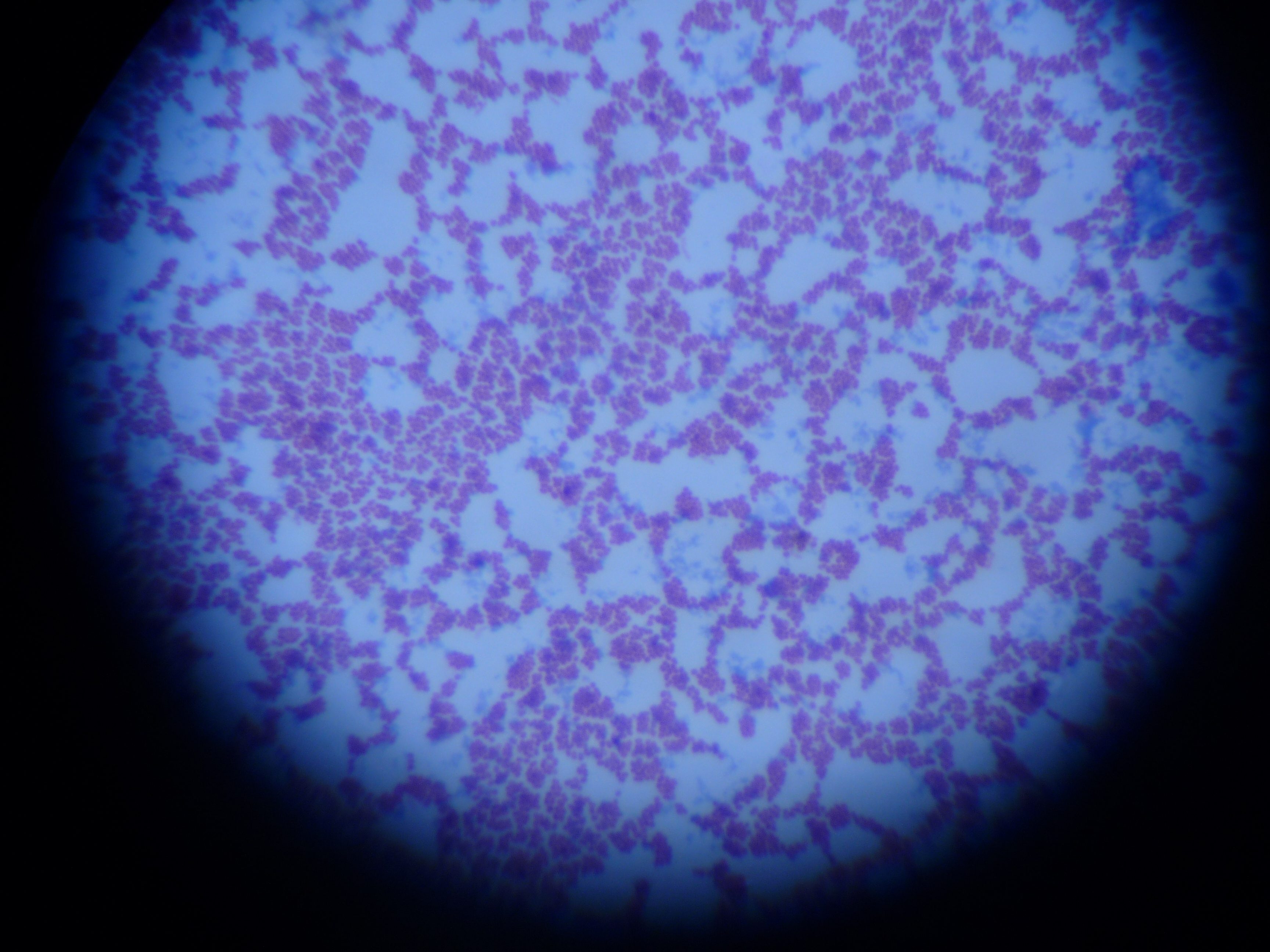
| Gram staining properties | Positive |
| Shape | Cocci |
| Mobility | Not Available |
| Flagellar presence | Yes |
| Number of membranes | Not Available |

Image source: Wikipedia/Wikimedia
| Ecology, Host, and Life Cycle | |
|---|---|
| Oxygen requirements | Facultative anaerobe |
| Optimal temperature | Not Available |
| Temperature range | Not Available |
| Habitat | dairy farms; dairy products; gastrointestinal tracts of ruminants; rumen |
| Biotic relationship | Not Available |
| Host(s) | Homo sapiens, Bos taurus, Bos |
| Cell arrangement | Not Available |
| Sporulation | Not Available |
| Energy source | Not Available |
| Pathogenicity | Not Available |
Genome Summary
Streptococcus lutetiensis strain NCTC11436 chromosome 1, complete
Gene Summary
Adenine Count
579202 bp
Thymine Count
574755 bp
Guanine Count
336279 bp
Cytosine Count
361800 bp
Genome Length
1852036 bp
Protein-coding Genes
1769 genes
Non-Coding Genes
133 genes
# of Chromosomes/Plasmids
2
Genes
| Name | Locus Tag | UniProt ID | Strand Orientation | Gene Start/End | Protein Molecular Weight |
|---|---|---|---|---|---|
| duf1797 family protein | EL020_RS03970 | Not Available | Positive | 749585 - 749815 | 8758.31 |
| amino acid abc transporter permease | EL020_RS03975 | Not Available | Positive | 750127 - 750813 | 25290.7 |
| amino acid abc transporter atp-binding protein | EL020_RS03980 | Not Available | Positive | 750813 - 751547 | 26778.7 |
| ferrous iron transport protein a | EL020_RS03985 | Not Available | Positive | 751913 - 752389 | 17479.4 |
| ferrous iron transport protein b | EL020_RS03990 | Not Available | Positive | 752386 - 754524 | 78237.8 |
| feob-associated cys-rich membrane protein | EL020_RS03995 | Not Available | Positive | 754530 - 754676 | 5174.56 |
| bifunctional methylenetetrahydrofolate dehydrogenase/methenyltetrahydrofolate cyclohydrolase | EL020_RS04000 | Not Available | Positive | 754815 - 755669 | 30961.8 |
| nad(p)h-hydrate dehydratase | EL020_RS04005 | Not Available | Positive | 755666 - 756499 | 29630.1 |
| ysirk-type signal peptide-containing protein | EL020_RS04010 | Not Available | Positive | 756822 - 757049 | 8086.59 |
| polc-type dna polymerase iii | EL020_RS04015 | Not Available | Positive | 757302 - 758291 | 37107.0 |
Pathways
0 pathways
No pathways found
No metabolic pathways have been associated with this bacterium yet.
Health Effects
| Health Condition | Relation | Reference |
|---|---|---|
| Bovine mastitis | Causes | PMC11726764 |
| Endocarditis | Causes | PMC6386949 |
| Bacteremia | Causes | PMC6386949 |
| Neonatal meningitis | Causes | PMC6386949 |
| Bovine mastitis | Causes | PMC10727937 |
| Bacteremia | Causes | PMC3102119 |
| Neonatal sepsis | Causes | PMC3102119 |
| Neonatal meningitis | Causes | PMC3102119 |
| Adult meningitis | Causes | PMC3102119 |