Kingdom
Bacillati
Phylum
Bacillota
Class
Bacilli
Order
Caryophanales
Family
Staphylococcaceae
Genus
Staphylococcus
Description
Taxonomy
| Kingdom | Bacillati |
|---|---|
| Phylum | Bacillota |
| Class | Bacilli |
| Order | Caryophanales |
| Family | Staphylococcaceae |
| Genus | Staphylococcus |
| Species | Staphylococcus pseudintermedius |
| Strain | No strain |
Profile
| Physiology | |
|---|---|
| Gram staining properties | Positive |
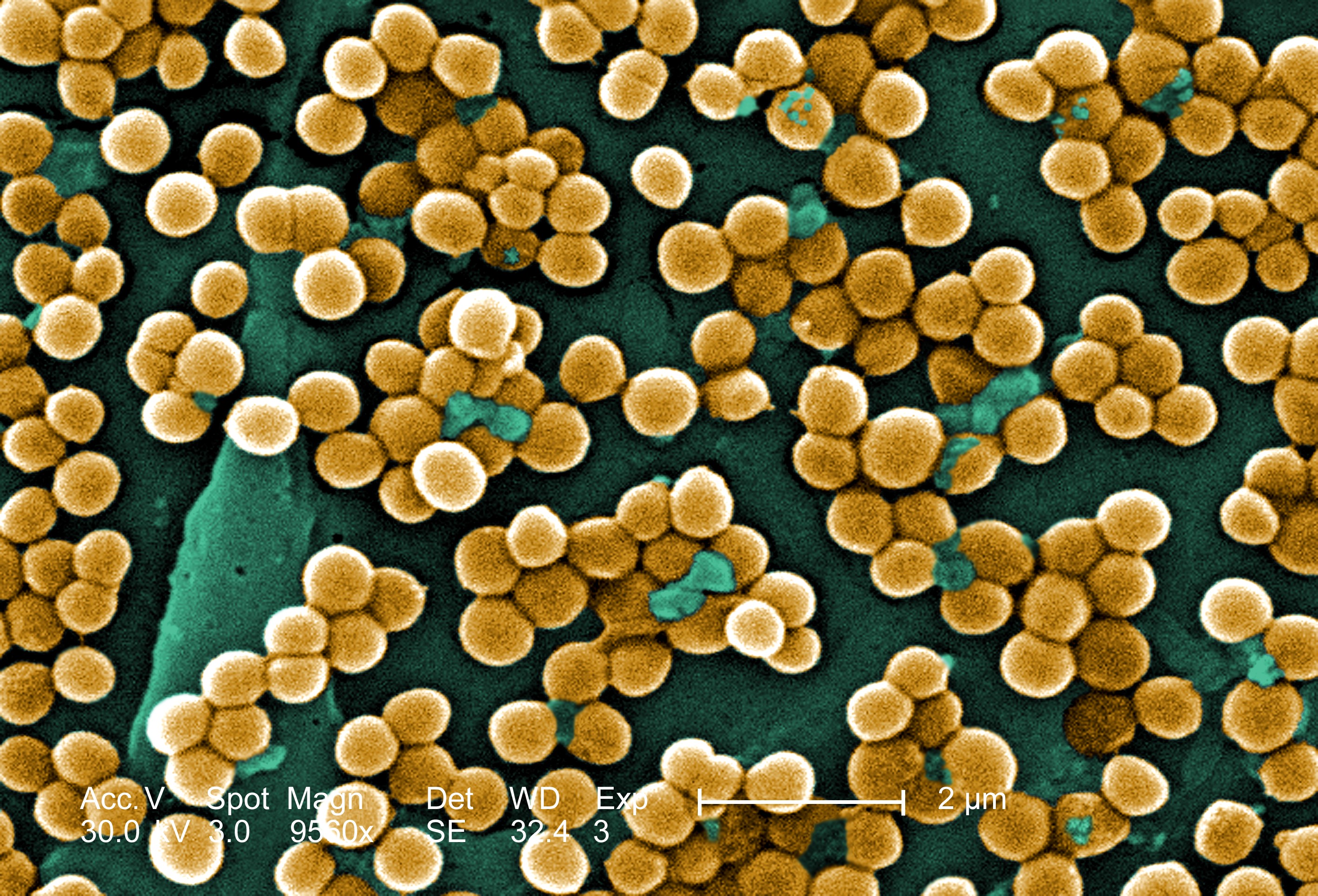
| Shape | Cocci |
| Mobility | No |
| Flagellar presence | Yes |
| Number of membranes | 1 |

Image source: Wikipedia/Wikimedia
| Ecology, Host, and Life Cycle | |
|---|---|
| Oxygen requirements | Facultative |
| Optimal temperature | 3 |
| Temperature range | Mesophilic |
| Habitat | HostAssociated |
| Biotic relationship | Free living |
| Host(s) | Homo sapiens, Gallus gallus, Bos taurus |
| Cell arrangement | Clusters - Singles |
| Sporulation | Not Available |
| Energy source | Not Available |
| Pathogenicity | Animal; Human |
Genome Summary
Staphylococcus pseudintermedius strain NCTC5661 chromosome 1.
Gene Summary
Adenine Count
802706 bp
Thymine Count
794250 bp
Guanine Count
487806 bp
Cytosine Count
478865 bp
Genome Length
2563627 bp
Protein-coding Genes
2292 genes
Non-Coding Genes
144 genes
# of Chromosomes/Plasmids
5
Genes
| Name | Locus Tag | UniProt ID | Strand Orientation | Gene Start/End | Protein Molecular Weight |
|---|---|---|---|---|---|
| Orf018 | DJ441_RS02500 | Not Available | Positive | 608252 - 608995 | 28579.1 |
| Hypothetical protein | DJ441_RS02505 | Not Available | Positive | 608992 - 609216 | 8400.15 |
| Hypothetical protein | DJ441_RS02510 | Not Available | Positive | 609204 - 609380 | 6547.16 |
| Orf058 | DJ441_RS02515 | Not Available | Positive | 609460 - 609720 | 9978.82 |
| hypothetical protein | DJ441_RS02520 | Not Available | Positive | 609732 - 609956 | 8762.26 |
| Hypothetical protein | DJ441_RS02525 | Not Available | Positive | 609940 - 610425 | 18137.5 |
| Erf-like recombinase | DJ441_RS02530 | Not Available | Positive | 610426 - 611094 | 25499.3 |
| Single-stranded dna-binding protein ssb | DJ441_RS02535 | Not Available | Positive | 611094 - 611531 | 16439.0 |
| Hypothetical protein | DJ441_RS02540 | Not Available | Positive | 611715 - 612383 | 25725.6 |
| 77orf016 | DJ441_RS02545 | Not Available | Positive | 612380 - 613093 | 27574.2 |
Pathways
1120 pathways
Health Effects
| Health Condition | Relation | Reference |
|---|---|---|
| Skin and soft tissue infections | Causes | PMC10127087 |
| Bones and joint infections | Causes | PMC10127087 |
| Infective endocarditis | Causes | PMC10127087 |
| Cardiovascular disorders | Causes | PMC10127087 |
| Osteomyelitis | Causes | PMC10127087 |
| Bacteremia | Causes | PMC10127087 |
| Pneumonia | Causes | PMC10127087 |
| Skin and soft tissue infections | Causes | PMC10269700 |
| Endocarditis | Causes | PMC10269700 |
| Pneumonia | Causes | PMC10269700 |