
Kingdom
Pseudomonadati
Phylum
Pseudomonadota
Class
Gammaproteobacteria
Order
Chromatiales
Family
Ectothiorhodospiraceae
Genus
Halorhodospira
Description
Taxonomy
| Kingdom | Pseudomonadati |
|---|---|
| Phylum | Pseudomonadota |
| Class | Gammaproteobacteria |
| Order | Chromatiales |
| Family | Ectothiorhodospiraceae |
| Genus | Halorhodospira |
| Species | Halorhodospira halochloris |
| Strain | DSM 1059 |
Profile
| Physiology | |
|---|---|
| Gram staining properties | Negative |
| Shape | Spirilla |
| Mobility | Not Available |
| Flagellar presence | Yes |
| Number of membranes | Not Available |
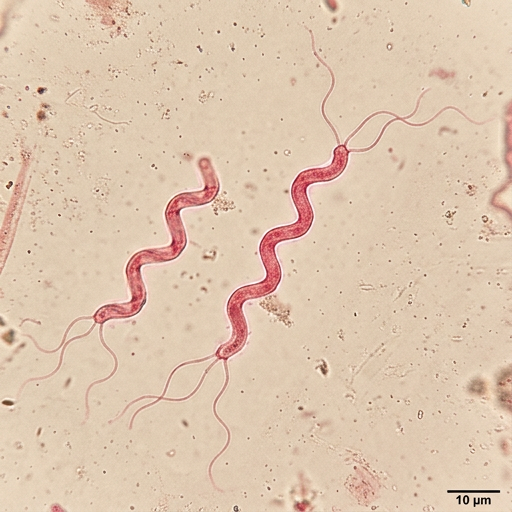
AI-generated image based on bacteria physiology
| Ecology, Host, and Life Cycle | |
|---|---|
| Oxygen requirements | anaerobic |
| Optimal temperature | Not Available |
| Temperature range | Not Available |
| Habitat | Not Available |
| Biotic relationship | Not Available |
| Host(s) | Not Available |
| Cell arrangement | Not Available |
| Sporulation | Not Available |
| Energy source | Not Available |
| Pathogenicity | Not Available |
Gene Summary
Adenine Count
622182 bp
Thymine Count
624232 bp
Guanine Count
791609 bp
Cytosine Count
796537 bp
Genome Length
2834560 bp
Protein-coding Genes
2526 genes
Non-Coding Genes
66 genes
# of Chromosomes/Plasmids
1
Genes
| Name | Locus Tag | UniProt ID | Strand Orientation | Gene Start/End | Protein Molecular Weight |
|---|---|---|---|---|---|
| bifunctional dna-formamidopyrimidine glycosylase/dna-(apurinic or apyrimidinic site) lyase | HH1059_RS00735 | Not Available | Positive | 154785 - 155603 | 30378.8 |
| rna polymerase sigma factor rpoh | HH1059_RS00740 | Not Available | Negative | 155709 - 156578 | 32860.0 |
| permease-like cell division protein ftsx | HH1059_RS00745 | Not Available | Negative | 156767 - 157840 | 39017.5 |
| cell division atp-binding protein ftse | HH1059_RS00750 | Not Available | Negative | 157840 - 158520 | 24460.8 |
| signal recognition particle-docking protein ftsy | HH1059_RS00755 | Not Available | Negative | 158517 - 159464 | 33845.5 |
| 16s rrna (guanine(966)-n(2))-methyltransferase rsmd | HH1059_RS00760 | Not Available | Positive | 159739 - 160308 | 20623.8 |
| pantetheine-phosphate adenylyltransferase | HH1059_RS00765 | Not Available | Positive | 160324 - 160818 | 18174.7 |
| radc family protein | HH1059_RS00770 | Not Available | Negative | 160940 - 161614 | 24888.9 |
| mapeg family protein | HH1059_RS00775 | Not Available | Positive | 161753 - 162133 | 13861.9 |
| bifunctional phosphopantothenoylcysteine decarboxylase/phosphopantothenate synthase | HH1059_RS00780 | Not Available | Positive | 162145 - 163413 | 44650.7 |
Pathways
0 pathways
No pathways found
No metabolic pathways have been associated with this bacterium yet.
Health Effects
No health effects information available for this bacterium.