
Kingdom
Pseudomonadati
Phylum
Bdellovibrionota
Class
Bacteriovoracia
Order
Bacteriovoracales
Family
Bacteriovoracaceae
Genus
Bacteriovorax
Description
Taxonomy
| Kingdom | Pseudomonadati |
|---|---|
| Phylum | Bdellovibrionota |
| Class | Bacteriovoracia |
| Order | Bacteriovoracales |
| Family | Bacteriovoracaceae |
| Genus | Bacteriovorax |
| Species | Bacteriovorax stolpii |
| Strain | No strain |
Profile
| Physiology | |
|---|---|
| Gram staining properties | Gram-negative |
| Shape | Curved rod |
| Mobility | Not Available |
| Flagellar presence | Yes |
| Number of membranes | Not Available |
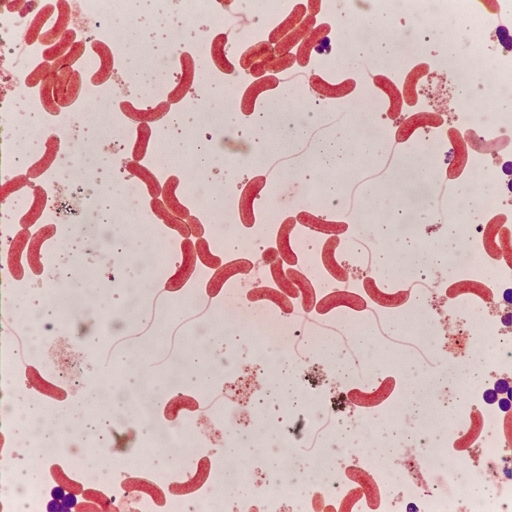
AI-generated image based on bacteria physiology
| Ecology, Host, and Life Cycle | |
|---|---|
| Oxygen requirements | Not Available |
| Optimal temperature | 25 |
| Temperature range | mesophilic |
| Habitat | Fresh water; gut; soil |
| Biotic relationship | Not Available |
| Host(s) | Oncorhynchus mykiss |
| Cell arrangement | Not Available |
| Sporulation | Not Available |
| Energy source | Not Available |
| Pathogenicity | Not Available |
Gene Summary
Adenine Count
1120980 bp
Thymine Count
1131634 bp
Guanine Count
776977 bp
Cytosine Count
780718 bp
Genome Length
3810309 bp
Protein-coding Genes
3767 genes
Non-Coding Genes
42 genes
# of Chromosomes/Plasmids
1
Genes
| Name | Locus Tag | UniProt ID | Strand Orientation | Gene Start/End | Protein Molecular Weight |
|---|---|---|---|---|---|
| ycao-like family protein | C0V70_RS08220 | Not Available | Positive | 1651318 - 1652259 | 35657.7 |
| sensor histidine kinase | C0V70_RS08225 | Not Available | Positive | 1652256 - 1653881 | 61101.1 |
| hypothetical protein | C0V70_RS08230 | Not Available | Positive | 1654128 - 1654826 | 26214.5 |
| hypothetical protein | C0V70_RS08235 | Not Available | Positive | 1654829 - 1657357 | 92174.2 |
| hypothetical protein | C0V70_RS08240 | Not Available | Negative | 1657467 - 1657964 | 17752.6 |
| carboxyl transferase domain-containing protein | C0V70_RS08245 | Not Available | Positive | 1658138 - 1659760 | 58987.7 |
| enoyl-coa hydratase-related protein | C0V70_RS08250 | Not Available | Positive | 1659775 - 1660551 | 28139.0 |
| acetyl/propionyl/methylcrotonyl-coa carboxylase subunit alpha | C0V70_RS08255 | Not Available | Positive | 1660554 - 1662053 | 55510.0 |
| acetyl-coa carboxylase biotin carboxyl carrier protein subunit | C0V70_RS08260 | Not Available | Positive | 1662053 - 1662523 | 17361.1 |
| hydroxymethylglutaryl-coa lyase | C0V70_RS08265 | Not Available | Positive | 1662517 - 1663437 | 32853.7 |
Pathways
0 pathways
No pathways found
No metabolic pathways have been associated with this bacterium yet.
Health Effects
No health effects information available for this bacterium.