
Kingdom
Pseudomonadati
Phylum
Bdellovibrionota
Class
Bacteriovoracia
Order
Bacteriovoracales
Family
Bacteriovoracaceae
Genus
Bacteriovorax
Description
Taxonomy
| Kingdom | Pseudomonadati |
|---|---|
| Phylum | Bdellovibrionota |
| Class | Bacteriovoracia |
| Order | Bacteriovoracales |
| Family | Bacteriovoracaceae |
| Genus | Bacteriovorax |
| Species | Bacteriovorax stolpii |
| Strain | No strain |
Profile
| Physiology | |
|---|---|
| Gram staining properties | Gram-negative |
| Shape | Curved rod |
| Mobility | Not Available |
| Flagellar presence | Yes |
| Number of membranes | Not Available |
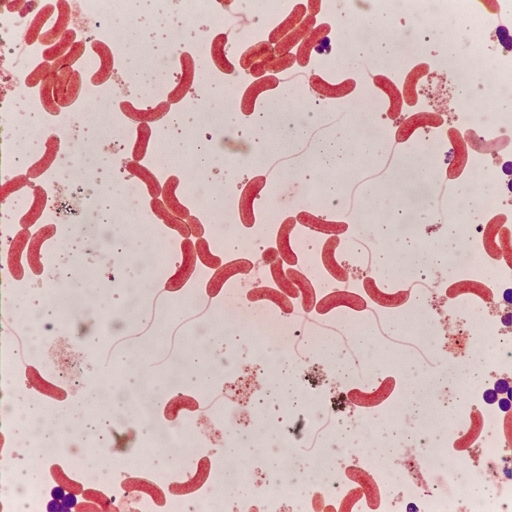
AI-generated image based on bacteria physiology
| Ecology, Host, and Life Cycle | |
|---|---|
| Oxygen requirements | Not Available |
| Optimal temperature | 25 |
| Temperature range | mesophilic |
| Habitat | Fresh water; gut; soil |
| Biotic relationship | Not Available |
| Host(s) | Oncorhynchus mykiss |
| Cell arrangement | Not Available |
| Sporulation | Not Available |
| Energy source | Not Available |
| Pathogenicity | Not Available |
Gene Summary
Adenine Count
1120980 bp
Thymine Count
1131634 bp
Guanine Count
776977 bp
Cytosine Count
780718 bp
Genome Length
3810309 bp
Protein-coding Genes
3767 genes
Non-Coding Genes
42 genes
# of Chromosomes/Plasmids
1
Genes
| Name | Locus Tag | UniProt ID | Strand Orientation | Gene Start/End | Protein Molecular Weight |
|---|---|---|---|---|---|
| rhomboid family intramembrane serine protease | C0V70_RS07475 | Not Available | Positive | 1496293 - 1497195 | 34709.3 |
| hypothetical protein | C0V70_RS07480 | Not Available | Positive | 1497206 - 1497451 | 9602.69 |
| hypothetical protein | C0V70_RS07485 | Not Available | Positive | 1497453 - 1497854 | 15448.4 |
| gnat family n-acetyltransferase | C0V70_RS07490 | Not Available | Negative | 1497855 - 1498295 | 16913.3 |
| hypothetical protein | C0V70_RS07495 | Not Available | Negative | 1498337 - 1498837 | 19185.0 |
| toprim domain-containing protein | C0V70_RS07500 | Not Available | Positive | 1499061 - 1501145 | 78339.8 |
| dna gyrase subunit a | C0V70_RS07505 | Not Available | Positive | 1501166 - 1502599 | 55562.5 |
| integration host factor subunit alpha | C0V70_RS19355 | Not Available | Positive | 1502719 - 1503150 | 15953.7 |
| merr family transcriptional regulator | C0V70_RS07515 | Not Available | Positive | 1503183 - 1503719 | 20468.4 |
| polyprenyl synthetase family protein | C0V70_RS07520 | Not Available | Negative | 1503675 - 1504616 | 35352.8 |
Pathways
0 pathways
No pathways found
No metabolic pathways have been associated with this bacterium yet.
Health Effects
No health effects information available for this bacterium.