Kingdom
Pseudomonadati
Phylum
Pseudomonadota
Class
Gammaproteobacteria
Order
Vibrionales
Family
Vibrionaceae
Genus
Vibrio
Description
Taxonomy
| Kingdom | Pseudomonadati |
|---|---|
| Phylum | Pseudomonadota |
| Class | Gammaproteobacteria |
| Order | Vibrionales |
| Family | Vibrionaceae |
| Genus | Vibrio |
| Species | Vibrio vulnificus |
| Strain | No strain |
Profile
| Physiology | |
|---|---|
| Gram staining properties | Negative |
| Shape | Rod |
| Mobility | Yes |
| Flagellar presence | Yes |
| Number of membranes | 2 |

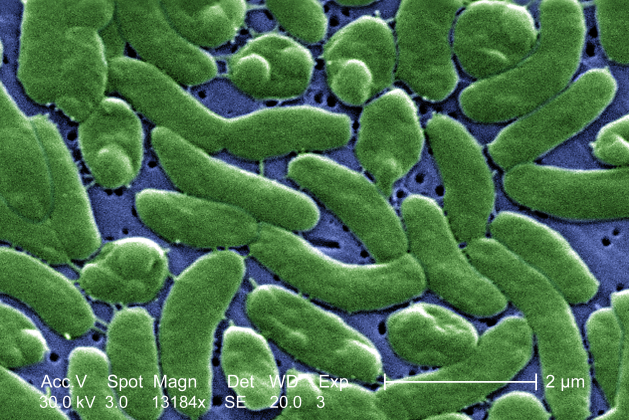
Image source: Wikipedia/Wikimedia
| Ecology, Host, and Life Cycle | |
|---|---|
| Oxygen requirements | Facultative anaerobe |
| Optimal temperature | 20 |
| Temperature range | Mesophilic |
| Habitat | Aquatic |
| Biotic relationship | Free living |
| Host(s) | Homo sapiens, Penaeus vannamei, Ostreidae |
| Cell arrangement | Singles |
| Sporulation | Not Available |
| Energy source | Heterotroph |
| Pathogenicity | Human |
Gene Summary
Adenine Count
1572196 bp
Thymine Count
1573432 bp
Guanine Count
1353116 bp
Cytosine Count
1350436 bp
Genome Length
5849180 bp
Protein-coding Genes
6478 genes
Non-Coding Genes
141 genes
# of Chromosomes/Plasmids
3
Genes
| Name | Locus Tag | UniProt ID | Strand Orientation | Gene Start/End | Protein Molecular Weight |
|---|---|---|---|---|---|
| methyl-accepting chemotaxis protein | CRN52_00090 | Not Available | Positive | 19088 - 20974 | 67427.5 |
| phosphate abc transporter substrate-binding protein | CRN52_00095 | Not Available | Negative | 21061 - 21882 | 29759.7 |
| duf3024 domain-containing protein | CRN52_00100 | Not Available | Positive | 22101 - 22457 | 13634.3 |
| arac family transcriptional regulator | CRN52_00105 | Not Available | Negative | 22513 - 23340 | 31133.6 |
| exoribonuclease 2 | CRN52_00110 | Not Available | Negative | 23455 - 25449 | 75073.3 |
| atp-dependent rna helicase | CRN52_00115 | Not Available | Positive | 25827 - 27752 | 71615.7 |
| acetate kinase | CRN52_00120 | Not Available | Positive | 28094 - 29287 | 42597.0 |
| arylsulfatase | CRN52_00125 | Not Available | Negative | 29417 - 30982 | 58636.6 |
| lysr family transcriptional regulator | CRN52_00130 | Not Available | Negative | 31254 - 32123 | 32845.8 |
| arylsulfatase | CRN52_00135 | Not Available | Positive | 32246 - 33763 | 56423.8 |
Health Effects
| Health Condition | Relation | Reference |
|---|---|---|
| Vibriosis | Causes | PMC10472736 |
| Pneumonia | Causes | PMC12801787 |
| Wound infections | Causes | PMC13070559 |
| Septicemia | Causes | PMC13070559 |
| Necrotizing soft tissue infection | Causes | PMC13070559 |
| Primary septicemia | Causes | PMC13070559 |
| Peritonitis | Causes | PMC7146884 |
| Septicemia | Causes | PMC7146884 |
| Myositis | Causes | PMC7146884 |
| Necrotizing fasciitis | Causes | PMC7146884 |