Kingdom
Pseudomonadati
Phylum
Pseudomonadota
Class
Gammaproteobacteria
Order
Vibrionales
Family
Vibrionaceae
Genus
Vibrio
Description
Taxonomy
| Kingdom | Pseudomonadati |
|---|---|
| Phylum | Pseudomonadota |
| Class | Gammaproteobacteria |
| Order | Vibrionales |
| Family | Vibrionaceae |
| Genus | Vibrio |
| Species | Vibrio vulnificus |
| Strain | FORC_036 |
Profile
| Physiology | |
|---|---|
| Gram staining properties | Negative |
| Shape | Rod |
| Mobility | Yes |
| Flagellar presence | Yes |
| Number of membranes | 2 |

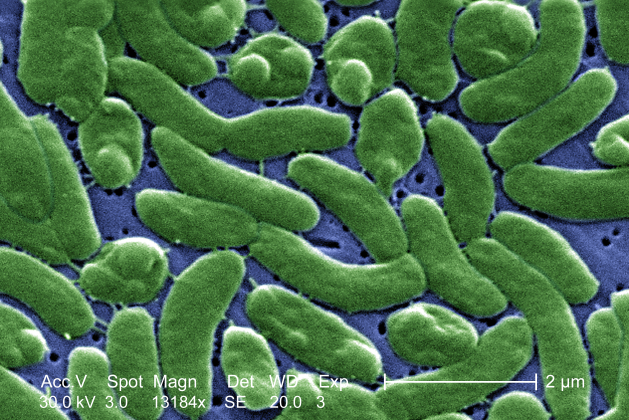
Image source: Wikipedia/Wikimedia
| Ecology, Host, and Life Cycle | |
|---|---|
| Oxygen requirements | Facultative anaerobe |
| Optimal temperature | 20 |
| Temperature range | Mesophilic |
| Habitat | Aquatic |
| Biotic relationship | Free living |
| Host(s) | Homo sapiens, Penaeus vannamei, Ostreidae |
| Cell arrangement | Singles |
| Sporulation | Not Available |
| Energy source | Heterotroph |
| Pathogenicity | Human |
Genome Summary
Vibrio vulnificus strain FORC_036 plasmid unnamed, complete
Gene Summary
Adenine Count
Not Available
Thymine Count
Not Available
Guanine Count
Not Available
Cytosine Count
Not Available
Genome Length
Not Available
Protein-coding Genes
1073 genes
Non-Coding Genes
85 genes
# of Chromosomes/Plasmids
3
Genes
| Name | Locus Tag | UniProt ID | Strand Orientation | Gene Start/End | Protein Molecular Weight |
|---|---|---|---|---|---|
| cpxcg motif-containing cysteine-rich protein | FORC36_RS07575 | Not Available | Positive | 1646071 - 1646274 | 7613.92 |
| riboflavin synthase | FORC36_RS07580 | Not Available | Negative | 1646302 - 1646922 | 22303.0 |
| mate family efflux transporter | FORC36_RS07585 | Not Available | Positive | 1647158 - 1648528 | 49178.8 |
| trbc/virb2 family protein | FORC36_RS07590 | Not Available | Negative | 1648630 - 1649253 | 23276.5 |
| hypothetical protein | FORC36_RS07595 | Not Available | Negative | 1649261 - 1649833 | 21188.7 |
| hypothetical protein | FORC36_RS07600 | Not Available | Positive | 1650898 - 1653090 | 82345.5 |
| paar domain-containing protein | FORC36_RS29665 | Not Available | Positive | 1653335 - 1653528 | 6889.49 |
| paar domain-containing protein | FORC36_RS07605 | Not Available | Positive | 1653665 - 1654863 | 42630.6 |
| hypothetical protein | FORC36_RS07610 | Not Available | Negative | 1654858 - 1655013 | 5749.04 |
| hypothetical protein | FORC36_RS07615 | Not Available | Negative | 1654998 - 1655414 | 16069.4 |
Health Effects
| Health Condition | Relation | Reference |
|---|---|---|
| Vibriosis | Causes | PMC10472736 |
| Pneumonia | Causes | PMC12801787 |
| Wound infections | Causes | PMC13070559 |
| Septicemia | Causes | PMC13070559 |
| Necrotizing soft tissue infection | Causes | PMC13070559 |
| Primary septicemia | Causes | PMC13070559 |
| Peritonitis | Causes | PMC7146884 |
| Septicemia | Causes | PMC7146884 |
| Myositis | Causes | PMC7146884 |
| Necrotizing fasciitis | Causes | PMC7146884 |