Kingdom
Pseudomonadati
Phylum
Pseudomonadota
Class
Gammaproteobacteria
Order
Vibrionales
Family
Vibrionaceae
Genus
Vibrio
Description
Taxonomy
| Kingdom | Pseudomonadati |
|---|---|
| Phylum | Pseudomonadota |
| Class | Gammaproteobacteria |
| Order | Vibrionales |
| Family | Vibrionaceae |
| Genus | Vibrio |
| Species | Vibrio vulnificus |
| Strain | FORC_036 |
Profile
| Physiology | |
|---|---|
| Gram staining properties | Negative |
| Shape | Rod |
| Mobility | Yes |
| Flagellar presence | Yes |
| Number of membranes | 2 |

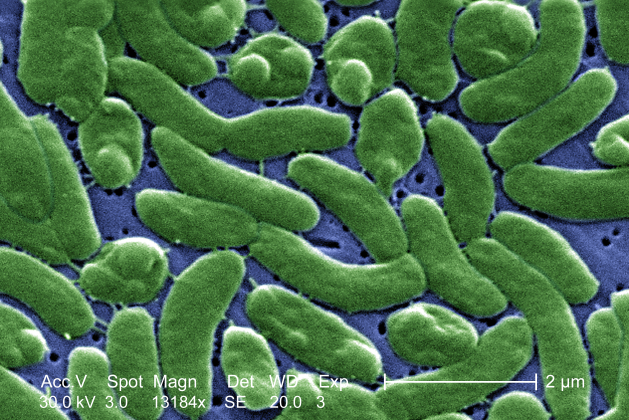
Image source: Wikipedia/Wikimedia
| Ecology, Host, and Life Cycle | |
|---|---|
| Oxygen requirements | Facultative anaerobe |
| Optimal temperature | 20 |
| Temperature range | Mesophilic |
| Habitat | Aquatic |
| Biotic relationship | Free living |
| Host(s) | Homo sapiens, Penaeus vannamei, Ostreidae |
| Cell arrangement | Singles |
| Sporulation | Not Available |
| Energy source | Heterotroph |
| Pathogenicity | Human |
Genome Summary
Vibrio vulnificus strain FORC_036 plasmid unnamed, complete
Gene Summary
Adenine Count
Not Available
Thymine Count
Not Available
Guanine Count
Not Available
Cytosine Count
Not Available
Genome Length
Not Available
Protein-coding Genes
1073 genes
Non-Coding Genes
85 genes
# of Chromosomes/Plasmids
3
Genes
| Name | Locus Tag | UniProt ID | Strand Orientation | Gene Start/End | Protein Molecular Weight |
|---|---|---|---|---|---|
| mmpl family transporter | FORC36_RS04340 | Not Available | Negative | 908455 - 910725 | 83140.2 |
| outer membrane lipoprotein carrier protein lola | FORC36_RS04345 | Not Available | Negative | 910754 - 911410 | 25127.9 |
| acyl-coa thioesterase | FORC36_RS04350 | Not Available | Negative | 911380 - 911826 | 17271.7 |
| histidine ammonia-lyase | FORC36_RS04355 | Not Available | Negative | 911835 - 913379 | 56596.8 |
| glycosyltransferase family 2 protein | FORC36_RS04360 | Not Available | Negative | 913357 - 915066 | 65339.6 |
| 3-hydroxyacyl-acp dehydratase | FORC36_RS04365 | Not Available | Negative | 915059 - 915430 | 13671.3 |
| amp-binding protein | FORC36_RS04370 | Not Available | Negative | 915443 - 916810 | 51182.2 |
| septation protein ispz | FORC36_RS04375 | Not Available | Negative | 916818 - 917375 | 20840.2 |
| acyl carrier protein | FORC36_RS04380 | Not Available | Negative | 917379 - 917633 | 9519.26 |
| phosphopantetheine-binding protein | FORC36_RS04385 | Not Available | Negative | 917650 - 917910 | 9389.99 |
Health Effects
| Health Condition | Relation | Reference |
|---|---|---|
| Vibriosis | Causes | PMC10472736 |
| Pneumonia | Causes | PMC12801787 |
| Wound infections | Causes | PMC13070559 |
| Septicemia | Causes | PMC13070559 |
| Necrotizing soft tissue infection | Causes | PMC13070559 |
| Primary septicemia | Causes | PMC13070559 |
| Peritonitis | Causes | PMC7146884 |
| Septicemia | Causes | PMC7146884 |
| Myositis | Causes | PMC7146884 |
| Necrotizing fasciitis | Causes | PMC7146884 |