Kingdom
Pseudomonadati
Phylum
Pseudomonadota
Class
Gammaproteobacteria
Order
Vibrionales
Family
Vibrionaceae
Genus
Vibrio
Description
Taxonomy
| Kingdom | Pseudomonadati |
|---|---|
| Phylum | Pseudomonadota |
| Class | Gammaproteobacteria |
| Order | Vibrionales |
| Family | Vibrionaceae |
| Genus | Vibrio |
| Species | Vibrio vulnificus |
| Strain | FORC_036 |
Profile
| Physiology | |
|---|---|
| Gram staining properties | Negative |
| Shape | Rod |
| Mobility | Yes |
| Flagellar presence | Yes |
| Number of membranes | 2 |

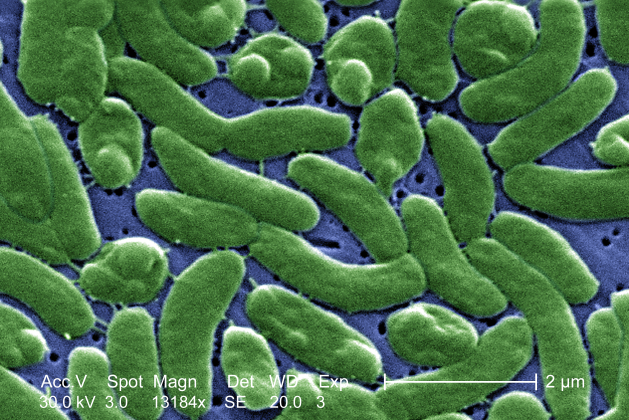
Image source: Wikipedia/Wikimedia
| Ecology, Host, and Life Cycle | |
|---|---|
| Oxygen requirements | Facultative anaerobe |
| Optimal temperature | 20 |
| Temperature range | Mesophilic |
| Habitat | Aquatic |
| Biotic relationship | Free living |
| Host(s) | Homo sapiens, Penaeus vannamei, Ostreidae |
| Cell arrangement | Singles |
| Sporulation | Not Available |
| Energy source | Heterotroph |
| Pathogenicity | Human |
Genome Summary
Vibrio vulnificus strain FORC_036 plasmid unnamed, complete
Gene Summary
Adenine Count
Not Available
Thymine Count
Not Available
Guanine Count
Not Available
Cytosine Count
Not Available
Genome Length
Not Available
Protein-coding Genes
1073 genes
Non-Coding Genes
85 genes
# of Chromosomes/Plasmids
3
Genes
| Name | Locus Tag | UniProt ID | Strand Orientation | Gene Start/End | Protein Molecular Weight |
|---|---|---|---|---|---|
| duf1249 family protein | FORC36_RS01980 | Not Available | Positive | 401361 - 401810 | 17157.8 |
| 3',5'-cyclic-amp phosphodiesterase | FORC36_RS01985 | Not Available | Positive | 401829 - 402653 | 30551.2 |
| esterase yqia | FORC36_RS01990 | Not Available | Positive | 402655 - 403245 | 22212.4 |
| dna topoisomerase iv subunit b | FORC36_RS01995 | Not Available | Positive | 403482 - 405362 | 69531.9 |
| dna topoisomerase iv subunit a | FORC36_RS02000 | Not Available | Positive | 405366 - 407651 | 84547.1 |
| outer membrane-stress sensor serine endopeptidase degs | FORC36_RS02005 | Not Available | Negative | 407728 - 408795 | 37625.3 |
| degq family serine endoprotease | FORC36_RS02010 | Not Available | Negative | 408927 - 410294 | 48270.0 |
| z-ring associated protein zapg | FORC36_RS02015 | Not Available | Negative | 410452 - 410901 | 16640.7 |
| cell division protein zape | FORC36_RS02020 | Not Available | Positive | 411061 - 412164 | 42767.4 |
| 50s ribosomal protein l13 | FORC36_RS02030 | Not Available | Positive | 412416 - 412844 | 15906.5 |
Health Effects
| Health Condition | Relation | Reference |
|---|---|---|
| Vibriosis | Causes | PMC10472736 |
| Pneumonia | Causes | PMC12801787 |
| Wound infections | Causes | PMC13070559 |
| Septicemia | Causes | PMC13070559 |
| Necrotizing soft tissue infection | Causes | PMC13070559 |
| Primary septicemia | Causes | PMC13070559 |
| Peritonitis | Causes | PMC7146884 |
| Septicemia | Causes | PMC7146884 |
| Myositis | Causes | PMC7146884 |
| Necrotizing fasciitis | Causes | PMC7146884 |