Kingdom
Pseudomonadati
Phylum
Pseudomonadota
Class
Gammaproteobacteria
Order
Vibrionales
Family
Vibrionaceae
Genus
Vibrio
Description
Taxonomy
| Kingdom | Pseudomonadati |
|---|---|
| Phylum | Pseudomonadota |
| Class | Gammaproteobacteria |
| Order | Vibrionales |
| Family | Vibrionaceae |
| Genus | Vibrio |
| Species | Vibrio parahaemolyticus |
| Strain | 229 |
Profile
| Physiology | |
|---|---|
| Gram staining properties | Negative |
| Shape | Rod |
| Mobility | Yes |
| Flagellar presence | Yes |
| Number of membranes | 2 |

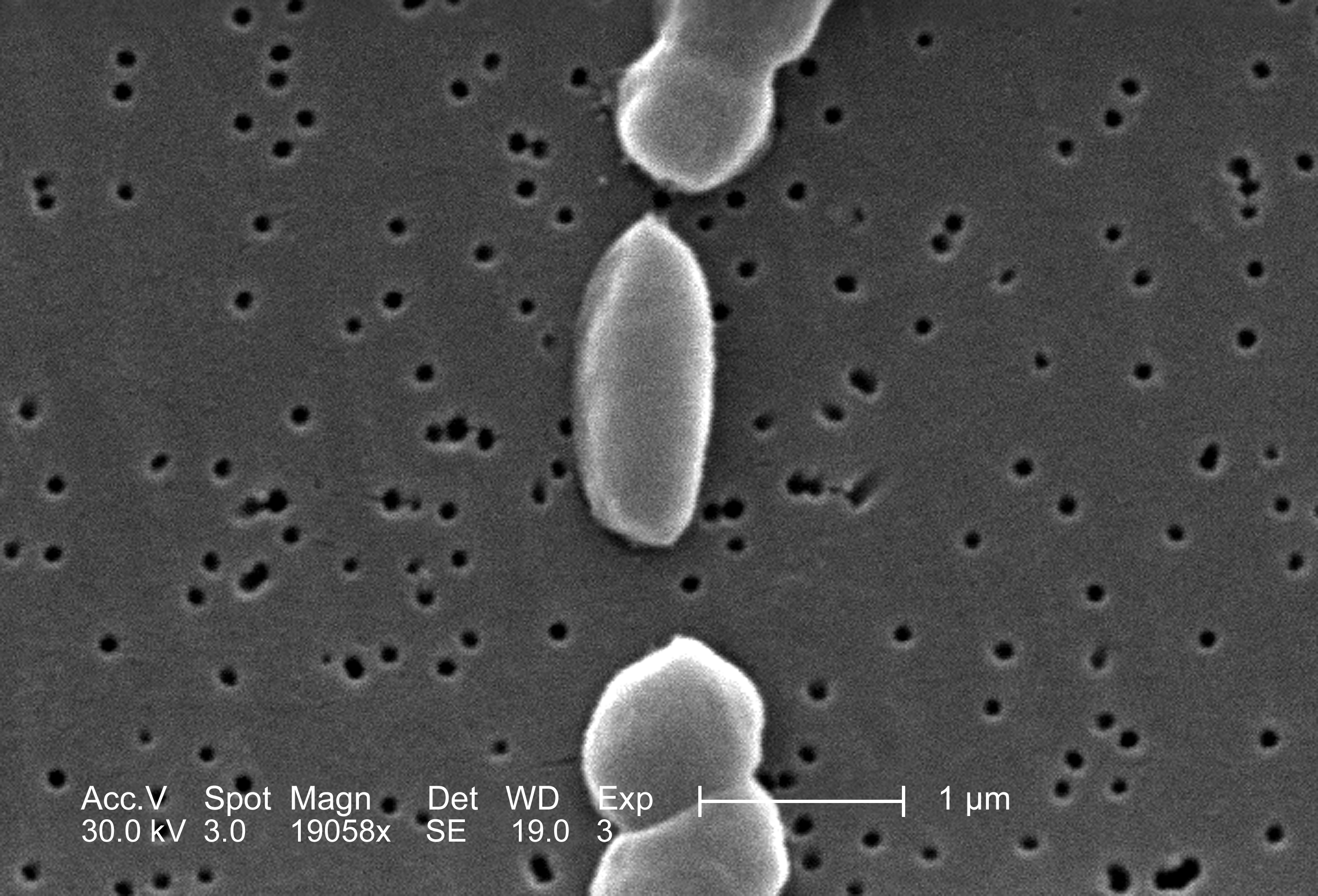
Image source: Wikipedia/Wikimedia
| Ecology, Host, and Life Cycle | |
|---|---|
| Oxygen requirements | Facultative anaerobe |
| Optimal temperature | 20 |
| Temperature range | Mesophilic |
| Habitat | Aquatic |
| Biotic relationship | Free living |
| Host(s) | Homo sapiens, Danio rerio, Pancrustacea |
| Cell arrangement | Singles |
| Sporulation | Nonsporulating |
| Energy source | Heterotroph |
| Pathogenicity | Human |
Gene Summary
Adenine Count
1322847 bp
Thymine Count
1331750 bp
Guanine Count
1051784 bp
Cytosine Count
1037083 bp
Genome Length
4743464 bp
Protein-coding Genes
4491 genes
Non-Coding Genes
64 genes
# of Chromosomes/Plasmids
1
Genes
| Name | Locus Tag | UniProt ID | Strand Orientation | Gene Start/End | Protein Molecular Weight |
|---|---|---|---|---|---|
| ribonuclease p protein component | BS585_02675 | Not Available | Positive | 598231 - 598587 | 13837.7 |
| membrane protein insertion efficiency factor yidd | BS585_02680 | Not Available | Positive | 598554 - 598811 | 9623.76 |
| membrane protein insertase yidc | BS585_02685 | Not Available | Positive | 598814 - 600436 | 60406.1 |
| trna uridine-5-carboxymethylaminomethyl(34) synthesis gtpase mnme | BS585_02690 | Not Available | Positive | 600553 - 601914 | 49168.6 |
| fmn-binding protein mioc | BS585_02695 | Not Available | Positive | 602019 - 602453 | 15580.2 |
| trna uridine-5-carboxymethylaminomethyl(34) synthesis enzyme mnmg | BS585_02700 | Not Available | Positive | 602928 - 604823 | 70019.6 |
| ribosomal rna small subunit methyltransferase g | BS585_02705 | Not Available | Positive | 604823 - 605458 | 23932.1 |
| para family protein | BS585_02710 | Not Available | Positive | 605469 - 606242 | 28140.2 |
| chromosome partitioning protein parb | BS585_02715 | Not Available | Positive | 606266 - 607147 | 32307.1 |
| atp f0f1 synthase subunit i | BS585_02720 | Not Available | Positive | 607338 - 607727 | 13801.6 |
Pathways
21 pathways
No pathways found
No metabolic pathways have been associated with this bacterium yet.
Health Effects
| Health Condition | Relation | Reference |
|---|---|---|
| Vibriosis | Causes | PMC10472736 |
| Acute gastroenteritis | Causes | PMC11171697 |
| Wound infections | Causes | PMC11171697 |
| Septicemia | Causes | PMC11171697 |
| Food poisoning | Causes | PMC12108532 |
| Vibrio infections | Causes | PMC12108532 |
| Acute gastroenteritis | Causes | PMC12849298 |
| Wound infections | Causes | PMC12849298 |
| Ear infections | Causes | PMC12849298 |
| Septicemia | Causes | PMC12849298 |